Case Study 4: Clinical Documentation Assistant
Design assistive clinical documentation around source traceability, omission tests, clinician verification, privacy, and safe operational fallback.
The Negative That Survived a Signature
This modeled case begins during a bounded outpatient pilot. A documentation assistant converts an encounter transcript into a polished note. It captures the complaint and follow-up plan correctly, then inserts “no known drug allergies.” Allergies were never discussed. The phrase resembles the surrounding chart, appears in the expected section, and survives a hurried clinician review.
The error is found at the patient’s next visit, when medication reconciliation disagrees with the signed note. No patient is harmed in this scenario, but the correction team cannot dismiss the event as a stray hallucination. A clinician signed the draft. The interface displayed the source transcript. The pilot’s aggregate factuality score was above its release threshold. Every named control was present, yet missing evidence became a clinical fact.
The pilot pauses. Its use case is restated narrowly: prepare a traceable draft from the authorized encounter record for a qualified clinician to verify, edit, and sign; never convert absent or ambiguous evidence into a clinical assertion. The system cannot recommend diagnoses, medications, orders, or patient messages. This chapter describes system design, not medical or legal advice.
Start With the Work the Assistant Must Beat
Without the assistant, clinicians document during or after the encounter using templates, dictation, typed notes, and structured fields. The baseline is burdensome and variable. Notes may be late, copied material may be stale, and time spent documenting competes with other work. It also has a known authority path: the clinician decides what belongs in the record and can continue documenting when an ancillary system fails.
The candidate must improve that complete workflow, not merely produce more polished text. The comparison includes time to a signed note, after-hours work, corrections, delayed documentation, missing material, privacy exposure, and the effect of review on the encounter itself. A faster first draft that takes longer to verify, or one that makes unsupported text harder to notice, has not beaten the baseline.
The first scope is deliberately small: one note type, one clinical setting, one recording method, supported languages, a defined group of clinicians, and sections whose source can be represented reliably. Medication decisions, diagnoses, orders, and patient communication stay outside the assistant’s authority. Allergy status remains clinician-entered unless the authorized encounter evidence explicitly supports it. A new specialty, language, template, or capture device is a new evidence problem, not routine configuration.
Patients, clinicians, nurses, records staff, quality and safety teams, privacy and security staff, and downstream care teams experience different consequences from the same note. The product may save a clinician several minutes while giving a later clinician a false premise, placing sensitive speech in an unexpected system, or moving correction work to records staff. The risk assessment follows those consequences across the full documentation path.
Preserve the Difference Between Missing and Negative
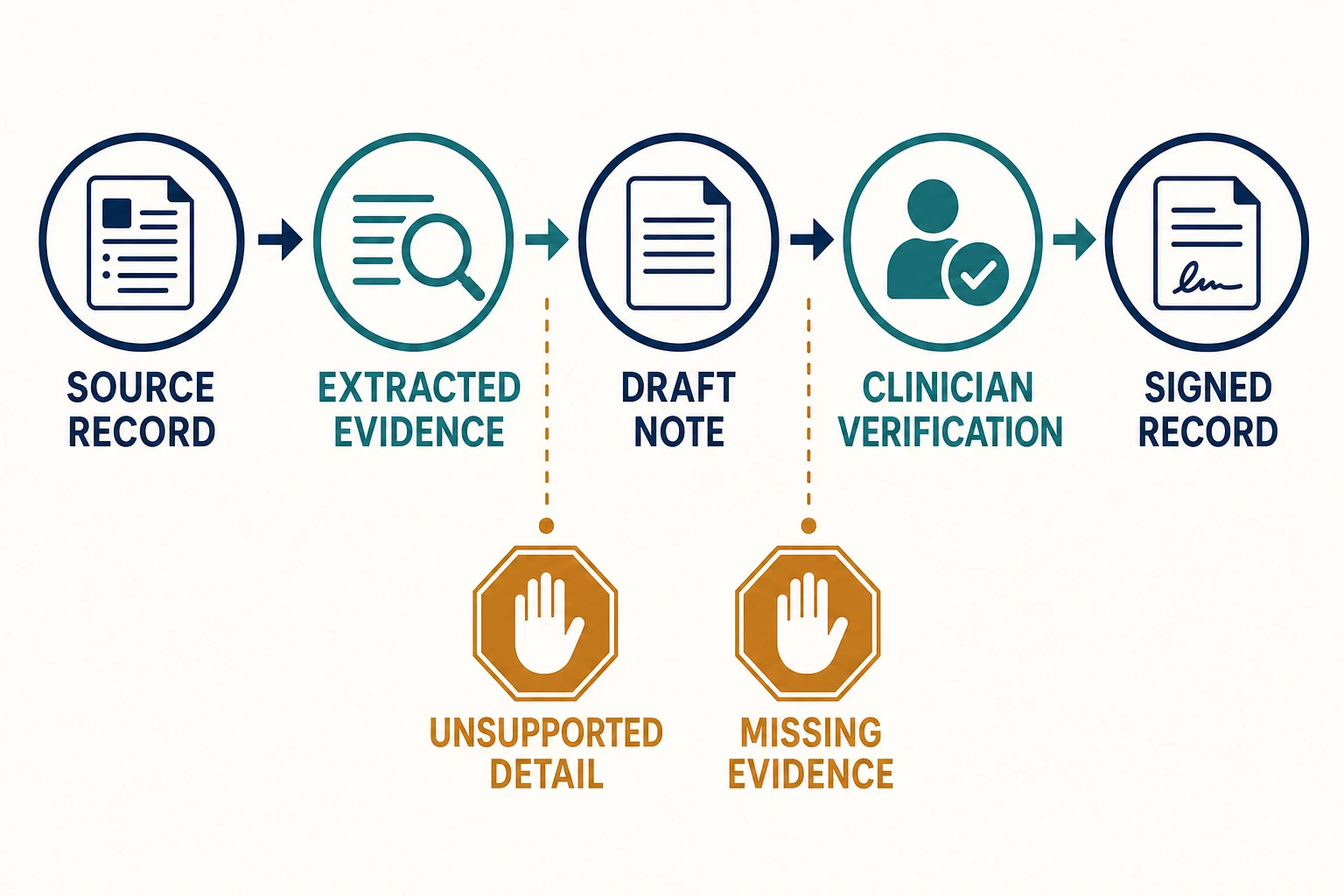
The failed pilot treated note generation as one transformation from transcript to prose. The repaired design makes the intermediate evidence state visible. Authorized audio and structured encounter data enter a patient-bound capture service. Transcription preserves speaker and time boundaries. An evidence service identifies candidate facts, their source spans, and whether the source is explicit, contradictory, ambiguous, or silent. Only then may the drafting service organize supported material into an allowed note section.
That state model preserves a clinically important distinction:
- “the patient denied a penicillin allergy” is an evidenced negative statement;
- “allergies were not discussed” is missing evidence;
- conflicting statements are unresolved evidence;
- poor audio is unusable evidence.
The template cannot turn the last three states into “no known drug allergies.” It either leaves the field for clinician entry or displays the unresolved state outside the draft prose. The same rule applies to medications, diagnoses, dates, negation, laterality, quantities, and follow-up commitments. Common phrasing is not evidence.
Every material draft statement carries a link to the smallest useful source span while the complete encounter context remains available. The system blocks a draft if patient identity, encounter identity, or required source lineage is uncertain. It does not quietly continue from partial transcription, a stale chart, or a source associated with another record. When source mapping or drafting is unavailable, the established documentation workflow remains usable.
This architecture also narrows the information boundary. The data-flow record covers the authority for capture and processing; transcription and model suppliers; temporary storage; access; signed-record transfer; evaluation sampling; logging; retention; deletion; and any secondary use. The team minimizes capture and log content rather than treating encryption as permission to retain everything. Patient content does not enter general-purpose product analytics or model training without a separately approved basis. Applicable privacy, records, device, professional, and institutional obligations require current specialist review for the actual jurisdiction and intended use.
A Signature Is an Outcome, Not Evidence of Review
In the first pilot, source links existed behind an icon. Clinicians rarely opened them because the draft looked complete and the interface offered one dominant action: sign. The allergy sentence also appeared in a familiar location, where routine text attracted less attention. Under a full clinic schedule, the nominal human control became a confirmation step.
The revised interface asks the clinician to resolve evidence states, not proofread an essay. High-consequence statements receive focused verification with their source in view. Unsupported additions and unresolved conflicts prevent signing. Missing evidence is not presented as an error the clinician should clear; it remains an invitation to enter knowledge the clinician actually has. The reviewer can edit, delete, add, reject the draft, or return to ordinary documentation. The signed record distinguishes source-supported draft text, clinician-added material, and later corrections in an access-controlled audit trail.
This still does not prove that oversight works. The team observes review under representative workload, including interruptions, long encounters, poor audio, late-day documentation, and alert clusters. It measures whether clinicians inspect the source, which classes of error they catch, how often they override the assistant, how long resolution takes, and whether warnings become habitual noise. If verification requires more attention than the workflow can reliably provide, the remedy is to reduce the assistant’s scope or redesign the interaction—not to declare clinicians accountable for compensating.
Evaluation Follows the Record From Source to Signature
The evaluation set includes governed cases with accents and supported languages, varied audio quality, interruptions, multiple speakers, complex histories, contradictions, sensitive discussions, and deliberately incomplete source material. Qualified reviewers apply a documented rubric, record severity, and adjudicate disagreements. Patient and clinician groups affected by the workflow help identify burdens and failure modes that a text-quality review can miss.
Testing begins before generation. Patient-to-encounter binding, speaker attribution, source completeness, transcription, and access controls must work. A wrong-patient source or unauthorized disclosure ends the evaluation; an excellent summary cannot repair it.
The next layer tests evidence extraction and drafting. Results keep unlike failures separate: unsupported additions, material omissions, incorrect attribution, negation errors, medication or allergy errors, temporal mistakes, source-link defects, privacy exposure, and formatting problems. Each result includes counts, severity, and relevant context rather than disappearing into one factuality average. A fluent note with one severe unsupported statement is not balanced by many correct sentences. Similarity to a reference note is useful only for the narrow behavior it measures; it does not establish completeness, safety, or effective review.
Then the interface and human-system pair are tested. In a prospective silent phase, drafts do not enter care. Reviewers compare them with authorized source evidence and completed records, while recognizing that a signed note is not perfect ground truth. The bounded live pilot introduces drafts gradually and measures correction type, source inspection, missed errors, edit burden, time to signature, after-hours work, delayed notes, bypass, complaints, privacy events, and safety signals. Results are stratified where setting, language, audio, clinician experience, or patient population could conceal a consequential difference.
Release gates follow failure severity. A critical identity, disclosure, unsupported-statement, or material-omission failure blocks release regardless of average performance or time saved. Lesser errors have explicit limits, sample requirements, and uncertainty. The pilot must also show that clinicians can reject a draft, document without the assistant, and complete a correction. Expansion waits until the new context has passed the same ordered argument.
The Near Miss Becomes an Incident Test
When the unsupported allergy statement is discovered, the team disables the affected drafting path but does not interrupt care. It preserves the source, transcript, evidence mapping, model, prompt, template, interface version, reviewer actions, and signed outcome under appropriate access and retention controls. Clinical safety staff determine the possible consequence; the responsible records process corrects the note and identifies downstream uses; privacy staff assess whether information crossed an unauthorized boundary; and the organization follows its established communication and reporting duties.
The investigation asks two different questions. How did the drafting system create the sentence? And why did the operating system allow it to become a signed record? In this case, a template completion behavior supplied the unsupported negative, the evidence service did not represent silence as a distinct state, and the review interface hid provenance behind an optional action. Training the model against more allergy examples might reduce recurrence, but it would not repair the two system failures.
The playbook therefore rehearses patient mismatch, cross-record disclosure, unsupported clinical statements, material omissions, source-link defects, transcription failure, performance disparity, and widespread reviewer overreliance. For each event it names containment, affected-record search, clinical and privacy escalation, correction, communication, evidence preservation, restoration criteria, and the tested fallback. Restoration requires evidence that the failure mechanism is controlled, not merely that a newer model scores better.
Ownership follows the record. Clinical leadership owns patient-safety boundaries and workflow. Qualified clinicians remain responsible for the record they sign, while the organization remains responsible for making review meaningful. Privacy and security own information controls; engineering owns identity binding, lineage, reliability, and rollback; quality owns independent evaluation and surveillance; records staff own governed correction; and the product owner owns benefit as well as transferred burden. No vendor assurance or clinician signature substitutes for those duties.
The Release Record
Before the pilot resumes, its decision record must make the whole argument inspectable:
- the note types, settings, languages, users, and sections inside the boundary;
- the clinical functions and unsupported field completion outside authority;
- the baseline and the benefit the candidate must demonstrate;
- the path from patient-bound source to evidence state, draft, review, and signed record;
- severity-specific results for additions, omissions, negation, attribution, medications, allergies, dates, identity, privacy, and source links;
- evidence that review works under representative load and that ordinary documentation remains available;
- named stop conditions, affected-record search, correction route, fallback, restoration criteria, and owners;
- the specialist decisions that must be revisited when jurisdiction, institution, intended use, supplier, or scope changes.
The strong system treats the draft as a provisional map from evidence to record. The weak one produces fluent prose, collects a signature, and calls the distance between them human oversight.
The fraud case before this one showed that human review can become unsafe when queue capacity is treated as an external assumption. Here, review fails for a different reason: the interface and workflow do not preserve the evidence distinctions a clinician must judge. The hiring case that follows will ask how a tool labeled “support” can quietly acquire decision power by controlling attention.
See Privacy by Design, Human Oversight, and AI Incident Response.