AI Systems Handbook / Chapter 11
Data Readiness and Rights Readiness
Decide whether an AI use case has usable evidence, lawful and contractual authority, representative coverage, reliable labels, and an operable data lifecycle.
Preparing audio…
Audio edition
Data Readiness and Rights Readiness
The Dataset Everyone Assumed They Could Use
A talent team proposes a model that ranks applicants for recruiter review. The company has years of résumés, interview notes, hiring decisions, and later performance ratings. A prototype trained on the archive separates past hires from non-hires with impressive accuracy.
The result seems to settle the feasibility question. Instead, it reveals that the team has asked the easiest question: can a model reproduce a pattern in the archive?
Applicant notices covered recruitment administration, not model development. Interview notes contain health and family details that should never have entered the record. Older roles were filled through a narrow referral network. “Successful hire” means accepted offer in one table, passed probation in another, and a high manager rating in a third. Outcomes exist for hired applicants but scarcely at all for rejected ones.
The rows are plentiful. The evidence is not yet defensible. Data readiness is the ability to use evidence for a specific system purpose with known authority, lineage, fitness, coverage, and lifecycle controls. Until those conditions hold together, model performance is beside the point.
Begin with the Claim and the Action
Before inventorying fields, write down what the system would claim and what would happen because of it. “Rank applicants” is too vague. Is the model estimating who meets published role requirements, predicting who recruiters historically advanced, or predicting later job performance? Will a low score reorder a queue, prompt a second review, or prevent an application from being seen?
Each answer requires different evidence and exposes people to different errors. Predicting historical recruiter choices needs the old decisions as labels, but it also reproduces the old process. Predicting later performance requires a defensible definition of performance and confronts a deeper gap: the company never observed how rejected applicants would have performed. No amount of cleaning creates those missing outcomes.
This claim-and-action statement becomes the boundary for the audit. It names the affected people, intended population, output, downstream decision, processing purpose, and unacceptable error paths. It also prevents a common escape: declaring a dataset “high quality” without saying what the quality is for.
Five Gates, One Bounded Use
The proposed use advances only when it can pass five independent gates:
- Authority: law, contract, license, consent, notice, and policy permit the exact processing path.
- Lineage: sources, transformations, labels, joins, exclusions, and versions lead back to accountable owners.
- Fitness: the records and labels support the intended claim at the accuracy, completeness, consistency, timeliness, uniqueness, validity, and stability the action requires.
- Coverage: the evidence covers the people, contexts, conditions, and severe edge cases inside the deployment boundary.
- Lifecycle: access, minimization, security, retention, correction, deletion, downstream propagation, and retirement can actually be operated.
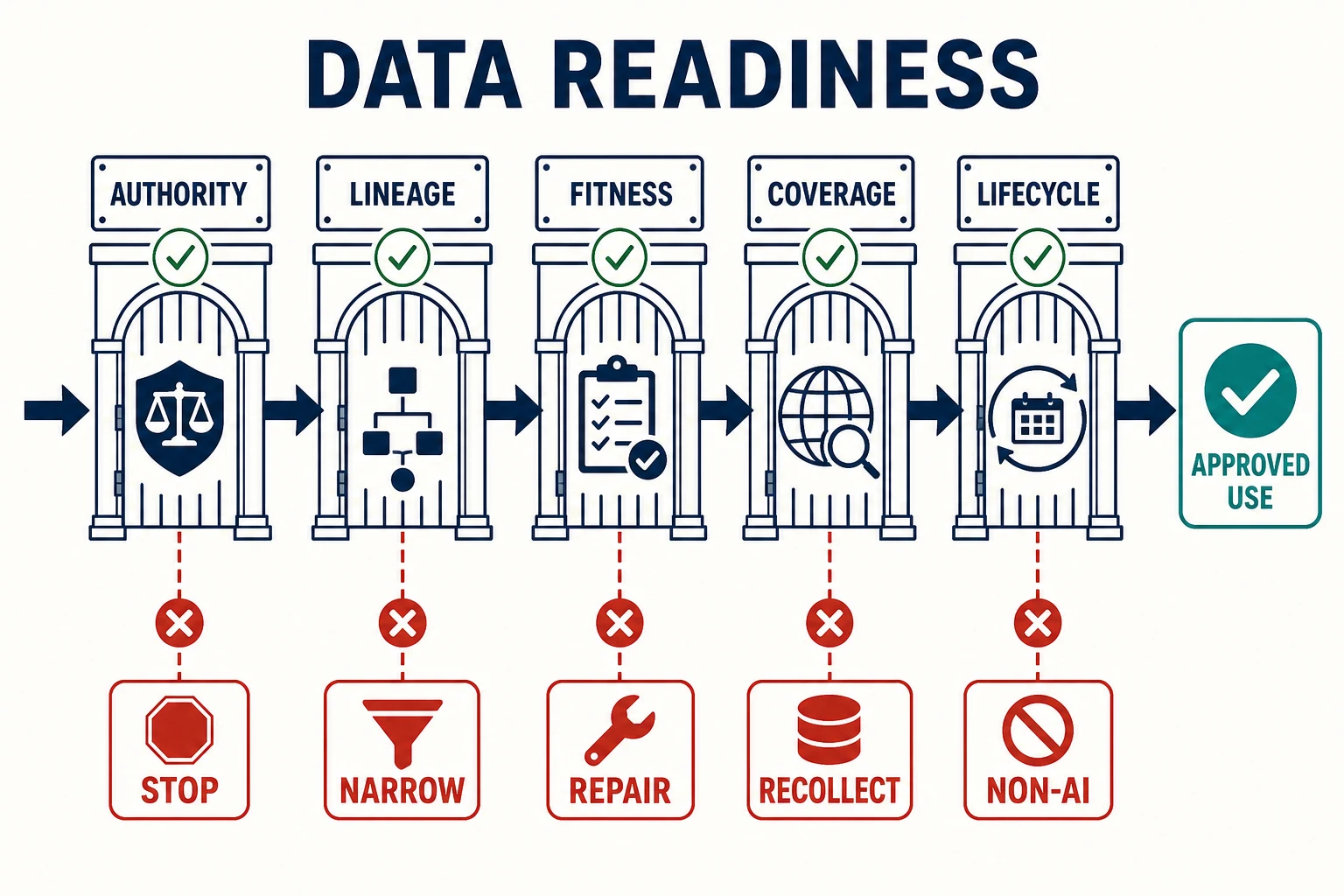
These are gates, not ingredients in a composite score. Excellent lineage cannot compensate for absent authority. Broad coverage cannot rescue an indefensible target. A pass also expires: rights, schemas, collection practices, suppliers, and populations change. Every approval therefore belongs to a named use and a review date.
Follow One Record Through the System
“Recruiting data” is too broad to audit. Separate the résumé, application fields, recruiter actions, interview notes, assessment results, offer events, employment records, manager ratings, and vendor-enriched attributes. Rights and quality differ across them.
Choose one applicant record and trace it from collection to proposed action. Record where each element came from, why it was collected, who controls it, which notice or agreement governed it, and which period and population it represents. Then follow every filter, join, normalization, redaction, label, feature, and exclusion. Continue into training, evaluation, vendor transfer, production inference, logs, human review, and future improvement. End with retention, correction, deletion, archival, and legal-hold behavior.
The exercise exposes gaps that a catalog alone can hide. A performance rating may have a named source but no stable meaning across departments. A résumé may have a deletion schedule while its extracted features and evaluation copies do not. An embedding, aggregate, or synthetic derivative does not shed restrictions merely because it no longer resembles the source.
The inventory should answer three practical questions for every source: may we use it this way, can we explain what it measures, and can we control where it goes?
Establish Authority for the Whole Path
Possession is not permission. Rights readiness is specific to jurisdiction, organizational role, data category, affected population, purpose, and processing path. The responsible legal or privacy function decides binding obligations; engineers give that reviewer an accurate system map rather than the phrase “internal data.”
Collection, annotation, model training, offline evaluation, retrieval into a prompt, transfer to a vendor, production logging, reuse for improvement, publication, and retention can each rest on different authority. A license that permits reading documents may not permit model training. A provider may permit temporary inference while prohibiting use of submitted data to improve a shared model. Access granted to recruiters does not automatically extend to annotators or an external API.
In the recruiting case, the questionable notice and sensitive free text are not paperwork to resolve after a successful prototype. They determine whether particular records may enter development at all. The team may need to remove whole sources, narrow the purpose, change processors, recollect under an appropriate process, or stop.
Minimization is part of that design. Remove fields that do not improve the documented decision, shorten time windows, restrict the eligible population, aggregate when detail is unnecessary, and log structured events instead of raw content when possible. “It might help later” is not an evidence requirement.
Test Fitness Where an Error Hurts
Generic quality scores conceal the consequence of a defect. For each important error path, state the property the data must have and the evidence that will demonstrate it before looking at model results.
If a decision-critical field is often absent, measure missingness by source, time, and relevant segment. If a record must match an underlying event, reconcile a sample against an authoritative source. If definitions collide across systems, enumerate and resolve the conflicts. Measure age when freshness affects the action, duplicate entities when they distort prevalence, and invalid values when domain or referential rules matter. Ask the source owner whether the collection process will remain stable; a schema can retain its shape while its meaning changes.
Thresholds come from error costs, not convenience. A missing postal code may be harmless for document summarization and decisive for a regional eligibility service. Imperfect transcription may be tolerable for topic routing and unsafe for extracting medication instructions. Set acceptance thresholds before a promising model score gives everyone a reason to excuse weak evidence.
The Archive Contains the Old Decision Process
Now examine how each record became observable. Who had an opportunity to appear? Who was filtered out before collection? What did the interface encourage people to enter? Which incentives shaped reviewers’ notes? Which outcomes are known only because an earlier decision selected the person for follow-up?
The recruiting archive includes later performance only for people the company hired. It therefore contains the company’s past selection process as well as information about applicants. Training on those outcomes can make historical judgment look like ground truth. Adding older rows strengthens the imprint of the old process; it does not reveal the missing counterfactual for rejected applicants.
Labels deserve the same scrutiny. A label definition needs an event, an observation window, exclusions, an uncertainty state, and an adjudication rule. When people label examples, preserve their instructions, qualifications, source context, independent overlap, disagreements, adjudication reasons, quality samples, and taxonomy version. Disagreement may expose vague policy or insufficient evidence. Majority vote can hide the uncertainty the deployed workflow must confront.
For this proposal, “successful hire” cannot survive as a convenient union of offer acceptance, probation, and manager rating. Those events answer different questions. The team must choose and defend a construct, or admit that the proposed ranking claim has no adequate label.
Coverage Limits the Promise
Representativeness is relative to a deployment claim. Compare expected production exposure with the available evidence across role families, geography, language, application channel, time period, case difficulty, relevant affected groups, and rare but severe conditions. Look separately at who appears in the inputs, whose outcomes are observed, and where an error causes a different kind or degree of harm.
The referral-heavy archive fails before the team computes a single overall coverage percentage. It underrepresents applicants reached through other channels, and the missing outcomes for rejected applicants are produced by the very selection being learned. The honest options are to narrow the claim, collect evidence through a better process, redesign the action so uncertainty reaches a human, or abandon the ranking use case.
Synthetic data cannot repair that history by declaration. It can exercise formats, rare scenarios, or privacy-preserving development workflows, but it inherits the generator’s assumptions and must be checked against real conditions. Treat it as another versioned source with a generation method, filters, provenance, and allowed uses.
A Dataset Must Be Retirable
The final gate asks whether the organization can govern the data after approval. Name owners for access, security, source changes, retention, correction, deletion, incident evidence, and retirement. Test whether a change to one applicant record can propagate to extracts, features, indexes, evaluation sets, logs, vendors, and other derived artifacts where required.
Indefinite retention is not a neutral default. Raw applications, interview notes, labels, model inputs, and audit evidence may need different schedules. A team that cannot locate downstream copies cannot confidently honor a correction, investigate an incident, or retire the use. Lifecycle controls belong in the feasibility decision because every successful prototype creates more copies.
Make the Decision While It Can Still Change the Design
The recruiting proposal does not advance as an applicant-ranking system. Authority for development is unresolved, the label conflates incompatible outcomes, selection makes performance unobservable for rejected applicants, historical sourcing narrows coverage, and the lifecycle of derived records is unknown. The prototype score answers none of those objections.
That conclusion need not end all useful work. The team could investigate a narrower, non-ranking tool—for example, checking applications for missing job-related information—provided it defines the action, establishes authority, evaluates segment-specific error, and keeps a human in control. Or it could repair collection and governance before revisiting a more ambitious claim. The audit changes the system boundary rather than decorating the original proposal with controls.
For any use case, record one of four decisions:
- Advance when all five gates pass for a bounded use and an evidence plan can test the remaining uncertainty.
- Narrow when authority, fitness, or coverage supports a smaller population, claim, action, or environment.
- Repair or recollect when owned work can correct lineage, labels, quality, coverage, or lifecycle controls.
- Stop when authority is absent, the target is indefensible, required evidence cannot be observed, or the error exposure is unacceptable.
The record names the supporting evidence, accountable owner, expiry date, and re-review triggers. It also becomes the handoff to the next part of this book, where an approved dataset must be maintained as a product, defended as evidence, and controlled as a liability.
Try the Audit on Call-Center Transcripts
A service organization wants to classify calls for escalation and generate summaries. Before reading further, write the claim and action, then identify the first gate likely to change the design.
The service-quality notice may permit internal review while the transcription-vendor contract does not permit transfer to a second model provider. Audio, transcripts, call metadata, agent corrections, and complaint outcomes have different owners and retention periods. Transcription error rises for noisy mobile calls, names, account numbers, and code-switching. Overnight, multilingual, and accessibility-assisted calls are underrepresented. Raw audio and generated summaries cannot safely inherit one indefinite retention rule.
A defensible first release might remain inside the approved processing boundary, compare a stratified sample with source audio, exclude automatic action, route low-evidence cases to people, set collection targets for missing segments, and define deletion propagation before launch. If those conditions cannot be met, the correct decision is repair or stop—not a more elaborate model.
Source Notes
- NIST AI RMF Core, mapping guidance for data availability, representativeness, suitability, collection, selection, construct validation, and privacy-risk documentation; verified 2026-07-10.
- UK Information Commissioner’s Office: data minimisation in AI, jurisdiction-specific guidance on adequate, relevant, and limited personal data; verified 2026-07-10. This source informs operational questions, not legal advice outside its jurisdiction.
- Datasheets for Datasets, the documentation proposal for dataset motivation, composition, collection, preprocessing, uses, distribution, and maintenance; verified 2026-07-10.