AI Systems Handbook / Chapter 50
Culture: Skepticism, Evidence, and Responsible Velocity
Create team norms that turn uncertainty into tests, decisions into accountable records, and production experience into safer learning.
Preparing audio…
Audio edition
Culture: Skepticism, Evidence, and Responsible Velocity
The Question After the Applause
An executive watches an assistant produce an excellent market brief in seconds and asks how soon everyone can have it. An analyst asks which sources support the claims, what the assistant does when sources disagree, and whether confidential material can enter the prompt. The room goes quiet. Afterward, the analyst is advised to be more solution-oriented.
The silence is more consequential than the demo. It teaches everyone which evidence is welcome. The next analyst will either keep the question private or spend personal standing to ask it.
The team may have evaluation tools, risk policy, and an incident process. None of them can work if doubt cannot travel from the person who notices it to someone with the authority and resources to respond. Culture is the path that doubt takes through the organization.
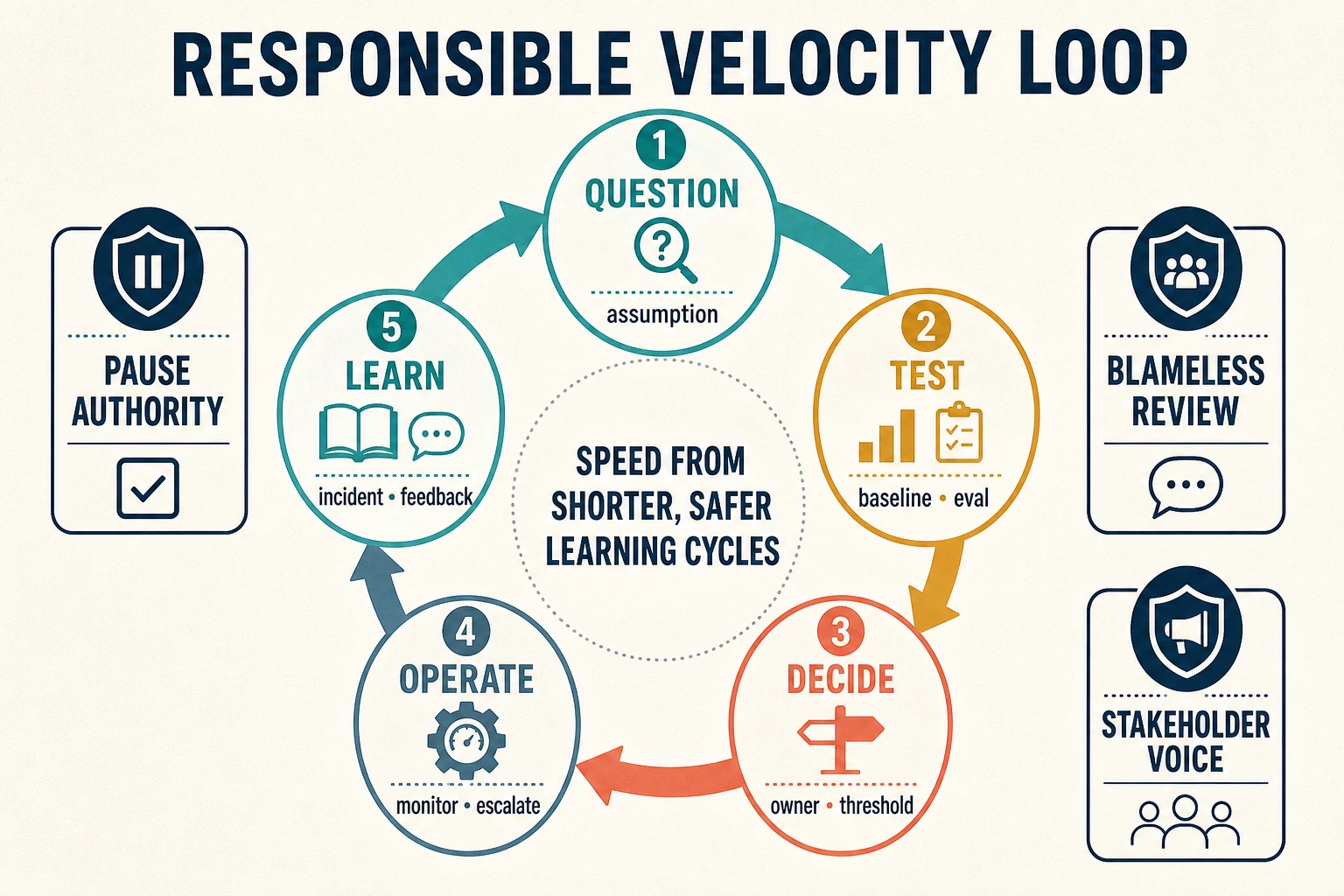
Responsible velocity is the ability to shorten the path from uncertainty to credible evidence, bounded action, and operational learning while preserving the authority to challenge, correct, pause, and stop.
Give Skepticism Somewhere to Go
The analyst’s questions could become a veto, a ritual debate, or a test plan. Only the third outcome helps the team move.
The product owner asks the analyst to state the decision at stake. A company-wide launch is on the table. The claims supporting it are that the assistant saves research time, produces supportable briefs, and can be used without exposing restricted material. Each claim can fail independently. The team does not need certainty about all future use; it needs evidence strong enough for the next bounded commitment.
That is calibrated skepticism. It neither assumes failure nor treats enthusiasm as proof. It asks what observation would change a decision and seeks the cheapest credible way to obtain it. “The demo is impressive” becomes “Which representative tasks and failure conditions were absent?” “A human will review it” becomes “What can the reviewer see, override, and manage under actual load?” “We will monitor it” becomes a demand for a signal, threshold, owner, response, and tested fallback.
Questions this specific are generous to delivery. They expose assumptions while redesign is still cheap. A vague objection can stall indefinitely; a falsifiable concern creates work that can finish.
Make Commitment Follow Evidence
The team separates the original request into three uses: internal research synthesis, customer-facing market commentary, and confidential deal analysis. It begins with internal research because the consequences are lower, source rights are clearer, and analysts can inspect the result before it travels.
The existing analyst workflow becomes the baseline. A versioned task set includes routine briefs, sparse-source topics, conflicting reports, stale material, and prompts containing restricted information. The team measures supported claims, missing-source behavior, confidentiality failures, analyst time, correction load, and the quality of the final brief. A fast draft that requires slow reconstruction has not saved time.
This evidence is less theatrical than the demonstration, but it can bear weight. A product owner approves a small pilot only after recording the scope, thresholds, known gaps, residual risks, stop conditions, and next review. Customer-facing and deal-analysis uses remain separate decisions. Commitment grows with evidence instead of with excitement.
Organizations receive the evidence their incentives reward. When leaders count demos, pilots, launches, or generated words, teams learn to produce visible motion. When leaders ask what changed against a baseline, where results failed by segment, how much hidden review work appeared, and which findings stopped or narrowed a release, negative results become usable progress.
“We do not know yet” is useful only when it has a bounded test, owner, date, and decision rule. Without those, uncertainty becomes either cover for delay or permission to proceed by instinct.
Shorten the Whole Learning Loop
The market-brief pilot moves through five linked acts:
- Question. Name the outcome, baseline, affected people, important assumption, and credible failure.
- Test. Gather enough representative evidence to answer the question without creating unmanaged exposure.
- Decide. Compare the evidence with thresholds and record the owner, scope, conditions, residual risk, and expiry.
- Operate. Observe the complete workflow, enforce limits, preserve fallback, and route material signals.
- Learn. Turn outcomes, complaints, incidents, and surprises into changed tests, controls, training, funding, or scope.
Speed belongs to the whole loop. Shipping quickly and then waiting weeks for a complaint to find an owner is slow learning. So is a review process that must renegotiate evidence formats and decision rights for every pilot. Shared evaluation harnesses, versioned evidence, staged exposure, standard control components, and known escalation routes remove repeated coordination without weakening the decision.
The team discovers this after launch. Analysts open citations less often when deadlines tighten, and correction load rises. The signal is useful because the pilot preserved source-opening telemetry, reviewer feedback, and a non-AI fallback. The response is also bounded: narrow the pilot, make sources visible beside the draft, adjust workload, rerun retained tests, and require fresh approval before expansion.
Skipping from question to operation would have hidden the premise. Stopping the loop at launch would have hidden the failure.
Bad News Needs Authority and a Destination
An analyst can now reject an unsupported brief, but the team has not yet decided who can suspend access for everyone. During a Friday release, several briefs cite the right reports while misreading their dates. The reviewer flags the pattern. The product owner is offline, engineering sees no outage, and nobody knows whether repeated factual error crosses the pause threshold.
A culture that says “speak up” has not solved this problem. The organization must name who can restrict the system, which signals justify action, how affected users are told, who investigates, and what evidence permits restoration. Good-faith use of that authority must not become a career debt. A switch controlled by an unavailable or punishable person is decoration.
The incident review then has two obligations. It reconstructs how versions, interfaces, workload, incentives, assumptions, controls, and decisions produced the error. It also assigns owners and deadlines for correction. Blamelessness protects inquiry from scapegoating; it does not erase responsibility for decisions, negligence, or misconduct.
Material disagreement needs the same route. Record the contested claim and its evidence, allow escalation outside the delivery chain, and return a reasoned decision. Users, frontline workers, domain experts, affected communities, accessibility specialists, and independent reviewers often see constraints that a laboratory evaluation cannot. Asking for their views without showing what changed merely trains them that listening is ceremonial.
Incentives Determine What the System Can See
The market-brief team initially celebrates time saved before counting correction. It rewards launch while treating source inspection as overhead. Under those conditions, people do not have to conspire to hide trouble. Each local decision simply makes trouble less visible.
Leadership changes the review. The same forum that celebrates a useful release examines severe errors, near misses, unresolved dissent, recovery time, review burden, and systems retired for weak value. Funding covers monitoring, human review, support, remediation, and exit. Teams receive credit for a well-supported rejection, a narrower use case, and reusable evaluation or control work—not only for a new launch.
The details matter. Punishing incident counts suppresses incident records. Setting a handling-time target without review capacity makes oversight ceremonial. Rewarding output volume encourages work whether or not anyone needs it. Treating retirement as failure keeps systems alive after their evidence has expired.
Technical humility becomes operational under these conditions. The team versions the model, prompt, data, evaluation, and policy tied to each claim. It states what the evaluation does not cover, uses abstention and fallback where evidence is weak, retests supplier changes, and time-bounds approval. Humility does not prevent commitment. It states the conditions under which commitment remains warranted.
Responsible AI Team Norms
Write norms as promises the organization can observe and resource:
- State the claim. Name the intended outcome, baseline, affected people, uncertainty, and evidence needed for the next decision.
- Show the work. Preserve versions, tests, limitations, decisions, dissent, and material changes.
- Scale commitment with evidence. Explore cheaply, prove credibly, expose progressively, and fund the operating burden.
- Make challenge ordinary. Give domain, worker, user, risk, and independent views a route into decisions before they harden.
- Keep authority explicit. Name who approves, accepts residual risk, overrides, pauses, restores, corrects, and retires.
- Learn without concealment. Protect reporting, investigate systems and incentives, and make corrective actions accountable.
- Prefer durable capability to novelty. Reuse evidence, controls, platforms, and lessons where their assumptions still hold.
- End what no longer earns its place. Stop when value, feasibility, risk, evidence, or ownership no longer supports operation.
Test the norms against a fictional program that has twelve pilots, three launches, no retired systems, falling incident counts, rising review time, and a dashboard of generated-output volume. Leaders call the program fast; frontline reviewers call it exhausting. Diagnose what the published numbers cannot distinguish. Then specify one changed incentive, one protected escalation route, one decision record, and one pause exercise that would make the next quarter’s evidence harder to hide.
Back in the demonstration room, the analyst’s question now has somewhere to go. It divides an attractive idea into testable claims, limits the first commitment, shapes the pilot, catches a failure, and changes the system. That is not friction applied to delivery. It is how an organization learns at the speed its consequences require.
Source Notes
- NIST AI RMF is a voluntary framework for incorporating trustworthiness considerations into the design, development, use, and evaluation of AI systems; the NIST page notes that version 1.0 is being revised, verified 2026-07-20.
- NIST AI RMF Playbook offers voluntary suggested actions aligned to Govern, Map, Measure, and Manage rather than a checklist to follow in full; verified 2026-07-20.
- ISO/IEC 42001:2023 uses a management-system approach with organizational responsibility and continual improvement; standard overview verified 2026-07-20.
- See Evaluation Mindset: From Demo to Evidence, AI Incident Response, and AI Portfolio Management.