AI Systems Handbook / Chapter 39
Decommissioning and End-of-Life
Retire AI-enabled systems with explicit stop triggers, dependency discovery, user transition, evidence retention, data disposition, and verified shutdown.
Preparing audio…
Audio edition
Decommissioning and End-of-Life
The System That Stayed Alive After Shutdown
A company announces the retirement of an employee-answer assistant and removes its chat link. Months later, scheduled jobs still refresh its vector index, a browser extension still calls the API, managers still consult exported scores, and a vendor retains prompt logs under an old contract. No team monitors quality or incidents because the product is considered closed.
The interface disappeared; the socio-technical system did not.
Decommissioning is the controlled removal of an AI-enabled system’s capability, influence, data, permissions, dependencies, and obligations. A system is retired only when its residual paths are discovered, treated, and verified.
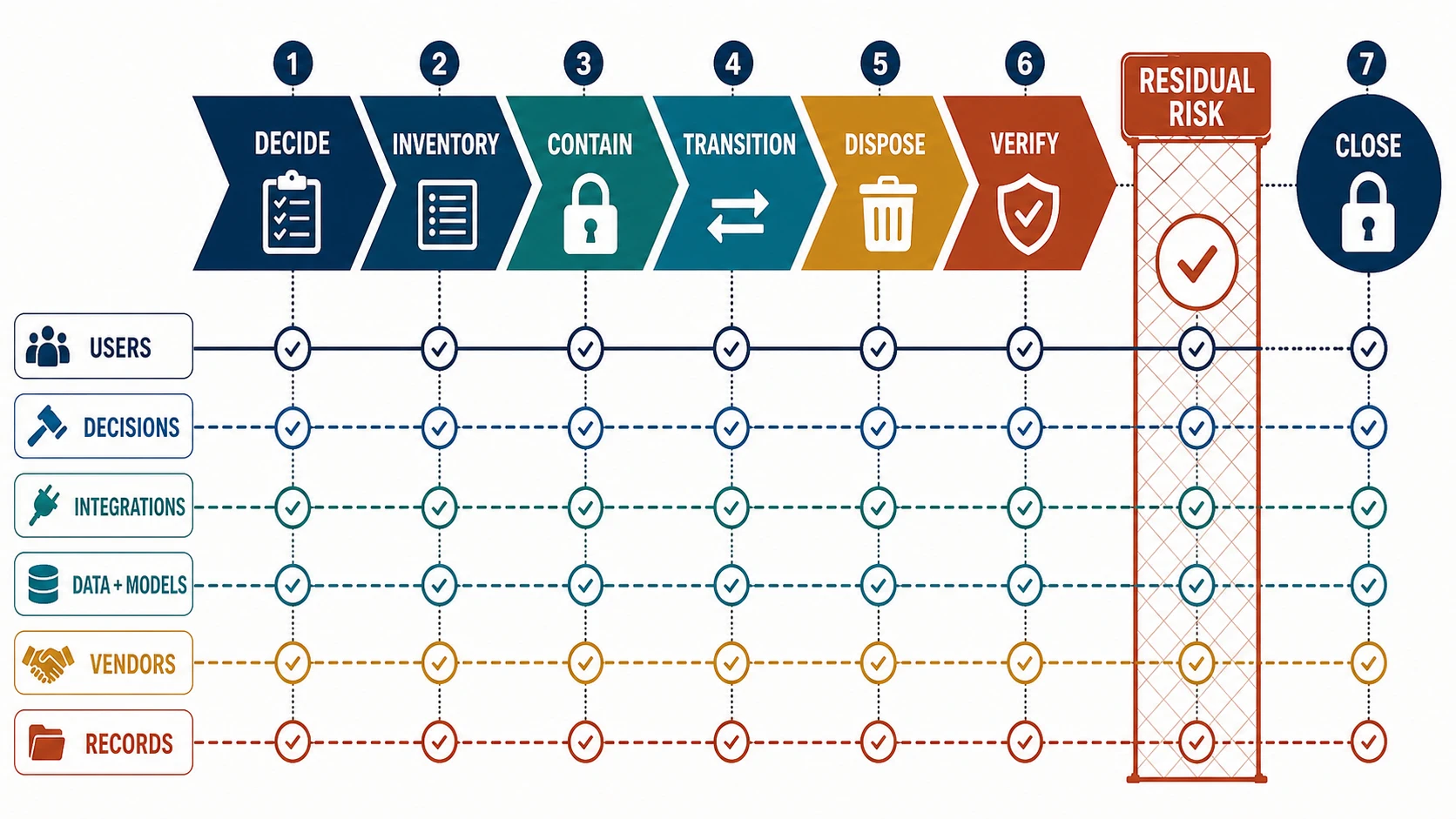
Decide Before the Exit Becomes an Emergency
The employee assistant has missed its answer-quality floor for three review periods. Correction time now costs more than the search-and-support workflow it replaced, and the model provider will withdraw the pinned version in ninety days. None of those facts alone dictates a hard stop. Together they make another indefinite optimization cycle difficult to defend.
A retirement trigger should connect evidence to authority. It might be persistent failure of value, quality, fairness, safety, security, privacy, reliability, or accessibility; loss of data rights or critical expertise; a change in law, policy, contract, or risk appetite; provider withdrawal; an uncontrollable threat; loss of the responsible owner; or a replacement that makes the system redundant. The trigger should also say who may recommend retirement, who may delay it, and who can order immediate shutdown when continued operation creates unacceptable harm.
Those decisions are easier while the system is healthy. Periodic review can compare observed benefits and harms with the non-AI alternative, reserve money for the eventual exit, and define what evidence must survive it. High-impact systems may need independent domain, risk, privacy, security, records, accessibility, labor, or legal review. Sunk cost is not evidence that a system remains fit to operate.
For the assistant, the accountable owner approves a phased withdrawal with a hard-stop condition: if authorization or confidentiality controls fail, new answers cease immediately. The plan freezes new integrations, pins the final release bundle, and gives the retirement work a budget and an end date.
Follow the Paths That Survived the Interface
The product team’s first inventory lists the web application and model endpoint. Traffic records immediately disprove it. A browser extension still calls the answer API; a nightly job refreshes embeddings; a manager’s dashboard imports weekly score exports. Identity logs reveal a service account owned by a departed engineer. Support tickets show that employees still use old answer links, and the vendor console shows prompt logs governed by a contract the product team had not found.
Each discovery changes the next question. The extension leads to its users and deployment policy. The dashboard leads to decisions still influenced by historical scores, the people who may need correction or appeal, and the retention rules for those records. The refresh job leads upstream to source documents and downstream to indexes, caches, backups, billing, and credentials. The vendor contract leads to subprocessors, export rights, deletion confirmation, notice periods, and the evidence needed if an earlier answer is challenged.
Technical discovery and interviews work together here. Search traffic, identity records, network calls, code, schedules, lineage, catalogs, vendor consoles, extensions, invoices, support cases, and audit trails. Then ask who relies on the system, who is affected by its outputs, and which training, policies, runbooks, risk acceptances, or support routes still teach people to use it. An undeclared consumer is more likely to appear in a log or expense than in the retirement meeting.
The result is not a flat asset list. It is a dependency map connecting people, live decisions, integrations, data, models, tools, vendors, records, obligations, and owners. Pinning the final release bundle makes that map explainable: the team can say which application, prompt, corpus, policy, tools, and model produced the behavior being retired.
Withdraw Capability Without Abandoning People
Urgency and continuity determine the shape of the exit. An unsafe action path may require a hard stop. Other capabilities can be withdrawn by cohort, feature, autonomy, or volume; returned to a known non-AI workflow; merged into another governed service; or left read-only so approved records remain available without new inference. A replacement may be appropriate, but it is a new release that must earn its own approval.
The assistant stops generating employment-policy interpretations first, because errors there have the greatest consequence. Those questions return to a maintained policy search and a staffed escalation route. Lower-risk knowledge answers remain available for four weeks while teams remove extensions and bookmarks. Every notice names the affected function, date, alternative, known limitation, accessible support, and route for correction, appeal, or record access. Usage data and support reports determine whether the alternative is actually absorbing the work.
Managers receive a separate instruction: historical scores are not a live decision service. Before the dashboard is frozen, the owner identifies decisions that may still rely on its exports and decides which require review or notification. Turning off new inference cannot undo an output that continues to influence a person.
Provider migration does not simplify this obligation. Copying a prompt to a new endpoint may change long-context behavior, refusals, data location, retention, tool use, or the ability to reproduce a disputed answer. A replacement must be evaluated as a complete release bundle, piloted by meaningful segment, monitored under its own limits, and kept behind rollback conditions until it meets acceptance criteria. Retirement and launch are two connected decisions, not one endpoint change.
Give Every Artifact a Disposition
The team now works through the dependency map rather than issuing a blanket deletion order. Source documents may belong to the employee policy service and remain valid after the assistant closes. Derived embeddings and caches no longer have a purpose and should go. Some prompts, outputs, evaluations, approval records, and incident evidence may need narrow retention so a decision can be explained or an appeal resolved. Old credentials and tool grants have no archival value at all.
For each source or derived dataset, label, feature, embedding, index, conversation, feedback record, model artifact, container, evaluation, trace, backup, export, vendor copy, secret, and permission, choose delete, return, transfer, restrictively archive, validly anonymize, or retain for a defined obligation. Conflicts among deletion requests, legal holds, audit needs, safety evidence, contracts, and research value belong with qualified owners, not an engineer making an improvised policy choice.
Deletion must be proved at the right boundary. Removing the vector index does not remove its source documents. Removing source documents does not automatically purge embeddings, caches, backups, exports, or vendor copies. The completion record therefore names scope, system, owner, method, date, verification, vendor confirmation, and any exception. A retained artifact likewise needs a purpose, basis, location, access control, owner, review date, and expiry. “Keep everything in case” simply converts the retired assistant into an unmanaged data service.
Make Closure Falsifiable
On the planned stop date, the team blocks production, batch, shadow, test, and fallback routes from accepting new work. It drains or reconciles queues, revokes service accounts and vendor access, closes reserved capacity, and updates the inventory, architecture, policies, training, contracts, and support material. Migrated consumers and temporary exceptions are recorded separately; each exception has an owner, control, accepted residual risk, and expiry.
Zero traffic is evidence only if attempted traffic remains visible. During the watch period, a call from the supposedly removed browser extension hits the retirement monitor. The extension owner fixes its managed deployment, and the closure date moves. Later, a support request reveals that screen-reader users cannot operate the replacement search, so the old link remains a redirect to accessible human support until that gap is repaired. The shutdown process is doing its job precisely because these findings can reopen closure.
Closure is credible when the team can produce evidence that new work is rejected, access is revoked, queues and uncertain actions are resolved, affected decisions and remedies were handled, consumers migrated, data received its recorded disposition, documents and costs were closed, and the watch period found no unexplained use. The accountable authority—not an empty dashboard—accepts the remaining risk.
AI Decommissioning Plan
- Decision: trigger, evidence, authority, urgency, residual risk, and review date.
- Inventory: users, affected people, decisions, integrations, data, models, tools, vendors, records, and owners.
- Strategy: stop, phase, archive, replace, rollback, or merge; rationale and timeline.
- Continuity: user communication, accessible alternative, training, appeal, correction, and support.
- Disposition: artifact-by-artifact delete, return, retain, transfer, or archive instruction.
- Controls: change freeze, access revocation, traffic block, queue reconciliation, and monitoring.
- Verification: evidence owner, acceptance checks, vendor confirmation, residual exceptions, and watch period.
Design the Exit Before Launch
Choose a high-impact AI system you know well enough to inspect. Write one performance, harm, rights, dependency, and value trigger that could require retirement. For each trigger, name the evidence, decision authority, urgency, and condition for hard stop rather than phased withdrawal.
Now assume its provider will withdraw the pinned model in ninety days. Trace one user decision from the interface through integrations, derived data, vendor copies, historical outputs, and appeal evidence. Propose a replacement, but do not approve it yet. What behavior, segment, continuity, and rollback evidence must it earn? Finish by naming one late signal that would reopen closure even after traffic first reaches zero.
A system that cannot be retired is not fully under operational control. Retirement closes that control loop; the next chapter asks how governance assigns the authority and evidence to keep it closed across the organization.
Source Notes
- NIST AI Risk Management Framework Core, Govern 1.7 calls for processes to decommission and phase out AI systems safely without increasing risk or reducing organizational trustworthiness; voluntary guidance verified 2026-07-20. NIST states that AI RMF 1.0 is being revised.
- NIST AI RMF Playbook, Govern, voluntary guidance on user and community concerns, dependencies, continuity, retention, migration, accountability, and downstream effects in deliberate decommissioning; verified 2026-07-20.
- Retention, deletion, notification, labor, and legal obligations vary by jurisdiction, sector, role, contract, and data. The plan routes these questions to qualified owners rather than providing legal advice.
- See Change Management and Continuous Improvement for governing a replacement and Incident Response for AI Systems for evidence preservation during urgent shutdown.