AI Systems Handbook / Chapter 30
Robustness, Fairness, Bias, and Segment Performance
Find concentrated failures by evaluating relevant segments, intersections, stress conditions, and harm pathways rather than trusting population averages.
Preparing audio…
Audio edition
Robustness, Fairness, Bias, and Segment Performance
Ninety-Two Percent Hid the Broken Corner
A telephone service lets customers speak a request instead of navigating a menu. On the launch set, 92% reach the intended destination. The review team sees a strong score. Then an accessibility reviewer asks to hear the failed calls.
The failures are not evenly scattered. Callers using one speech-generating device are often routed to billing whatever they ask for. Several dialect-and-region combinations fail mainly on high-cost requests such as reporting fraud or restoring service. These callers repeat themselves, wait for an operator, or abandon the call. The aggregate is correct; the release conclusion is not.
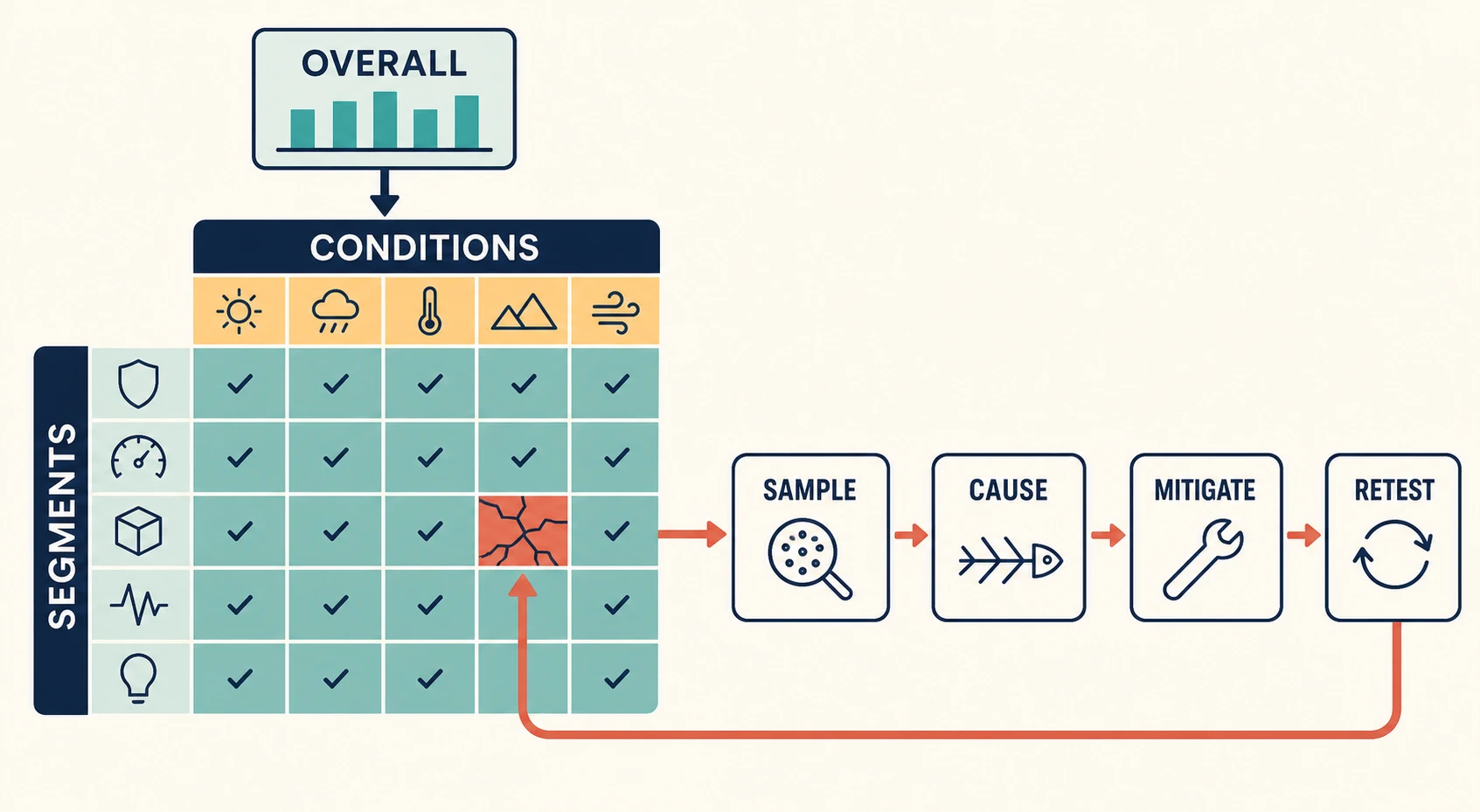
The team now has a more useful question than “How accurate is the router?” It must ask which callers encounter which errors, under what conditions, with what consequences, and whether a repair improves their route through the service without shifting the burden elsewhere.
Start With the Consequence, Then Choose the Slice
The available columns suggest dozens of ways to divide the test set: device, language, region, call type, customer tenure, time of day, audio quality, and demographic attributes. Exhaustively crossing them would create thousands of cells, many too small to interpret. Choosing only the largest cells would repeat the blindness of the aggregate.
The call team begins with the decision path. A wrong route for a store-hours question costs a little time. A wrong route for fraud reporting can leave an account exposed. A failed request to restore essential service has another consequence again. Callers differ in their exposure to these errors and in their ability to recover from them. That harm map makes call intent a primary slice, and it gives the team reasons to examine device, language, dialect-region, noise, and their plausible intersections.
This is the governing rule: choose slices because a mechanism or consequence may differ, not because a field happens to be available. Affected people and frontline operators can reveal conditions that a schema does not name. Conversely, collecting a sensitive attribute requires a defined purpose, appropriate authority, access and retention controls, and a safe reporting plan. Identity inferred from a name, voice, or postcode is uncertain evidence and can cause fresh harm; it must not quietly become ground truth.
Make the Hidden Cell Legible
The first report had one number. The revised report keeps the aggregate but shows the denominator and the consequence-bearing cells. The following fixture is illustrative:
| Test condition | Successful routes | Calls | Success rate |
|---|---|---|---|
| All evaluated calls | 8,464 | 9,200 | 92.0% |
| Speech-generating device | 163 | 240 | 67.9% |
| Target dialect-region intersections | 119 | 180 | 66.1% |
| Fraud requests within those intersections | 22 | 50 | 44.0% |
The table earns its space because the denominators must be compared at once. It does not yet prove why any gap exists, and its smallest cell cannot carry the certainty of the full set. Each reported rate also needs its sampling frame, time window, production threshold, exclusions, prevalence, and an uncertainty interval appropriate to the design.
Small groups create an uncomfortable combination: severe failures may be missed, point estimates may move sharply with a few cases, and fine-grained publication may identify people. The honest response may be targeted collection, a longer observation window, qualified aggregation, a hierarchical estimate, protected qualitative review, or a finding that evidence is insufficient for release. Dropping the cell is not a statistical remedy.
The team defines the main slices and minimum acceptable performance before inspecting the final results. Exploratory intersection searches remain useful for discovery, but apparent gaps found among many searches need confirmation on fresh data. Otherwise chance gets mistaken for diagnosis.
Decide Which Relationship the System Owes
“Fair” does not name one metric. For the fraud route, the urgent relationship is recall: among callers who need fraud support, how many reach it? False-positive rates answer a different question: how often are other requests unnecessarily sent to fraud specialists? Predictive value asks how often a call routed to fraud truly belongs there. Calibration matters if a score drives confidence thresholds. Selection or allocation rates describe who receives an outcome, while individual or counterfactual consistency asks whether relevantly similar cases receive consistent treatment under an explicit account of similarity.
These criteria can disagree when prevalence, labels, measurement, or constraints differ. Raising fraud recall may swamp specialists with false alarms; equalizing one rate can widen another. The team therefore records which relationship follows from the harm, whose interests it represents, which alternatives it rejected, and who can accept the residual trade-off. Mathematics exposes the choice but cannot make it.
Equal model metrics would not by themselves create an equitable service. Some callers pay for a long wait, cannot use the fallback channel, distrust an unexpected transfer, or have no practical way to appeal. Access, delay, human handling, and remedy belong in the evaluation because they belong in the system.
Follow the Gap Until It Has a Mechanism
The team listens to the failed calls and audits the route from collection to outcome. Qualified reviewers first discover disagreement in the intent labels: short phrases such as “someone used my card” were inconsistently tagged as billing or fraud. The speech-generating device also passes through noise suppression tuned on ordinary handset audio, which erases part of its signal. Finally, the router was optimized for average intent accuracy, so abundant low-cost requests dominated rare, consequential ones.
The observed gap came from several layers, not from an inherent property of a group:
service design -> audio capture -> preprocessing -> intent labels
-> sampling -> objective -> confidence threshold -> route
-> operator queue -> correction and remedy
That trace changes the possible repairs. More recordings alone would not fix contradictory labels, destructive preprocessing, or an objective that discounts rare severe errors. Removing device or region fields would not remove their proxies and would make the gap harder to audit. A correlation identifies where to investigate; it does not establish the cause.
Stress the Repair, Not Only the Model
The revised system uses reviewed intent definitions, preprocessing that preserves the device signal, greater weight for high-consequence routing errors, and a low-confidence path that asks one short clarifying question before offering an operator. Each change is a hypothesis with side effects.
The team now pairs cases that should remain stable with cases that should change. Re-encoding the same audio or adding ordinary background noise should not reverse a route. Changing “I need to check a card payment” to “My card was stolen” should. It tests handset and assistive devices, compression, packet loss, noisy environments, code-switching, new but in-scope phrases, dependency failure, peak volume, and operator overload. A temporal holdout checks whether the repair survives shifts in call vocabulary after launch.
This is where robustness and segment performance meet. A system may tolerate synthetic noise in the aggregate yet fail when that noise is produced by one channel used by a small population. It may be accurate offline but unsafe when its fallback queue takes forty minutes. Test conditions must describe the deployed workflow, not merely the perturbations that are convenient to generate.
After the repair, the team reruns every primary cell, not only the one that prompted the work. It checks success, severe errors, uncertainty, operator load, wait and abandonment rates, privacy, and callers’ ability to escape or correct the route. The new clarification improves fraud recall but adds several seconds to some ordinary calls. That burden is visible in the release decision rather than declared negligible.
The Release Record
A useful segment performance report is compact enough to govern a decision and complete enough to reproduce it. It records:
- the use case, consequential decisions, system boundary, and evaluated version;
- affected parties, benefits, harms, recovery paths, and the people consulted;
- data provenance, collection authority, limitations, exclusions, and privacy controls;
- primary segments, plausible intersections, stress conditions, and why each was chosen;
- counts, prevalence, thresholds, time windows, uncertainty, and severe examples;
- the fairness relationships considered and the rationale for selecting or rejecting them;
- mechanism hypotheses, evidence, repairs, and effects across the full metric and workflow portfolio;
- unsupported populations, residual gaps, user remedy, decision owner, monitoring triggers, and re-evaluation date.
The report describes system performance under observed conditions. It does not rank populations as intrinsically easy or difficult. Missing evidence remains a limitation, not a flattering blank cell.
For the call router, release authority is narrower than the aggregate score once implied. The high-cost routes stay behind a monitored rollout until the device and dialect-region cells meet their predefined floors, the operator queue remains within capacity, and severe misses trigger review. Production monitoring watches route correction, repeat calls, abandonment, queue delay, and new language patterns. A sustained floor breach pauses expansion; loss of a safe fallback suspends automated routing for the affected path.
Now transfer the method to a benefit-application extractor whose overall field accuracy is 96%. One language, scanned forms, and forms completed with assistive technology have poorer recall on decision-critical fields. Draft the first four rows of its segment report: name the harm, choose justified slices and intersections, specify the numerator and denominator for each, and identify what evidence would distinguish bad labels from bad extraction. Then find two proxy variables that could encode sensitive attributes and explain whether removing them would reduce harm or merely hide it.
Average performance starts the investigation. Release depends on whether the team can see the concentrated failure, explain its mechanism, test the repair under credible conditions, and preserve a remedy when the system is wrong.
Source Notes
- NIST Special Publication 1270, Towards a Standard for Identifying and Managing Bias in Artificial Intelligence, socio-technical guidance on bias across the AI lifecycle; verified 2026-07-20.
- NIST AI RMF Core: Measure, voluntary guidance on deployment-relevant measurement, uncertainty, representative evaluation, affected-community feedback, and documented trade-offs; verified 2026-07-20.
- See Metrics for Predictive Models for threshold and calibration mechanics and Human Oversight, Escalation, and Accountability for remedy and review design.