AI Systems Handbook / Chapter 19
Human Oversight, Escalation, and Accountability
Build human review that has the information, time, authority, capacity, quality controls, and evidence needed to reduce AI risk.
Preparing audio…
Audio edition
Human Oversight, Escalation, and Accountability
The Reviewer Who Could Only Agree
A benefits-triage system marks applications for accelerated review or investigation. Policy says a human makes every final decision. In practice, reviewers see a risk score without the evidence behind it, handle sixty cases an hour, and need manager approval to overturn the recommendation. Agreement helps their performance rating; an override slows the queue and invites scrutiny.
Oversight works only when a person or accountable team can detect a reason to intervene, understand the case, act with authority, and verify the result. Proximity to an AI output is not a control.
Suppose the system encounters a household whose income record is stale and whose uploaded document uses a format absent from the evaluation data. The model assigns an ordinary score. Nothing in the review screen reveals either weakness. The reviewer clicks approve, exactly as the workflow was designed to encourage. The organization later describes the error as human.
It was a system failure. Meaningful oversight has to be engineered before the case reaches the reviewer.
Follow the Case Through the Oversight Loop
An oversight path has six links.
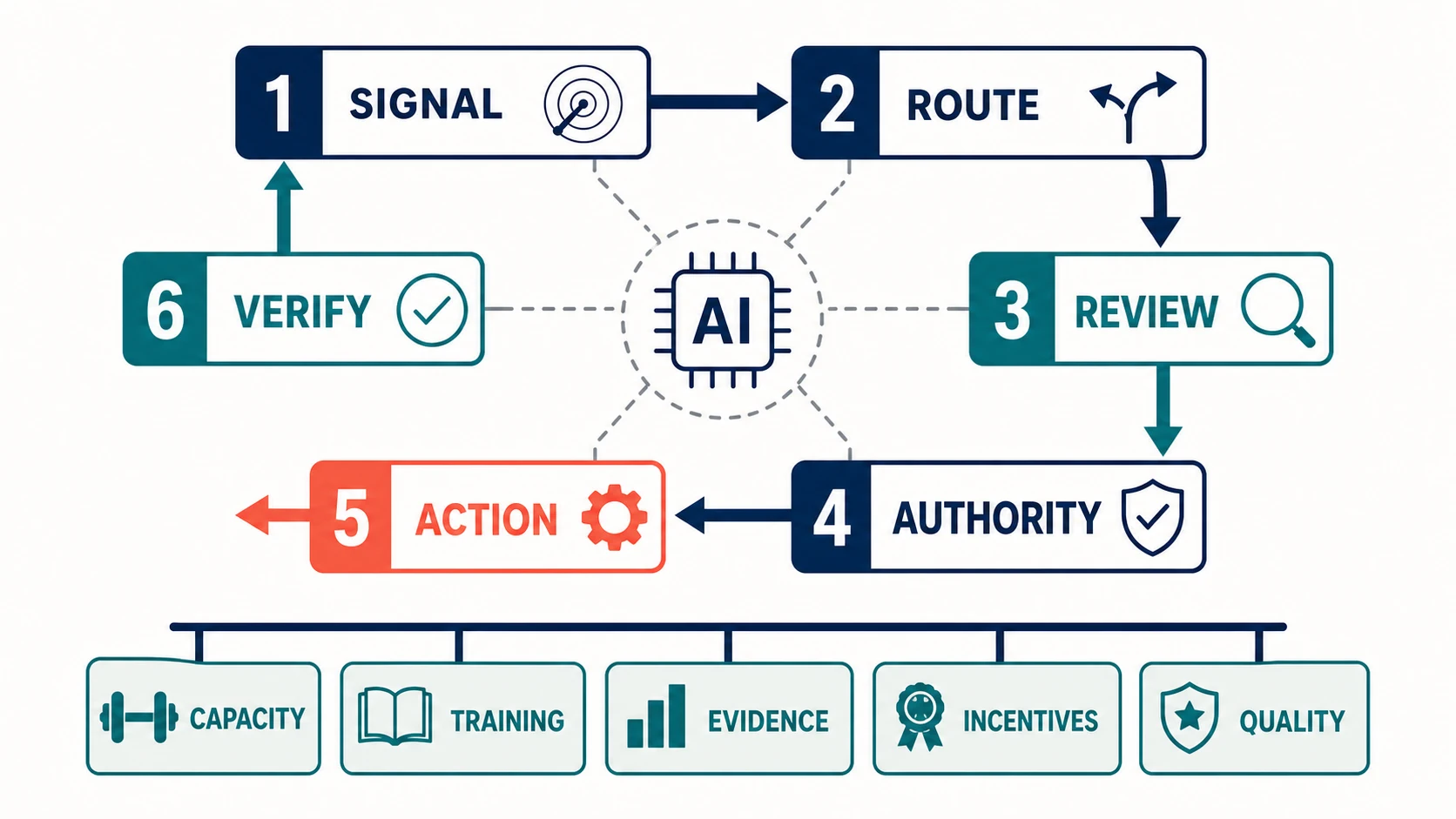
First, the system must produce a signal that review is needed. In this case, the stale record and unfamiliar document format should each qualify. The case must then route to someone able to interpret those conditions before the decision causes harm. That person needs enough evidence to review independently, the authority to change or stop the proposed action, and a workflow that faithfully performs the chosen action. Finally, sampling, appeals, and outcome checks must verify whether intervention actually reduced error.
Capacity, training, incentives, and audit records support every link. A broken link can make the presence of a person worse than useless: it transfers responsibility to someone who lacks control.
Put the Human Where Intervention Can Still Work
A human in the loop reviews before the governed action occurs. The pattern is appropriate when later recovery would be inadequate and the reviewer can make an independent judgment. The review must happen before the harm, not before an inconsequential system step that makes the eventual action inevitable.
A human on the loop supervises operation and can intervene. This can work for bounded, reversible actions only when detection and response are faster than the path to harm. A supervisor who receives an alert after an irreversible action is monitoring history, not controlling the system.
A human out of the loop performs no case-level review. The organization still needs an owner, validation, monitoring, incident response, periodic audit, and a route for affected people to challenge outcomes. Removing routine review does not remove responsibility.
Choose among these patterns by tracing severity, reversibility, time to harm, signal reliability, volume, reviewer competence, and affected-person rights. A compulsory pre-action click is not inherently safer than well-designed supervision. In the benefits workflow, the unfamiliar document requires review before triage changes the application’s path because delay itself can be consequential and difficult to repair.
Escalation Is a Staffed Promise
“Escalate when the model is uncertain” is not an operating rule. Uncertainty may be uncalibrated, absent, or confidently wrong. The team needs triggers it can observe without trusting the same judgment under review.
For the triage system, missing or conflicting evidence should trigger review. So should inputs outside evaluated populations, languages, document sources, or time ranges; high-consequence categories; calibrated low confidence or model disagreement; privacy, security, fairness, or policy flags; complaints and appeals; production anomalies; and sampled ordinary cases. A system that can take action also needs triggers for irreversible or externally visible steps, unusual tool sequences, and repeated failure.
Each trigger needs a severity, destination, response time, information package, allowed action, backup route, and expiry. “Send to specialist” is incomplete unless a specialist is staffed within the relevant harm window and the case has a safe state while it waits. Escalation without a reachable destination is a failure mode disguised as mitigation.
Let the Reviewer Form a Different View
The benefits reviewer needs the original application, relevant history, source documents, extracted fields linked to their locations, missing or contradictory evidence, applicable policy, and the action that approval will cause. They also need the system version and any material warnings. A confidence estimate belongs on the screen only if it has been validated for this population and decision.
Order and interaction design matter. If the recommendation appears first in large type and the evidence sits behind three clicks, the interface anchors the judgment before review begins. One useful test is to ask a qualified reviewer to assess the case with the evidence but without the recommendation, then compare that decision with review under the normal interface.
An explanation that merely rationalizes the score can strengthen automation bias. The reviewer needs evidence that could prove the recommendation wrong, not a fluent account of why it might be right.
Information alone cannot create authority. The reviewer must be able to correct extracted data, request more evidence, reject the route, pause the case, or send it to a specialist without seeking permission from the system’s owner. The workflow must execute that choice without a hidden rule restoring the original recommendation. Reviewers should be able to disagree without a speed, agreement, or adoption target turning that choice into personal cost.
Design for the Queue’s Bad Day
Oversight is also queueing and labor design. Estimate arrival rate, review time, skill mix, operating hours, rework, predictable peaks, and severe-case response times. Then rehearse the day when arrivals double, two specialists are absent, and a new document format sends more cases to review.
The overload rule belongs in the system design. Depending on consequence, the system might pause automated routing, narrow its scope to well-tested cases, extend a non-harmful deadline, add qualified staff, or fall back to the previous process. Quietly raising the queue threshold or asking reviewers to click faster spends the safety margin the review step was meant to provide.
Measure queue age by severity alongside audited decision quality, missed escalations, time to safe action, appeal and reversal, affected-person outcomes, and reviewer fatigue. Override, modification, abstention, and escalation rates are diagnostic signals, not targets. An unusually low override rate could mean excellent recommendations, a useless review step, or a workforce that has learned not to disagree.
Test Disagreement, Not Button Use
Before release, compare the human baseline, the system alone, and people working with the system. Add degraded cases: a confidently wrong score, conflicting evidence, a policy violation, an unfamiliar document, and a correct but surprising recommendation. Observe whether reviewers detect error, accept valid disagreement from the model, and use escalation appropriately.
The evaluation unit is the human-AI team and the outcome it produces. Interface satisfaction and approval speed cannot show that oversight works. After launch, sample routine approvals as well as escalations; reviewing only flagged cases hides errors that produced no signal. Use shared cases to calibrate reviewers, adjudicate consequential disagreement, and update training as failure patterns change.
Responsibility Must Follow the Failure
The reviewer owns the judgment they are empowered and qualified to make in one case. They do not own poor training data, an unsafe interface, inadequate staffing, or the decision to deploy the system.
Responsibility must follow those decisions. The product owner defines intended use and scope. Technical and data owners answer for release integrity, rollback, provenance, quality, access, and retention. The domain owner defines the professional decision standard. The oversight operations owner supplies staffing, training, service levels, and quality assurance. A named risk owner accepts residual risk; an incident commander coordinates containment when that risk becomes an event. The executive sponsor is responsible for the resources and high-level risk decisions appropriate to the organization.
Names are insufficient if authority is vague. Record who can pause the benefits system, who can restore a known-safe process, and who carries those powers outside normal business hours. When an incident occurs, the audit record should show the input and evidence available at the time, system and policy versions, recommendation, human action, override or escalation, resulting workflow state, and later correction. Log what is needed to reconstruct responsibility without turning sensitive case data into an unrestricted archive.
An Appeal Completes the Control Loop
The household affected by the stale income record may see what the reviewer could not. A visible appeal route lets them add current evidence and reach someone with authority to reconsider the outcome. It must state what can be challenged, what information is needed, when a response will arrive, and how the result changes the case.
An appeal is not generic product feedback and should not silently become training data. It is a request for accountable reconsideration. Its outcome should inform quality assurance: Was the original signal absent? Did routing fail? Was the evidence hidden? Did the reviewer lack time or authority? That inquiry returns the error to the appropriate system owner instead of leaving it attached to the last person who clicked.
Write the Oversight Plan Around a Decision
An oversight plan should be short enough to use and exact enough to operate. For one supported decision, record:
- the action being supported and the autonomy that remains prohibited;
- whether review happens before action, during supervised operation, or through sampling and audit—and why that timing can prevent or limit harm;
- observable triggers, severity, destinations, response times, backup routes, and the safe waiting state;
- reviewer competence, training, evidence, tools, and authority to override, pause, undo, or escalate;
- expected volume, staffing assumptions, quality sampling, adjudication, and the overload response;
- records needed to reconstruct the decision, with access, retention, and privacy limits;
- appeal and incident routes, including who can change an outcome or stop the system;
- measures of team effectiveness and affected-person outcomes;
- the product, technical, data, domain, operations, risk, and executive owners; and
- the changes or evidence that require the plan to be reviewed again.
Return to the original benefits case and apply the plan. The stale record and unfamiliar document now create visible signals. The case waits safely in a specialist queue. The reviewer sees the underlying documents before the recommendation, can correct the record without a penalty, and can send the application back to the ordinary path. A later sample verifies that the corrected route held. If the signal still fails, the household can appeal and the resulting correction reaches the owners who can change the system.
That is what makes the person in the workflow a control rather than a witness. Meaningful oversight leaves evidence: people catch defined failures, alter decisions, survive queue pressure, and return errors to owners with the power to prevent them.
Source Notes
- NIST AI RMF Core, governance outcomes for clear roles, trained and empowered personnel, human-AI configurations, monitoring, and executive responsibility; verified 2026-07-10.
- Microsoft Guidelines for Human-AI Interaction, evidence-based guidance for correction, user control, failure handling, and changing behavior over time; verified 2026-07-10.
- People + AI Guidebook: Feedback + Control, guidance on making user feedback and control part of the product experience; verified 2026-07-10.