AI Systems Handbook / Chapter 41
Accountability, Transparency, and Explainability
Design answerable ownership, audience-specific disclosure, faithful explanations, and usable challenge routes for AI-enabled systems.
Preparing audio…
Audio edition
Accountability, Transparency, and Explainability
The Explanation That Answered the Wrong Question
A lender uses a model to prioritize applications for manual review. An applicant asks why her case was delayed. The support agent reads a feature-attribution chart: income stability contributed 31 percent, recent credit activity 22 percent, and account history 17 percent. The chart says nothing about who set the review threshold, whether the data was correct, how to contest it, or when a human will respond.
The system produced an explanation artifact but failed to answer the applicant’s question.
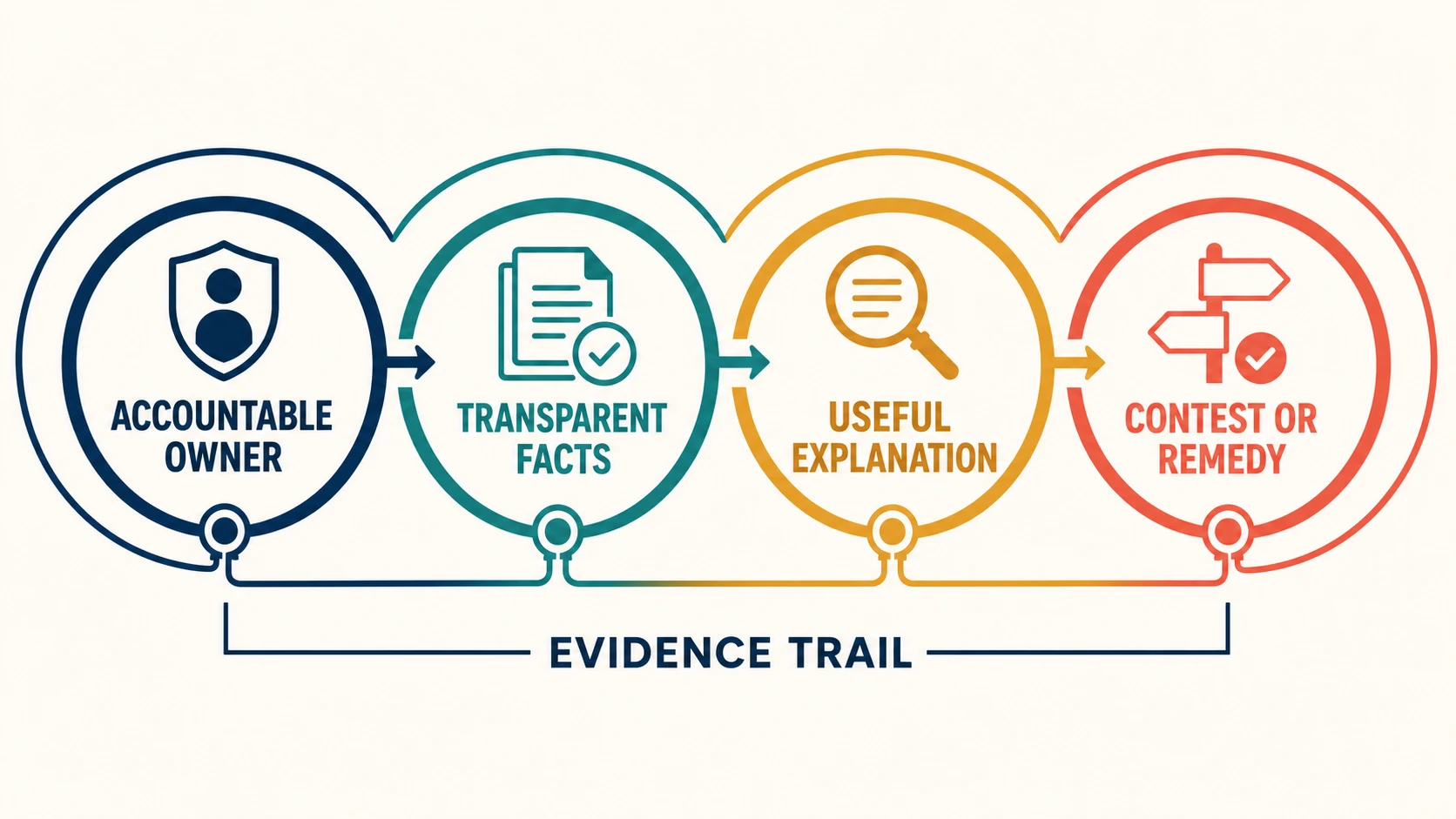
Accountability assigns an answerable owner with authority to act. Transparency makes relevant facts and records available. Explainability gives a particular audience useful, sufficiently faithful insight into an output or process. None substitutes for remedy.
Begin With the Unanswered Question
The applicant is not asking how the model distributes importance among its inputs. She is asking what happened to her application and what can happen next. Those questions expose four obligations that should not be collapsed into “explainable AI.”
Accountability begins with a person or institution that must answer for the workflow. The owner needs authority to obtain evidence, correct the process, fund remediation, and pause unsafe operation. A committee without those powers is a meeting, not an accountable owner.
Transparency determines what facts another person can inspect. For the applicant, that includes the role of automation, the data used, the policy applied, and the route to review. An operator needs operating limits and warnings. An auditor needs versions, approvals, lineage, and exceptions. Transparency is therefore selective, not indiscriminate: privacy, security, trade-secret, and abuse-prevention limits can justify withholding detail, but “confidential” cannot become a way to hide the facts someone needs to use, review, or challenge the system.
Explainability supplies useful insight into an output or process for a particular audience. A feature-attribution chart may help an evaluator diagnose model behavior. It is a poor answer to an applicant who needs to find an incorrect input. No explanation is complete merely because it is technical.
Contestability gives the answer somewhere to go. A person can question the result, correct relevant data, obtain qualified human review, appeal the decision, and learn the outcome. Without that route, disclosure may describe a wrong decision perfectly while leaving it intact.
Let One Evidence Trail Serve Different Decisions
Suppose the lender traces the delayed application. The same event must support several different decisions.
The applicant needs plain language: an automated score changed the review order; these submitted facts materially influenced that score; this is how to inspect or correct them; a human reviewer will respond by a stated time. The reviewer needs more: data provenance, evidence quality, the threshold policy, operating-limit warnings, comparable cases, and authority to override. The product and risk owners need the pattern around the case—delays, reversals, complaints, segment outcomes, and control failures—to decide whether continued operation remains acceptable. An auditor needs to reconstruct which model, data, policy, and approval were in force. An engineer needs enough detail to reproduce the behavior and locate the responsible component.
These are not six independent stories. They are views over a shared evidence spine. A useful system records the event once with enough provenance to render each view, and makes disagreement between views detectable. If the applicant notice says “income data was incomplete” while the reviewer saw a threshold change, the record should expose the contradiction.
That evidence spine also separates the system’s output from the institution’s decision. In a human-AI workflow, record what the AI supplied, what the reviewer actually inspected, what authority the reviewer exercised, and who owns the final outcome. “A human was involved” says nothing about whether the person could disagree or had evidence worth reviewing.
Ask What Kind of Output Needs Explaining
A loan score needs its relevant factors, data-quality limits, threshold policy, and meaningful uncertainty. Feature importance is not automatically a causal account of why a person’s financial circumstances exist, or even a complete account of why the workflow produced its final action.
Other systems create different explanatory debts. A recommender should expose its objective, candidate set, important ranking factors, exclusions, and commercial rules. Generated content may need sources, retrieved evidence, verification boundaries, and an abstention condition. A tool-using agent needs an action trace: goal, permissions, approvals, side effects, result, and rollback status. The method follows the consequence and the next decision; it does not begin with whichever explanation library is easiest to add.
Where an interpretable model meets the full requirement set, its inspectable operation can be valuable, especially when individual explanation and challenge recur. A more complex model may still be justified, but a post-hoc explanation must be tested as a fallible component. Is it stable for materially similar cases? Does it faithfully represent the local behavior it claims to describe? Can the intended audience understand it? Does its plausible narrative invite a stronger causal interpretation than the method supports?
The last question is easy to miss. A convincing explanation can be more dangerous than an obvious gap because it closes inquiry too early.
Make Uncertainty Change the Route
“This may be inaccurate” attached to every output teaches users to proceed as though the warning were absent. Uncertainty earns space only when it changes what someone may do.
For the lender, materially missing application data should block an adverse action and trigger correction. Conflicting evidence may require abstention or specialist review. An unfamiliar case should leave the automated route. If the explanation method is outside the conditions in which it was validated, the interface should say that an explanation is unavailable, not improvise one. If the system cannot support the contest required for a consequence, it should not automate at that level.
Test the resulting cues with the people who must act on them. A percentage can appear precise even when it is poorly calibrated for the current population or use. “Evidence incomplete—human review required” may be the more accurate and operationally useful statement.
Build the Record Before the Explanation Screen
The support interface cannot reconstruct evidence the workflow failed to preserve. For the delayed application, the event record needs the versions of the model, code, data, and policy; the provenance and transformations of material inputs; the score, evidence, threshold, and rules applied; the notice shown at the time; the review, override, and final action; and any complaint, correction, appeal, or resolution that follows.
The record must also carry its own controls: who may see each field, for what purpose, for how long, and with what audit trail for access, redaction, and deletion. Recording every prompt, document, or sensitive attribute in the name of transparency can create a new privacy or security failure. Traceability is designed, not maximized.
Now the applicant reports that the income history belongs to a closed joint account and should not have been treated as current. Support can locate the exact input rather than recite a chart. A trained reviewer verifies the correction, reruns or bypasses triage under recorded authority, restores the application’s place in the queue, and communicates the result. The complaint is linked to monitoring. If similar corrections cluster around the same transformation, the product owner opens a system change; if delay or correction failures cross a defined threshold, the risk owner can pause the workflow.
The original feature attribution still has value. It helped locate where to look. Answerability begins when that insight can travel through evidence and authority to a changed outcome.
Transparency and Explanation Plan
- Decision context: output, action, affected people, consequence, reversibility, and non-AI alternative.
- Accountability: product, technical, data, operational, risk, complaint, and pause owners with explicit authority.
- Audience map: decision each audience makes, facts needed, format, language, accessibility, and timing.
- Explanation method: evidence or factors shown, intended meaning, fidelity limits, uncertainty, and prohibited interpretation.
- Transparency record: system purpose, versions, data categories, evaluation, limitations, controls, incidents, and changes.
- Contest route: correction, human review, appeal, service target, escalation, and outcome communication.
- Protection: privacy, security, trade-secret, abuse, access, retention, and redaction controls.
- Tests: comprehension, fidelity, stability, coverage, response time, reversal, and segment outcomes.
Disturb the Plan
Draft the plan for the loan-triage system, then test it with three changes. First, the applicant disputes a source field that the lender obtained from a third party. Next, the model’s explanation method gives unstable factors for nearly identical applications. Finally, the lender changes the review threshold without changing the model.
For each change, decide what the applicant, reviewer, owner, auditor, and engineer must learn; which versioned record supplies it; who may correct or override the result; and what event reopens approval or pauses operation. Do not add a new disclosure unless it helps someone make a legitimate decision. If the exercise ends with a better explanation but no possible correction, the plan is unfinished.
Accountability, transparency, and explainability meet at the moment an answer becomes consequential. The organization can name who must act. The record can show what happened. The explanation can help its recipient understand what matters. The contest route can make a justified correction real. The next chapter widens that same inquiry from one disputed application to the distribution of benefits, burdens, and harms across everyone the system reaches.
Source Notes
- NIST, Four Principles of Explainable Artificial Intelligence, NISTIR 8312, describes explanation, meaningfulness, explanation accuracy, and knowledge limits; verified 2026-07-20.
- NIST AI RMF trustworthiness characteristics distinguishes accountability and transparency from explainability and interpretability and treats them as contextual socio-technical characteristics; voluntary guidance verified 2026-07-20. NIST states that AI RMF 1.0 is being revised, so adopters should verify the current version.
- OECD transparency and explainability principle emphasizes context-appropriate information, awareness of AI interaction, understanding outputs, and the ability to challenge adverse outcomes; policy principle verified 2026-07-20.
- See Human Oversight, Escalation, and Accountability and Governance as an Operating System for authority and escalation design.