Appendix H: Human Oversight Plan Template
Design human review with enough authority, information, time, training, escalation, and quality evidence to change AI system outcomes.
Give the Reviewer a Real Decision
A claims team requires an analyst to approve every high-risk prediction. The interface shows only a score and an Approve button, analysts have forty seconds per case, and supervisors criticize override rates. The workflow contains a human, but the human cannot inspect the evidence, pause the queue, or reject the system’s recommendation without penalty.
Human oversight is meaningful only when it can change an outcome. This plan turns the phrase “human in the loop” into an operating design: who reviews, what they see, which authority they hold, when they must escalate, how affected people can contest the result, and how the organization tests whether review works under real workload.
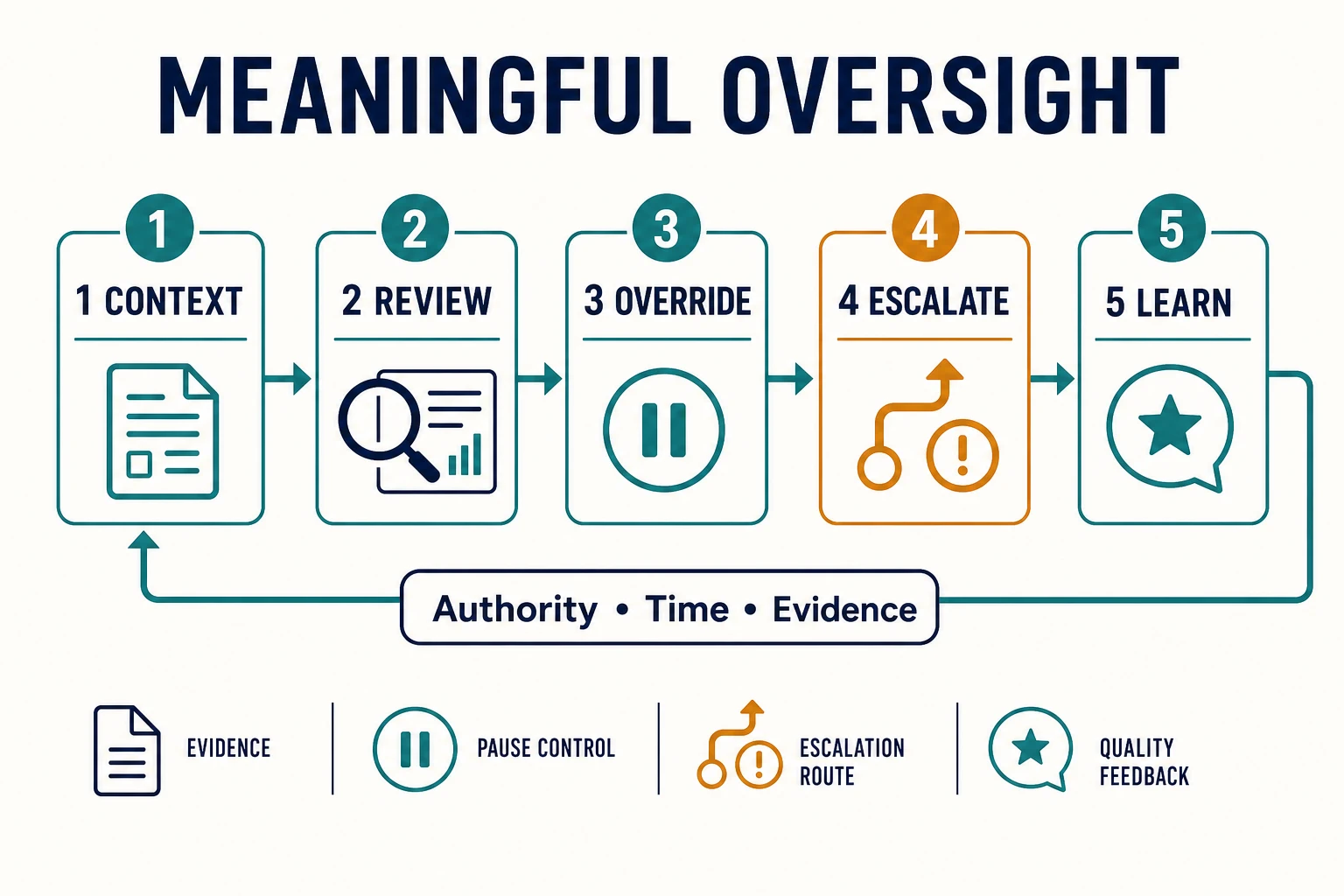
Put Review Before the Last Reversible Step
Choose the review point by tracing what happens after the AI output. Use pre-action review when an error could create a consequential or difficult-to-reverse outcome. Supervisory review can govern bounded, reversible actions only when detection, routing, and intervention together are faster than the path to harm. Sampled review measures quality; it cannot stand in for approval where every case requires judgment. Exception review works only if the exception detector is itself evaluated and ordinary cases are still sampled for failures that produced no signal.
The plan must cover the complete decision path. If a model score feeds a rule that automatically denies service, oversight of the score alone is insufficient. Document the output, the rule, the action, the notice, the correction path, and the person accountable for the final operating policy. Mark the last point at which intervention can still prevent the consequence; review after that point is audit or remedy, not approval.
Human Oversight Plan
IDENTITY AND SCOPE
System, version, and owner:
Workflow and decision supported:
Users and affected people:
AI output and action that follows:
Actions the system may never take:
Oversight plan version / review date:

OVERSIGHT MODE
[ ] Pre-action review: human decides before action
[ ] Supervisory review: human monitors and can intervene
[ ] Sampled quality review: human audits a defined sample
[ ] Exception review: defined cases route to a human
[ ] Post-action review: reversible actions checked afterward
Why this mode matches consequence and reversibility:

HUMAN ROLE AND ACCOUNTABILITY
Reviewer role and qualifications:
Final decision-maker:
Escalation owner:
Quality-assurance owner:
Policy and risk owner:
Who is answerable when human and system disagree:

INFORMATION AVAILABLE AT REVIEW
Original request or case facts:
AI output, score, or proposed action:
Evidence, provenance, and relevant alternatives:
Uncertainty, policy, safety, or data-quality flags:
Prior decisions and material context:
What the reviewer sees before seeing the AI recommendation:
Information intentionally hidden and why:

AUTHORITY AND CONTROLS
[ ] Accept     [ ] Reject     [ ] Edit or correct
[ ] Request more evidence    [ ] Abstain
[ ] Pause one case           [ ] Pause the system
[ ] Escalate                 [ ] Initiate appeal or correction
Actions requiring a second approver:
Maximum action scope and blast radius:
How override is recorded without punitive incentives:

TIMING, CAPACITY, AND WORKLOAD
When review occurs:
Time budget by case type:
Expected volume and staffing model:
Queue limit and overload behavior:
Fatigue, interruption, and shift controls:
Safe fallback when no qualified reviewer is available:

ESCALATION AND CONTESTABILITY
For each trigger, record severity, destination, response target, backup route,
safe waiting state, and authority at the destination.
Uncertainty or conflicting-evidence trigger:
Severity or consequence trigger:
Policy-conflict trigger:
Novel, shifted, or anomalous input trigger:
User contestation or appeal trigger:
Coverage outside normal hours:
Notice, correction, appeal, and remedy available to affected people:

TRAINING AND DECISION SUPPORT
Required domain, policy, system, and bias training:
Practice cases and certification threshold:
Known system limitations reviewers must recognize:
Refresher and change-triggered training:
Where reviewers obtain independent help:

LOGGING AND EVIDENCE
Case facts and versions retained:
AI recommendation and evidence retained:
Human action, reason, and timestamps retained:
Escalation, appeal, and final outcome retained:
Access, privacy, retention, and deletion controls:

QUALITY ASSURANCE
Sampling method and review cadence:
Second-review or adjudication process:
Agreement and reviewer-accuracy measures:
Override and escalation analysis:
Appeal, reversal, harm, and near-miss analysis:
Feedback into evaluation, policy, training, and product changes:

ACCEPTANCE TESTS
Reviewer can locate decisive evidence: pass / fail
Reviewer can reject and pause without workaround: pass / fail
Escalation arrives at a qualified owner on time: pass / fail
Peak workload preserves minimum review quality: pass / fail
Affected person can obtain correction or appeal: pass / fail
Recorded human choice survives downstream rules: pass / fail

APPROVAL AND REVIEW
Residual limitations and risk:
Approvers and dates:
Next review date:
Change and incident triggers for re-review:
Work the Plan: Benefits Triage Under Deadline Pressure
A public-service team uses a classifier to prioritize incomplete applications for outreach; it does not determine eligibility. Reviewers see the submitted facts, missing-field reasons, score range, policy rules, and source version before the proposed priority. They can remove a case from the ordering, request information, and pause the queue when an upstream feed is stale. Applications near a deadline, contested by an applicant, or involving conflicting records route to a senior caseworker.
On paper, the plan promises senior review within one business day. A rehearsal begins with a translation backlog and a deadline-day burst that triples the queue. The senior caseworker is absent. Cases continue to arrive, but the plan names no backup owner and does not say what happens while they wait. The escalation target is therefore not a control; it is an unstaffed promise.
The team changes the plan before launch. A duty caseworker becomes the backup authority. Deadline-sensitive cases remain on the pre-existing chronological path until reviewed; the classifier cannot push them behind other work. When the qualified queue exceeds its safe age, new prioritization pauses rather than asking reviewers to work faster. The rehearsal has changed system behavior, staffing, and the safe waiting state—not merely filled blanks in a document.
Quality assurance now samples ordinary approvals as well as escalations. It compares reviewer decisions with later adjudication, audits workload by language and case complexity, checks whether overrides lead to retaliation or coaching pressure, and follows whether outreach reached the intended people in time. Appeals can restore a case to the correct path and feed the failure back to the owners of routing, staffing, and policy.
Read the Measures as Diagnostic Signals
Override rate is not a target by itself. A very low rate can mean excellent recommendations, or it can reveal automation bias, weak authority, hidden workload pressure, or an interface that makes correction expensive. A high rate can reveal a bad model, a policy mismatch, or healthy expert challenge. Interpret overrides with sampled case quality, later outcomes, escalation reasons, review time, appeals, reversals, and differences across reviewers and affected groups.
Read time-to-review the same way. A falling median may reflect a better interface, or it may hide hurried review and a long tail of severe cases. Break the measure down by consequence, language, complexity, reviewer, shift, and outcome. Pair speed with missed escalations, reversals, appeals, near misses, and affected-person outcomes.
Rehearse the Queue’s Bad Day
Before approval, run a consequential case through the normal interface and downstream workflow. Then remove a dependency: make the recommendation confidently wrong, hide a decisive fact in conflicting evidence, double the arrival rate, or make the primary escalation owner unavailable. Observe the system rather than asking what policy says should happen.
The rehearsal should answer five questions. Did the case produce an observable signal? Did it reach a qualified person before the last reversible step? Could that person form an independent view and act without penalty? Did the chosen action survive downstream automation? Could an affected person obtain correction if every earlier control failed?
Repair the plan wherever the answer depends on goodwill, spare time, or an owner who is merely named. Approval is justified only when the workflow fails into a bounded state and leaves evidence that the intervention changed the outcome.
Use this plan with Human Oversight, Escalation, and Accountability, the Launch Readiness Checklist, and the AI Incident Report Template.