AI Systems Handbook / Chapter 40
Governance as an Operating System
Design governance that routes AI decisions to accountable owners, proportionate challenge, required evidence, and enforceable lifecycle controls.
Preparing audio…
Audio edition
Governance as an Operating System
The Assistant That Changed Routes
A mid-size company buys an employee-support assistant to answer policy questions. Procurement records a software subscription. The product team calls the assistant low risk because it only drafts answers. The monthly AI council sees a slide about productivity and approves a pilot.
Then a manager asks the assistant to summarize an employee’s attendance history before a promotion discussion. Nothing about the model changed. The purpose, affected person, data, and consequence did. Yet the approval record has no owner who can suspend the new use, no evaluation for employment decisions, and no route for an employee to challenge a wrong summary.
A governance system should catch that change before the assistant influences the meeting. If it does not, the company has a committee, not control.
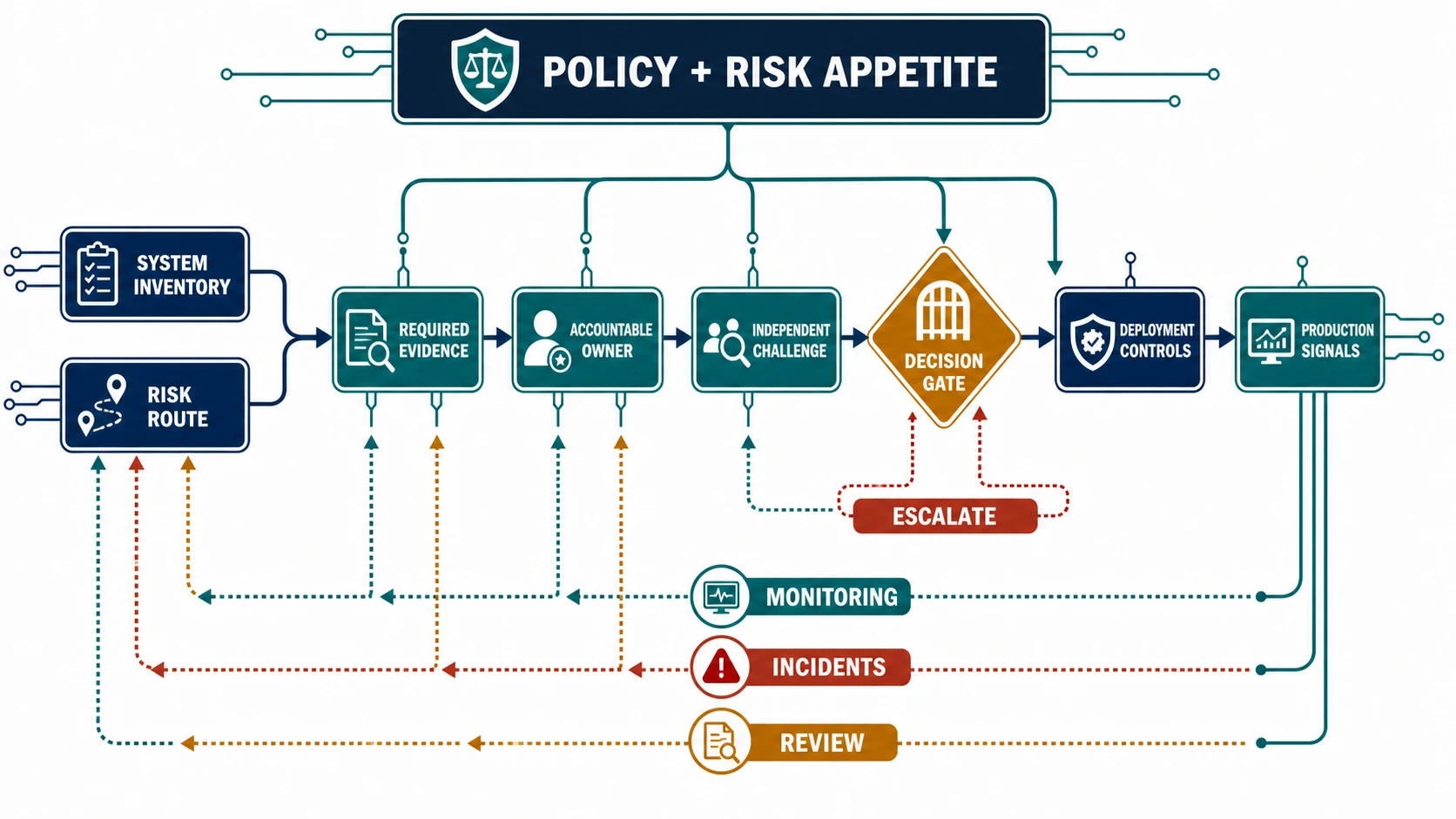
Governance is decision infrastructure: it connects a changing AI use to the authority, evidence, challenge, controls, and escalation that the decision now requires. It should make responsible work easier to route and evasions harder to hide.
Turn Principles Into Decisions
The company already has principles: respect human agency, protect privacy, avoid unfair treatment, keep people accountable for consequential decisions. Those statements establish direction. They do not tell the product owner whether the assistant may read attendance data tomorrow.
Policy makes the first translation. It defines the uses in scope, prohibited uses, risk appetite, mandatory controls, exception authority, and consequences of evasion. Standards and approved patterns then make recurring choices easier: which data classes an employee assistant may access, how an assistive interface must represent its limits, which logs are required, and when human review is real rather than ceremonial. Procedures route intake, evaluation, launch, change, incident, and retirement. Records preserve what evidence was considered and what was decided. Assurance checks whether the controls operated and changed outcomes.
The chain should be traceable in both directions. A required artifact needs a reason: a risk, obligation, or decision it informs. A principle needs an operating consequence that can be observed. Otherwise principles become aspiration while procedures become paperwork.
Governance also keeps related lenses distinct. Compliance asks whether applicable requirements are met. Ethics asks what ought to be done, including effects that law or contract may not capture. Enterprise risk management compares the exposure with the organization’s objectives and tolerances. Governance brings those judgments to an authorized decision without pretending they are interchangeable.
Make the Inventory a Routing Index
The employee assistant first enters the inventory through procurement. Its record names its purpose, accountable owner, users and affected people, model and vendor, data classes, integrations, regions, permitted and prohibited uses, non-AI alternative, lifecycle stage, internal risk route, and any separate legal or contractual classification. As it moves into production, the same record points to the approved release, required evidence, monitoring, incidents, complaints, appeals, exceptions, and eventual exit plan.
That is more than an asset register. It is an index into live decisions. A leader should be able to ask which systems can influence employment, which use sensitive data, which rely on a single provider, which exceptions expire this quarter, and which lack an appeal path or tested fallback.
No single intake form will find everything. Discovery should connect procurement, architecture, data catalogs, identity, expense records, vendor management, and deployment pipelines. It should cover built, bought, embedded, experimental, shadow, and retired uses. Workers also need a safe route to disclose unsanctioned tools; punishment alone drives discovery underground.
When the manager connects attendance history and changes the assistant’s purpose, the inventory record must change. That change is not clerical maintenance. It is the event that sends the system back through governance.
Give Challenge Somewhere to Stand
A practical adaptation of the three-lines model separates ownership, oversight, and independent assurance:
- first line — system and business owners: design, operate, monitor, document, and manage risk within approved boundaries;
- second line — risk, security, privacy, legal, compliance, responsible-AI, accessibility, and domain oversight: set policy, advise, challenge, monitor portfolio risk, and approve where authority requires;
- third line — independent audit or assurance: assess whether governance and controls are designed and operating effectively.
The model is about independence of judgment, not distance on an organization chart. A smaller company may combine roles, but it should expose conflicts and arrange cross-functional or external challenge when the consequence demands it.
One person remains accountable for the system. A committee may approve or advise, but it cannot absorb the duty to keep evidence current, fund controls, respond to complaints, and stop unsafe operation. Around that owner, decision rights must be explicit: who classifies the use, approves data and architecture, authorizes a pilot or material change, accepts residual risk, pauses the service, hears an appeal, verifies remediation, and closes a finding.
In the employee-assistant case, the product owner cannot declare the changed use harmless, provide the evidence, and accept the risk alone. The employment domain owner can reject the proposed purpose. Privacy and security reviewers can constrain attendance-data access. An independent reviewer can challenge whether the evaluation represents affected groups and realistic errors. The incident lead can pause the capability without waiting for the next council meeting.
Authority must travel with evidence, time, and resources. A reviewer who cannot inspect the release, delay it, or trigger escalation is offering an opinion, not exercising oversight.
Let Consequence Determine the Route
Sending every system to one board creates delay without producing proportionate attention. A bounded, reversible assistant using an approved pattern may take a standard route: automated controls, owner attestation, and sampled assurance. A use with a material but recoverable effect needs cross-functional review, formal evaluation, human oversight, monitoring, and reassessment. Consequential domains, sensitive data, rights or safety effects, substantial autonomy, or hard-to-reverse outcomes demand independent challenge, domain review, staged exposure, senior risk acceptance, and audit. A use outside law, policy, rights commitments, or risk appetite should meet a clear rejection path and a safer alternative.
The route is a control choice, not a label attached to the model. Severity, scale, autonomy, data sensitivity, affected populations, reversibility, and weakness of evidence all matter. The assistant can therefore move from a standard route for policy retrieval to a higher route when it begins shaping employment decisions. Uncertainty should escalate review rather than disappear into a reassuring score.
Internal routes prioritize the company’s work. They do not replace legal or contractual classification, and a low internal tier cannot waive a binding requirement.
Make the Gate Decide Something
At intake, the company needs enough evidence to name the purpose, baseline, owner, affected people, and preliminary route. Design review asks whether the team has rights to the data, a defensible architecture, a credible threat and privacy model, meaningful human oversight, and an impact assessment proportionate to the use. Evaluation brings a versioned plan, representative cases, segment results, safety and security tests, limitations, and explicit acceptance criteria. Launch adds the exact release bundle, verified controls, monitoring, fallback and incident plans, user communication, and approvals.
Operation then supplies evidence the design could not: quality and harm signals, complaints, appeals, overrides, incidents, vendor changes, drift, cost, and control performance. Material changes reopen the relevant gates. Retirement has its own evidence for dependencies, transition, artifact disposition, and residual risk.
A gate must decide. Its outcome may be approval, bounded approval, return for evidence, narrower scope, rejection, pause, or retirement. The record names the evidence version, rationale, dissent, conditions, owner, expiry, and route for appeal or escalation.
For the assistant, the original policy-answering pilot does not authorize attendance summaries. The proposed change returns to intake and design. The team has not shown that a summary is needed, that its errors are recoverable before the promotion discussion, or that a manager will detect omission and framing bias. Governance does not ask for more slides. It limits the approved purpose to policy retrieval while the company decides whether any employment-summary use is acceptable at all.
“Approve with monitoring” is not a decision unless the record names signals, thresholds, owners, response, and pause authority. Risk acceptance should expire because evidence, use, and environment change.
Put Residual Risk in the Hands of Someone Who Can Act
Residual risk is what remains after controls. Its acceptance record should state:
- risk scenario, affected people, severity, likelihood or uncertainty, and evidence;
- controls in place and their tested effectiveness;
- alternatives considered, including non-AI and reduced-scope options;
- benefits expected and who receives them;
- owner authorized to accept the risk;
- conditions, exposure limit, monitoring, stop triggers, and expiry;
- review or escalation required if assumptions change.
The person accepting risk should be able to bear organizational accountability and allocate remediation resources. A project manager should not accept enterprise-level rights or safety risk merely because a deadline is near.
Dissent belongs in the evidence record. A reasoned objection can reveal a contested assumption that averages and approval totals conceal. Safe reporting and anti-retaliation routes are therefore controls: frontline workers and affected people often see weak behavior first.
Let Production Evidence Change Governance
Three weeks into the policy-answering pilot, an employee reports that the assistant quoted an obsolete leave rule. The service dashboard is green. The complaint record, however, links the answer to an archived document that remained in the retrieval index after a policy migration.
The system owner pauses answers for that policy family under preauthorized authority. The product team repairs the corpus and regression set. The second line asks a portfolio question: which other assistants share the ingestion pipeline? The inventory identifies two. Independent assurance samples their document-removal controls and finds that one has the same weakness. A local complaint has become evidence for a broader policy and control change.
This feedback loop is what makes governance an operating system. Production does not merely report upward; incidents, complaints, appeals, overrides, audit findings, vendor changes, and retirement evidence can change patterns, risk appetite, review requirements, and authority.
Measure whether that circuit works. Inventory coverage, classification delay, review time by route, expired authority, control failures, remediation time, undeclared systems, aging exceptions, and time from stop trigger to containment all expose different breaks. So do outcomes by affected segment, repeated findings, complaints that cannot reach an owner, and material changes discovered only after release.
Counts need interpretation. A low incident total may indicate weak detection or fear of reporting. Fast review may indicate clear approved patterns, or shallow evidence and evasive classification. Use case sampling, interviews, control tests, audits, and affected-stakeholder feedback to distinguish them.
Rehearsal reveals authority that exists only on paper. Walk through a vendor changing a model alias, an agent taking an unauthorized action, a worker challenging a summary, a critical reviewer leaving, or a system owner refusing a pause order. Repair the decision path before the real event supplies the clock.
AI Governance Charter
- Purpose and scope: systems, entities, regions, lifecycle stages, and exclusions.
- Principles and risk appetite: values, prohibited uses, tolerances, and escalation rules.
- Inventory: discovery sources, minimum fields, owner, and update obligations.
- Roles and authority: first, second, and third lines; decision rights; conflicts; pause authority.
- Risk routes: classification dimensions, required evidence, forums, and service expectations.
- Lifecycle gates: intake, design, evaluation, launch, operation, change, incident, and retirement.
- Records: decision, dissent, risk acceptance, exception, version, retention, and access rules.
- Assurance: monitoring, control testing, audit, reporting, and affected-stakeholder feedback.
- Improvement: incident learning, policy updates, training, review cadence, and charter owner.
Design the Route, Then Disturb It
Design governance for a mid-size company adopting AI across customer support, software development, marketing, and human resources. Give routine, reversible uses a published fast path. Choose one use whose consequence requires deeper challenge and name the accountable owner, independent reviewer, evidence gate, residual-risk authority, operating limits, and pause condition.
Now disturb the design. The vendor silently changes a model alias; a team connects a new sensitive data source; an affected person disputes an output; and the system owner is unavailable. Trace which signal changes the inventory, who can act before the next committee meeting, what evidence reopens approval, and which portfolio rule should change afterward. If the route ends with “refer to the AI council,” the decision infrastructure is unfinished.
Productive governance makes ordinary work predictable and consequential work contestable. Its proof is not the charter on the shelf. It is whether a changed use, weak evidence, dissent, or production harm can reach someone with the authority and resources to change what happens next. The next chapter follows that obligation into answerable ownership, disclosure, explanation, and remedy.
Source Notes
- NIST AI Risk Management Framework Core, voluntary guidance organizing AI risk management through Govern, Map, Measure, and Manage, including clear roles, inventory, monitoring, accountability, and safe decommissioning; verified 2026-07-20. NIST states that AI RMF 1.0 is being revised, so adopters should verify the current version.
- ISO/IEC 42001:2023, an international standard specifying requirements for establishing, implementing, maintaining, and continually improving an AI management system; official ISO summary verified 2026-07-20.
- The three-lines adaptation in this chapter is author guidance for practical AI governance; organizations should align it with their own enterprise governance, jurisdiction, sector, contracts, and qualified advice.
- See Risk Triage Before Building, Change Management and Continuous Improvement, and Decommissioning and End-of-Life for lifecycle governance decisions.