Chapter 20
Asking High-Value Clarifying Questions
A practical senior-interview chapter on asking high-value clarifying questions in coding, system design, debugging, project, and behavioral rounds while avoiding question lists that stall progress.
Jump around the book
On this page
What this questioning method controls
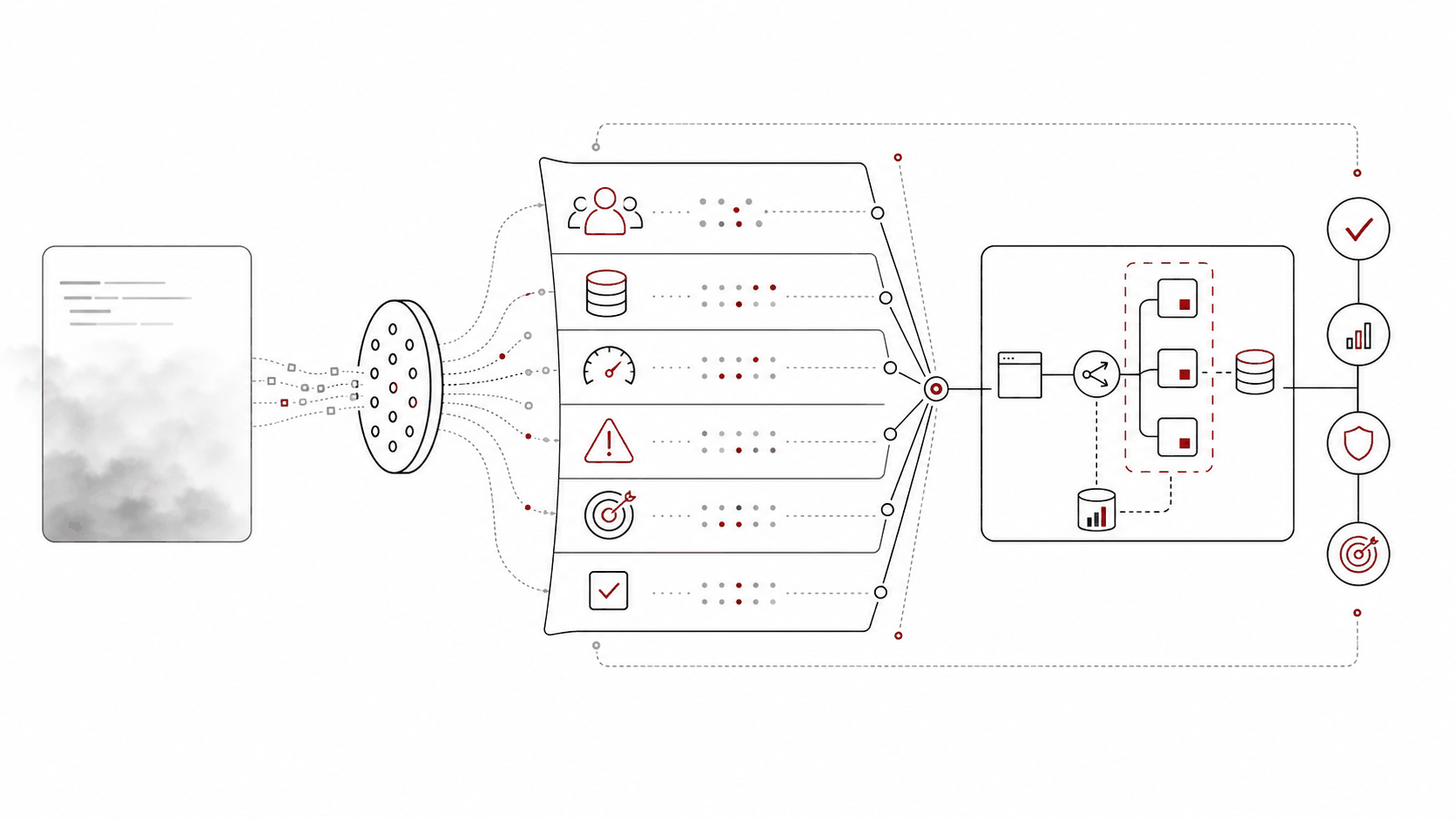
Clarifying questions are not a politeness ritual. They are a problem-framing tool.
Interviewers use ambiguous prompts because real senior engineering work is ambiguous. The question is whether you can discover the requirements that matter, make reasonable assumptions where discovery is not worth the time, and move into execution with shared context.
High-value clarifying questions expose:
- functional requirements;
- constraints and non-goals;
- scale and performance expectations;
- users and stakeholders;
- data shape and correctness requirements;
- failure tolerance and operational expectations;
- success criteria.
Low-value clarifying questions delay execution without changing the solution. They can make a candidate look cautious in the wrong way: someone who needs perfect instructions before acting.
What senior-level performance looks like
A weak candidate either asks no questions or asks a memorized list:
“What is the scale? What database should I use? What are the edge cases? Is security important? What about caching?”
A mid-level candidate asks some relevant questions, but often mixes decisive requirements with details that could wait.
A senior candidate does three things well:
- They identify which uncertainty matters now.
- They phrase questions in terms of solution consequences.
- They stop clarifying once they have enough to proceed.
Senior clarification sounds like:
“If this endpoint is on the checkout path, I will optimize for low latency and graceful degradation. If it is back-office reconciliation, I would optimize more for correctness and auditability. Which path should I design for?”
That question is valuable because each answer leads to a different design.
The change-the-solution operating model
Use the “change the solution” test.
Before asking a question, silently ask:
“Would a different answer change my algorithm, architecture, debugging path, story choice, or success criteria?”
If yes, ask it. If no, defer it or turn it into an assumption.
| Question type | High-value version | Low-value version |
|---|---|---|
| Functional requirement | “Should users be able to edit scheduled notifications after creation?” | “What features do you want?” |
| Constraint | “Is data loss unacceptable, or is at-least-once processing with deduplication acceptable?” | “Are there any constraints?” |
| Scale | “Are we designing for thousands, millions, or billions of events per day?” | “What is the scale?” |
| Failure tolerance | “What should happen if the payment provider is unavailable?” | “Should it be reliable?” |
| Users | “Who consumes this: end users, internal operators, or partner systems?” | “Who are the users?” |
| Data | “What is the source of truth for account state?” | “What data do we have?” |
| Success criteria | “Is the main success metric latency, correctness, cost, or operator control?” | “What does success look like?” |
The high-value versions force a decision. The low-value versions are not always wrong, but they often push the work back onto the interviewer.
Essential knowledge
Functional requirements define behavior
Functional requirements answer what the system, function, or candidate response must do.
In coding, they include:
- expected input and output;
- duplicates;
- ordering;
- invalid input;
- whether to return one answer or all answers;
- mutability;
- precision or rounding;
- tie-breaking.
In system design, they include:
- user actions;
- API behavior;
- workflows;
- administrative actions;
- integrations;
- reporting or audit behavior;
- lifecycle states.
In behavioral interviews, clarification is not about functional requirements. It is about selecting the right story and the right evidence:
- stakes: what made the situation matter;
- conflict type: technical disagreement, delivery pressure, values tension, or stakeholder mismatch;
- personal role: what you personally owned or influenced;
- outcome: what changed because of the action;
- reflection target: what the interviewer wants to learn from the example.
Example:
“For the coding prompt, should the result preserve original order, or is any valid ordering acceptable?”
If the answer changes your data structure or algorithm, it was worth asking.
Constraints shape trade-offs
Constraints are limits that make one solution better than another.
Useful constraint categories:
- latency;
- throughput;
- memory;
- correctness;
- consistency;
- availability;
- durability;
- privacy;
- security;
- compliance;
- cost;
- team size;
- migration risk;
- time to deliver.
Senior candidates do not ask “What constraints exist?” and wait. They propose likely constraints and ask the interviewer to prioritize.
Better:
“I see a trade-off between immediate consistency and write availability. For this product, is it acceptable for users to see stale status for a few seconds, or does the write need to be visible immediately?”
This question reveals that you understand the design consequence.
Scale should be specific enough to drive architecture
“Scale” is too broad by itself. Ask for the dimension that changes the answer.
Important scale dimensions include:
- number of users;
- active users;
- requests per second;
- events per day;
- data volume;
- object size;
- fan-out;
- read/write ratio;
- geographic distribution;
- tenant count;
- number of internal teams or services;
- peak-to-average ratio.
For system design:
“Is the hard part high fan-out to millions of users, or high write volume from many producers?”
For coding:
“Is the input size small enough for O(n log n), or should I optimize for linear time and extra memory?”
For debugging:
“Is this affecting all traffic, one region, one customer segment, or one endpoint?”
Scale questions should help you choose between a simple local solution and a design with partitioning, caching, batching, queues, indexes, or distributed coordination.
Failure tolerance separates toy designs from production designs
Senior interviewers listen for failure thinking. Clarifying failure tolerance early prevents you from designing the wrong reliability posture.
Useful questions:
- “What happens if this dependency is unavailable?”
- “Is duplicate processing acceptable if we make operations idempotent?”
- “Can users retry safely?”
- “Is losing this event unacceptable, or can it be reconstructed?”
- “How quickly must the system recover?”
- “Do we need auditability for operator actions?”
- “Is graceful degradation acceptable?”
Example:
“If the notification provider fails, should we block the user action, queue for retry, or drop non-critical notifications?”
Each answer creates a different design and a different operational burden.
Users and stakeholders define what matters
Different users imply different requirements.
| User or stakeholder | Likely concerns |
|---|---|
| End user | Latency, correctness, understandable state, trust. |
| Internal operator | Search, override, audit trail, recovery tools. |
| Developer user | API clarity, local testing, observability, backward compatibility. |
| Product manager | Experimentation, metrics, launch control, user impact. |
| Support | Diagnosability, account history, safe remediation. |
| Security or compliance | access control, auditability, data retention, privacy. |
| Finance or risk | correctness, reconciliation, approvals, traceability. |
Question:
“Who needs to inspect or correct this workflow when something goes wrong?”
That question often surfaces operational requirements that a purely happy-path design misses.
Data questions should expose ownership and correctness
Data is not just schema. It includes source of truth, lifecycle, cardinality, mutation pattern, retention, and correctness.
High-value data questions:
- “What is the source of truth?”
- “Can records be updated, deleted, or corrected?”
- “Do events arrive out of order or more than once?”
- “Is historical reconstruction required?”
- “What data is sensitive?”
- “How long must data be retained?”
- “Do we need tenant isolation?”
- “Are there existing schemas or APIs we must preserve?”
Coding example:
“Can the input contain duplicate IDs, and if so should duplicates be collapsed or preserved?”
System design example:
“Is the order state derived from events, or is there a mutable order record that downstream systems trust?”
Data questions matter because they often determine whether a simple CRUD design is enough.
Success criteria tell you when to stop
Success criteria give the answer a target. Without them, candidates can optimize the wrong thing.
Useful success criteria include:
- correctness;
- p95 or p99 latency;
- throughput;
- availability;
- recovery time;
- operator effort;
- customer impact;
- cost;
- delivery speed;
- maintainability;
- adoption;
- business metric;
- risk reduction.
Question:
“If we can improve only one dimension in the first version, should it be correctness, latency, operator visibility, or speed of delivery?”
This is a senior question because it acknowledges trade-offs.
Some assumptions are better stated than asked
You do not need permission for every ordinary assumption. State it and proceed.
Examples:
- “I will assume ASCII strings unless character encoding becomes relevant.”
- “I will assume a single region for the first version, then discuss what changes for multi-region.”
- “I will assume authentication exists and focus on authorization decisions specific to this workflow.”
- “I will assume the behavioral example should be from work unless you prefer a non-work example.”
Stated assumptions keep momentum. They also give the interviewer an easy chance to correct you.
A clarification ladder
Use this ladder when a prompt is broad.
| Step | Ask | Stop when |
|---|---|---|
| Objective | “What outcome matters most?” | You know what to optimize. |
| Scope | “What is in and out for this version?” | You can avoid solving extra problems. |
| Users | “Who uses or operates this?” | You know whose needs drive the design. |
| Data | “What data exists, changes, and must be trusted?” | You can model state correctly. |
| Scale | “Which scale dimension changes the solution?” | You can choose simple versus distributed mechanisms. |
| Failure | “What failures must the system tolerate?” | You can set reliability posture. |
| Success | “How will we know this is good enough?” | You can validate and stop. |
Do not climb every rung for every prompt. Use the ladder to find the missing piece.
Worked example
Prompt:
“Design a system for sending appointment reminders.”
Weak clarification:
“How many users? What database should I use? Should it be scalable? Do we need caching? Is security important?”
The questions are not useless, but they are generic. They do not reveal a clear model.
Senior clarification:
“I want to pin down the product behavior first. Are reminders scheduled by users, generated from an appointment system, or both?”
Interviewer:
“Generated from an appointment system.”
Candidate:
“Should reminders go through email, SMS, push, or multiple channels? The channel affects provider integration, user consent, and retries.”
Interviewer:
“Email and SMS for now.”
Candidate:
“For failure handling, is a late reminder still useful, or should reminders expire after the appointment starts?”
Interviewer:
“They should expire after the appointment starts.”
Candidate:
“Then I will model reminders as scheduled jobs with an expiration time, user contact preferences, delivery attempts, and provider-specific results. I will assume exact timing is less important than not sending duplicates or expired reminders. I will start with that unless you want to optimize for sub-minute precision.”
This candidate asked only three questions before moving. Those questions changed the design: source of truth, channels, expiration, deduplication, and timing.
Annotated clarification transcript
| Transcript | Signal |
|---|---|
| “Are reminders scheduled by users, generated from an appointment system, or both?” | Finds the source of truth and workflow owner. |
| “The channel affects provider integration, user consent, and retries.” | Explains why the question matters. |
| “Is a late reminder still useful, or should reminders expire?” | Exposes failure tolerance and product semantics. |
| “I will assume exact timing is less important than not sending duplicates or expired reminders.” | Converts ambiguity into an explicit design priority. |
| “I will start with that unless you want to optimize for sub-minute precision.” | Moves forward while leaving room for correction. |
Weak, mid-level, and senior responses
| Level | Pattern | Example |
|---|---|---|
| Weak | No clarification or a memorized list. | “I will use a queue, workers, and Twilio. We can scale it with Kubernetes.” |
| Mid-level | Clarifies obvious scope but misses consequences. | “How many reminders and what channels? I will store them in Postgres and have workers send them.” |
| Senior | Asks questions that determine data ownership, failure behavior, and success criteria. | “If appointments are the source of truth and expired reminders must not send, I will design around scheduled jobs with expiration, idempotent delivery attempts, provider result tracking, and operator visibility.” |
Clarifying by round type
Coding
High-value coding questions usually concern:
- input size;
- duplicates;
- ordering;
- invalid input;
- mutation;
- expected output format;
- tie-breaking;
- precision;
- memory constraints.
Examples:
- “Can I sort the input, or must I preserve original order?”
- “Should duplicate values produce duplicate pairs?”
- “Is the graph directed or undirected?”
- “Can values be negative?”
- “Should I optimize for time or memory if there is a trade-off?”
Avoid asking about implementation preferences unless the prompt suggests them. “Should I use a hash map?” is usually your decision.
System design
High-value system design questions usually concern:
- primary user and workflow;
- read/write ratio;
- scale dimension;
- consistency;
- latency;
- failure behavior;
- data ownership;
- privacy and compliance;
- operational needs;
- launch scope.
Examples:
- “Is the product more read-heavy or write-heavy?”
- “Which operation is on the critical user path?”
- “Can users tolerate stale data?”
- “What is the source of truth?”
- “Do operators need to correct bad state?”
- “Is multi-region required for availability, latency, or compliance?”
Avoid asking the interviewer to choose components for you. “Should I use Kafka?” is weaker than “Do we need replayable ordered events, or is a simple job queue enough?”
Debugging
High-value debugging questions usually concern:
- exact symptom;
- blast radius;
- timing;
- recent changes;
- affected users;
- error distribution;
- reproduction;
- mitigation status;
- observability available;
- rollback criteria.
Examples:
- “When did the symptom start relative to deploys, traffic changes, or dependency incidents?”
- “Is this affecting all users or one segment?”
- “Do errors cluster by endpoint, tenant, region, or provider?”
- “Do we have traces for a successful and failed request?”
- “What is the current customer impact, and do we need mitigation before root cause?”
The best debugging questions reduce the search space.
Project deep dive
High-value project clarification helps you choose the right level of detail:
- “Would you like the architecture path, the rollout path, or the cross-team decision path?”
- “Should I go deeper on the data model or the incident that changed the design?”
- “Are you trying to understand my personal contribution, the system constraints, or the outcome?”
These questions prevent a senior project from becoming a chronological dump.
Behavioral
High-value behavioral clarification helps you choose the right story:
- “Would you prefer an example involving peer disagreement or stakeholder disagreement?”
- “Do you want a failure where I made the original mistake, or one where I inherited the problem?”
- “Should I focus on mentoring, delivery, or technical decision-making?”
One clarifying question is often enough. Then answer directly.
Failure modes and red flags
Common failure modes:
- asking questions whose answers would not change the solution;
- asking a broad list before forming any hypothesis;
- asking the interviewer to design the solution;
- using clarification as a stalling tactic;
- ignoring the answers after asking;
- failing to restate assumptions;
- treating “scale” as a single number;
- clarifying only functional behavior and missing failure tolerance;
- asking no success-criteria question before optimizing.
Red flags for interviewers:
- “What database should I use?” before discussing requirements;
- “Are there any edge cases?” instead of identifying likely edge cases;
- “Should it be scalable?” without naming the scale dimension;
- “Is security important?” as a generic checkbox;
- “What do you want me to do?” after the prompt has enough direction;
- a long question sequence with no plan.
Timed drills
Three-question cap
8 minChange-the-solution filter
10 minCoding edge-case preflight
8 minFailure-first design
10 minBehavioral story selection
8 minAssumption practice
10 minSelf-scoring rubric
Score each dimension from 1 to 5.
| Dimension | 1 - Weak | 3 - Usable | 5 - Senior-ready |
|---|---|---|---|
| Relevance | Questions are generic or ceremonial. | Some questions affect the solution. | Most questions expose requirements that change the answer. |
| Specificity | Uses vague prompts like “What is scale?” | Names a few concrete dimensions. | Targets the precise dimension that drives design or algorithm choice. |
| Momentum | Stalls before execution. | Eventually moves after several questions. | Asks enough, states assumptions, and proceeds. |
| Consequence | Does not explain why answers matter. | Implies some trade-offs. | Connects each major question to a solution consequence. |
| Coverage | Focuses only on happy-path behavior. | Covers behavior and some constraints. | Covers functional needs, constraints, users, data, scale, failure, and success criteria as needed. |
| Adaptation | Ignores answers or follows a script. | Adjusts the answer somewhat. | Updates the model, plan, and validation based on the answers. |
One-page field reference
Field reference
High-value clarifying questions
Ask clarifying questions that change the work.
| Area | Ask when it changes… | Example |
|---|---|---|
| Functional requirements | behavior | “Should users be able to cancel after scheduling?” |
| Constraints | trade-offs | “Is immediate consistency required?” |
| Scale | architecture or complexity | “Is the hard part event volume, fan-out, or data size?” |
| Failure tolerance | reliability posture | “What should happen if this dependency is down?” |
| Users | priorities | “Who operates this when state is wrong?” |
| Data | model and correctness | “What is the source of truth?” |
| Success criteria | optimization target | “Are we optimizing for latency, correctness, cost, or delivery speed?” |
Use the question, assumption, proceed pattern:
Question: "Does X matter for this prompt?"
Assumption: "If not, I will assume Y."
Proceed: "Given that, I will start with Z."
This pattern shows senior judgment: you reduce ambiguity, avoid delay, and keep ownership of the answer.