Chapter 3
Choose Your Preparation Path
A route-selection chapter that turns the baseline diagnostic into a practical preparation plan with mandatory chapters, optional modules, mock cadence, and readiness gates.
Jump around the book
On this page
What this process controls
Choosing a preparation path is itself a senior-engineering exercise. You have limited time, ambiguous requirements, uneven risk, and a high cost for optimizing the wrong thing. The right path is not the longest path. It is the path that closes the highest hiring risks before the interview loop samples them.
This chapter helps you convert a diagnostic heat map into a plan with scope, sequence, trade-offs, and gates. A senior candidate does not say “I will study system design and grind coding.” A senior candidate says “Given my target backend platform roles and a yellow-red design score, I will protect design mocks and production drills, maintain coding fluency, and defer specialty material unless it appears in the job description.”
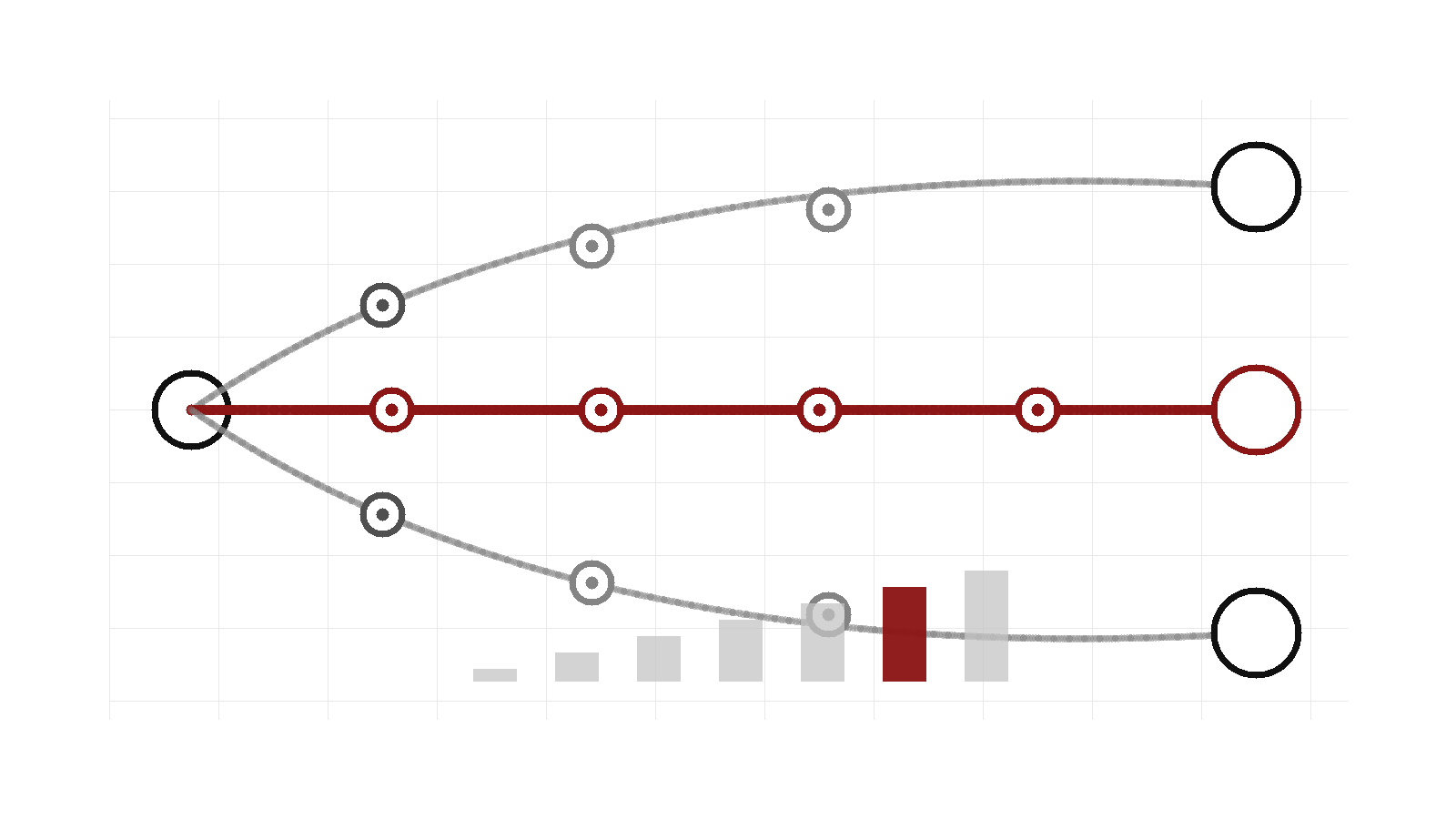
The four routes are:
- Emergency route: interview in 14 days.
- Focused route: interview in 30 days.
- Standard route: eight weeks.
- Deep route: twelve or more weeks.
Each route has a different relationship to coverage. Emergency plans reduce risk. Focused plans restore interview fluency. Standard plans build durable readiness. Deep plans rebuild weak foundations and add specialty depth.
Inputs, outputs, and constraints
A senior preparation plan has explicit constraints:
- Target role and likely interview loop.
- Diagnostic heat map and highest-risk signals.
- Available practice hours per week.
- Required workstreams and optional modules.
- Mock interview cadence.
- Readiness gates for scheduling or delaying loops.
- Maintenance plan for already-green lanes.
Senior-level planning also includes trade-offs. If you have 14 days, you cannot deeply rebuild algorithms, system design, behavioral stories, and role-specific knowledge. You can choose the failure modes most likely to remove you from consideration and practice those deliberately.
Good plans are not heroic. They are executable. They leave room for sleep, job responsibilities, family constraints, and review. Burnout creates interview volatility, which is especially expensive for senior candidates whose communication and judgment are being evaluated.
Workflow and cadence
Use the “route, spine, branch, gate” model.
| Element | Meaning | Example |
|---|---|---|
| Route | Your time horizon. | 14 days, 30 days, 8 weeks, or 12+ weeks. |
| Spine | The mandatory senior signals every candidate must show. | Coding workflow, design trade-offs, project depth, communication. |
| Branch | Role-specific or company-specific preparation. | Frontend performance, SRE incident response, data pipelines, ML systems. |
| Gate | A measurable readiness condition. | Two mocks in a row with no core lane below 3. |
Choose the route from your real calendar, not from ambition. Then choose branches from the target role, not from curiosity. Finally, schedule gates before real interviews whenever possible.
Preparation sequence matters:
- Diagnose.
- Stabilize interview execution.
- Close the highest-risk core signal.
- Add role-specific branches.
- Run mocks.
- Re-score.
- Schedule, delay, or narrow the target list.
Decision points and trade-offs
The routes share a common spine:
- Understand the senior bar and seven signals.
- Practice the response loop: clarify, model, plan, execute, validate, reflect.
- Maintain coding fluency.
- Practice system design with explicit trade-offs.
- Prepare project-depth stories with ownership and metrics.
- Prepare behavioral leadership stories.
- Run mocks and score artifacts.
Route selection guide:
| Situation | Route | Primary objective |
|---|---|---|
| Interview loop is already scheduled within two weeks. | 14-day emergency | Reduce obvious failure risk and rehearse the loop. |
| You have a month and some recent interview experience. | 30-day focused | Restore fluency and close yellow lanes. |
| You have two months and want a serious campaign. | 8-week standard | Build balanced senior readiness with mocks. |
| You are changing domains, returning after a long gap, or targeting a higher bar. | 12-week deep | Rebuild foundations, add specialty depth, and calibrate level. |
Mandatory content by route:
| Route | Mandatory focus | Mock cadence | Branching |
|---|---|---|---|
| 14-day | Diagnostic, coding workflow, system design skeleton, project stories, behavioral leadership, day-of execution. | 2 to 4 total mocks. | Only branches clearly required by the target role. |
| 30-day | Core coding patterns, design trade-offs, production judgment, project depth, behavioral bank. | 1 to 2 mocks per week. | One primary specialty branch. |
| 8-week | Full core path plus repeated mocks and readiness gates. | Weekly, then twice weekly near the end. | One or two specialty branches. |
| 12-week | Core path, weak foundation rebuilding, specialty modules, company calibration, multiple full loops. | Weekly from week 3, full-loop simulations near the end. | Multiple branches if target list requires them. |
Published core and route workstreams:
| Route | Published core | Required workstreams |
|---|---|---|
| 14-day emergency | Chapter 1, Chapter 2, Chapter 3, and Chapter 19. | Coding execution, design skeleton, project-story compression, behavioral leadership, and one target-role branch if it appears directly in the job description. |
| 30-day focused | Emergency route core plus Chapter 6, Chapter 8, Chapter 10, and Chapter 20. | Trade-off practice, testing discipline, production judgment, project evidence, and one primary specialty branch. |
| 8-week standard | 30-day route core plus Chapter 7, Chapter 11, Chapter 13, Chapter 15, and Chapter 18. | Balanced coding, system design, production judgment, project deep dive, behavioral leadership, and one or two specialty branches. |
| 12-week deep | 8-week route core plus Chapter 4, Chapter 5, Chapter 9, Chapter 12, Chapter 14, Chapter 16, and Chapter 17. | Weak foundation rebuilding, specialty depth, company calibration, readiness gates, and repeated full-loop simulations. |
Readiness gates should be behavioral and observable:
- Coding: solve representative prompts with tests and complexity explanation.
- Design: produce a complete 45-minute design including failure, observability, data, and trade-offs.
- Project depth: tell two stories at 8 minutes each and survive probing.
- Behavioral: answer leadership, conflict, failure, and ambiguity prompts without vagueness or blame.
- Communication: summarize, invite correction, and recover from hints.
Worked scenario
Mateo is targeting senior full-stack roles at product companies. His baseline diagnostic:
| Lane | Score |
|---|---|
| Coding fluency | 3 |
| Algorithmic reasoning | 2 |
| Practical engineering | 3 |
| System design | 2 |
| Production judgment | 2 |
| Project depth | 3 |
| Behavioral leadership | 3 |
| Communication | 2 |
He has 30 days before likely technical screens. He can practice 8 hours per week.
A poor plan would be “do 100 algorithm problems and watch design videos.” It ignores communication and production judgment, two visible risks for senior roles.
A better 30-day route:
| Week | Focus | Output |
|---|---|---|
| 1 | Coding workflow and design structure. | Three timed coding drills, one design outline, one recorded project story. |
| 2 | Production-aware design and communication timeboxes. | Two design mocks, one incident drill, transcript review. |
| 3 | Algorithm weak spots and behavioral leadership. | Four targeted algorithm drills, four story-bank answers, one mock coding screen. |
| 4 | Full-loop rehearsal and readiness decision. | One coding mock, one system design mock, one behavioral mock, re-scored heat map. |
His gate before scheduling full onsite loops:
- Coding stays at 3 or better in two timed prompts.
- System design reaches 3 in one external mock.
- Communication score improves to 3: concise summaries and fewer unbounded monologues.
- Production judgment appears in design without interviewer prompting.
If he misses the design and communication gates, he can still take recruiter calls and coding screens, but he should avoid stacking multiple full loops in the same week.
Planning-review scenario: choosing the route
Reviewer: You have four weeks. How did you choose what to prepare?
Candidate: I started from my diagnostic and the target loop. For these senior full-stack roles, I expect coding, system design, project depth, and behavioral rounds. My coding is serviceable, but my system design and communication are the risks. So my plan protects two design mocks and one transcript review each week, while keeping coding warm with timed drills.
Annotation: Strong. The candidate connects route, target loop, and diagnostic risk.
Reviewer: Why not spend most of the time on algorithms?
Candidate: Algorithmic reasoning is yellow, so I am not ignoring it. But my target roles are not algorithm-heavy trading or research roles, and my coding implementation score is already a 3. The bigger senior-level risk is that I design plausible components but do not surface production constraints unless prompted.
Annotation: Senior trade-off. The candidate does not overfit to generic preparation folklore.
Reviewer: What would make you delay interviews?
Candidate: If I cannot complete a 45-minute design with failure modes, data ownership, and observability, I would delay full loops. I would still continue recruiter conversations. The gate is not confidence; it is whether an interviewer can see senior production judgment without dragging it out of me.
Annotation: Strong. The gate is observable and tied to senior signal quality.
Reviewer: How will you handle specialty topics?
Candidate: I will branch only where the job description points. For full-stack product roles, I will add frontend performance, accessibility, API design, and release safety. I will not spend time on deep distributed consensus unless a role clearly requires infrastructure depth.
Annotation: Practical scope control.
Weak, mid-level, and senior route choices
| Prompt | Weak response | Mid-level response | Senior response |
|---|---|---|---|
| “Which path are you taking?” | “The longest one, to be safe.” | “Probably 30 days because that is how much time I have.” | “The 30-day route, because my diagnostic has no red core lane but design and communication are yellow for my target loop.” |
| “What are you cutting?” | “Nothing. I need to cover everything.” | “I will skip some behavioral prep.” | “I am cutting low-probability specialty depth and preserving mocks, coding maintenance, design production drills, and project-story rehearsal.” |
| “How often will you mock?” | “Maybe when I feel ready.” | “Once near the end.” | “Weekly at first, then two in the final week, with a re-score after each mock.” |
| “How will you know you are ready?” | “I will feel less nervous.” | “I will have finished the study list.” | “No target-role core signal below 3, no repeated red flag, and at least one full mock loop that produces senior evidence.” |
Failure modes and red flags
- Choosing the deepest route as a way to avoid scheduling hard practice.
- Choosing the emergency route because you are impatient, not because the interview date requires it.
- Building a plan around content consumption instead of performance artifacts.
- Treating all target roles as if they test the same bar.
- Spending all preparation time on coding when project depth or system design is the real level risk.
- Skipping behavioral preparation because you have many real stories.
- Skipping mocks until the end, leaving no time to change behavior.
- Adding too many specialty branches and starving the core spine.
- Ignoring recovery, sleep, and schedule load.
- Declaring readiness because all chapters were read, not because gates were passed.
Planning defects that reveal poor preparation strategy:
- “I memorized a few architectures” without being able to adapt them.
- “I did not prepare behavioral because I prefer technical interviews.”
- “I can talk about production if they ask” rather than surfacing it naturally.
- “I solved many problems” without evidence of tests, explanation, and recovery.
- “I am targeting anything senior” with no role calibration.
Practice drills
Use these route-selection drills immediately after the baseline diagnostic.
| Drill | Time | Instructions | Output |
|---|---|---|---|
| Route selection | 20 minutes | List interview date, weekly hours, target roles, and diagnostic red/yellow lanes. | One chosen route and reason. |
| Core spine map | 25 minutes | Map each expected interview round to the seven senior signals. | Round-to-signal matrix. |
| Cut list | 15 minutes | Name what you will not study in this route. | Explicit trade-off list. |
| Mock calendar | 20 minutes | Put mocks, drills, and review blocks on the calendar. | Executable schedule. |
| Readiness gates | 20 minutes | Write pass/fail gates for coding, design, project depth, behavioral, and communication. | Observable gate checklist. |
| Branch decision | 15 minutes | Read two target job descriptions and identify role-specific branches. | Branch list with priority. |
| Weekly re-score | 30 minutes | Re-run the weakest diagnostic lane and update the heat map. | Revised priority list. |
Route-specific minimums:
- 14-day route: one coding mock, one design mock, one behavioral/project-depth mock, one day-of rehearsal.
- 30-day route: at least four mocks total, with re-scoring after each.
- 8-week route: at least six mocks, including two full-loop simulations.
- 12-week route: at least eight mocks, specialty branch drills, and a final readiness week.
Readiness gate and self-scoring rubric
Score the preparation plan from 0 to 4 in each category.
| Category | 0 | 2 | 4 |
|---|---|---|---|
| Diagnostic alignment | No diagnostic or ignored results. | Plan references broad weaknesses. | Plan directly targets scored red/yellow lanes. |
| Route realism | Plan exceeds available time. | Plan is possible but crowded. | Plan fits calendar, energy, and interview date. |
| Senior signal coverage | Focuses on one favorite round. | Covers most expected rounds. | Covers every target-role core signal with artifacts. |
| Practice quality | Mostly reading and videos. | Some timed drills and mocks. | Timed drills, mocks, transcripts, review, and re-scoring. |
| Trade-off clarity | Tries to study everything. | Cuts some topics informally. | Explicitly cuts low-probability work to protect high-risk signals. |
| Readiness gates | Based on confidence or completion. | Some measurable goals. | Clear behavioral gates tied to interview evidence. |
| Role calibration | Generic senior prep. | Some job-description awareness. | Branches selected from target role, level, and likely loop. |
Interpretation:
- 0 to 12: The plan is mostly aspiration. Rebuild it from the diagnostic.
- 13 to 20: The plan can work if narrowed and given stronger gates.
- 21 to 25: The plan is usable; schedule mocks and re-score.
- 26 to 28: The plan is strong; focus on execution and calibration.
One-page field reference
Pick the route by constraint:
- 14 days: reduce failure risk.
- 30 days: restore fluency and close yellow lanes.
- 8 weeks: build balanced senior readiness.
- 12+ weeks: rebuild foundations and add specialty depth.
Protect the core spine:
- Coding workflow.
- System design structure.
- Production judgment.
- Project depth.
- Behavioral leadership.
- Communication and recovery.
Add branches only when target roles require them:
- Backend and platform: APIs, storage, distributed systems, reliability.
- Frontend and full-stack: UX constraints, accessibility, performance, state, release safety.
- Infrastructure and SRE: incidents, capacity, observability, automation, risk.
- Data: pipelines, correctness, quality, lineage, backfills.
- ML and AI: evaluation, data, serving, reliability, product risk.
- Security: threat modeling, secure design, incident response, compliance.
Readiness gate: No core target-role signal below 3, no repeated red flag, and at least one mock where senior judgment is visible without heavy prompting.
Weekly review: Re-score one weak lane, update the cut list, and schedule the next mock.