Chapter 19
The Six-Phase Response Loop
A senior-engineer interview operating method for turning ambiguous prompts into structured answers: clarify the objective, model the problem, plan the approach, execute visibly, validate the result, and reflect on trade-offs.
Jump around the book
On this page
What this operating loop controls
Senior interview performance is not only the quality of the final answer. Interviewers are also scoring how you operate while the answer is still incomplete.
They want to know whether you can:
- turn ambiguity into a workable problem statement;
- identify the important model, constraint, or invariant;
- choose a plan before spending time on details;
- execute without losing the thread;
- test your own work instead of waiting to be rescued;
- explain trade-offs and next steps with judgment.
The six-phase response loop gives you a default operating method:
- Clarify.
- Model.
- Plan.
- Execute.
- Validate.
- Reflect.
This structure works across coding, system design, debugging, practical engineering, project deep dives, and behavioral questions. The artifacts change, but the shape of good senior thinking is the same.
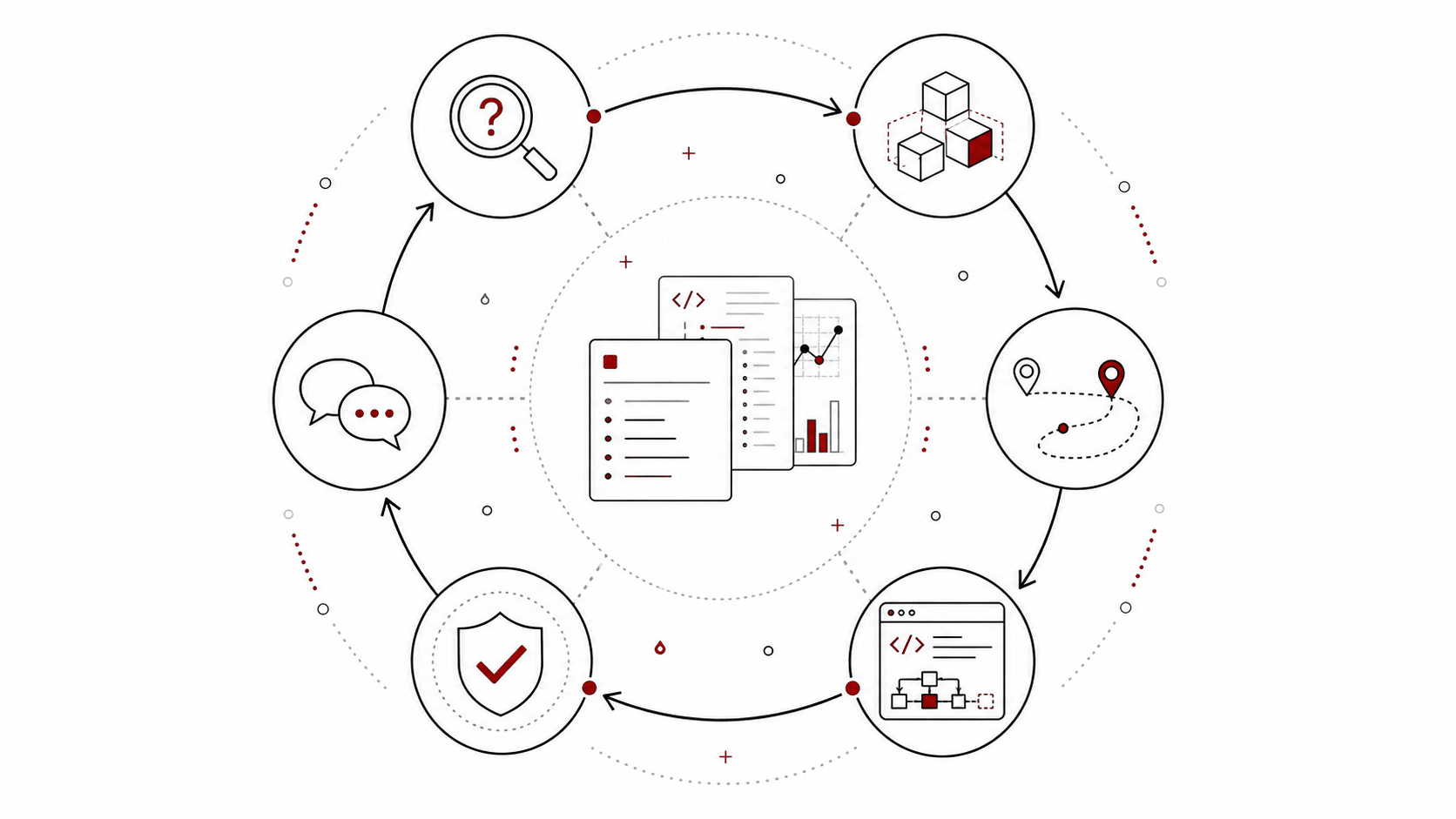
What senior-level performance looks like
A weak candidate jumps directly into execution. They start coding before understanding edge cases, draw architecture boxes before defining users, or answer a behavioral prompt with a story that has no clear stakes.
A mid-level candidate may ask a few questions and then solve competently, but their structure depends heavily on the prompt. If the interviewer changes a constraint, they often restart from scratch.
A senior candidate brings a stable operating rhythm:
- They clarify only the assumptions that affect the solution.
- They build a model that exposes the core difficulty.
- They state a plan and invite correction before investing deeply.
- They execute in increments that the interviewer can follow.
- They validate against examples, constraints, failures, and success criteria.
- They reflect on trade-offs, limitations, and what they would do next.
Senior performance is not rigid. You do not need to say “now I am in phase three.” The loop should feel like disciplined thinking, not theater.
The six-phase operating model
The six phases answer six different questions.
| Phase | Question | Output |
|---|---|---|
| Clarify | What problem are we actually solving? | Requirements, assumptions, boundaries, success criteria. |
| Model | What structure explains the problem? | Data model, invariant, state machine, architecture sketch, story spine, failure hypothesis. |
| Plan | How will I approach it? | Algorithm, design sequence, debugging path, answer outline, trade-off strategy. |
| Execute | Can I produce the artifact? | Code, design, diagnosis, story, analysis, decision. |
| Validate | Does it work under the important cases? | Tests, walkthroughs, edge cases, failure modes, scale checks, evidence checks. |
| Reflect | What are the consequences? | Trade-offs, limits, alternatives, production concerns, lessons, next steps. |
The phases are sequential enough to prevent chaos, but flexible enough for real interviews. You may loop back from validation to execution when a test fails. You may return from execution to modeling when a design reveals a missing state. You may clarify again when the interviewer introduces a new constraint.
That flexibility is part of the signal. Senior engineers do not cling to a plan after the problem changes.
Essential knowledge
Clarify means reduce ambiguity, not postpone work
Clarifying is the first phase because most interview prompts are deliberately underspecified. The goal is to expose requirements that change the solution.
Useful clarification topics include:
- objective: what outcome matters most;
- inputs and outputs;
- users and callers;
- constraints and non-goals;
- scale or data volume;
- latency, reliability, correctness, privacy, and cost expectations;
- failure tolerance;
- success criteria.
The mistake is asking every possible question. Ten unfocused questions can look like avoidance. Two precise questions can show judgment.
For coding:
“Can I assume the input fits in memory, and should I return all matching ranges or just the first one?”
For system design:
“Is the primary goal low-latency reads for end users, or correctness of the processing pipeline after delayed events?”
For behavioral:
“Would you like an example focused on technical disagreement, delivery pressure, or mentoring?”
Good clarification narrows the target and lets you move.
Model the problem before solving it
Modeling is where you name the structure underneath the prompt.
In coding, the model might be:
- sorted intervals;
- graph traversal;
- monotonic stack;
- dynamic programming state;
- sliding window invariant;
- producer-consumer queue;
- tree recursion with return values.
In system design, the model might be:
- users, clients, services, stores, and queues;
- read and write paths;
- data ownership boundaries;
- consistency requirements;
- failure domains;
- state transitions;
- hot paths and cold paths.
In debugging, the model might be:
- expected versus observed behavior;
- recent change surface;
- request lifecycle;
- dependency graph;
- resource saturation path;
- reproduction matrix.
In behavioral answers, the model might be:
- situation, stakes, decision, action, result, reflection;
- conflict participants and constraints;
- ownership boundary;
- trade-off between delivery, quality, and trust.
Modeling prevents random motion. It also gives the interviewer an early chance to redirect you before you spend 20 minutes solving the wrong version of the problem.
Plan before deep execution
The plan is a compact commitment to a direction.
A useful plan includes:
- the approach you will take;
- why it fits the constraints;
- what you will produce first;
- how you will check it;
- where the risky part is.
Coding plan:
“I will sort the intervals by start time, scan once while tracking the current merged range, and append whenever the next interval starts after the current end. After coding, I will test overlap, adjacency, empty input, and unsorted input.”
System design plan:
“I will start with requirements and scale, define the core APIs and data model, sketch a simple design, then deep-dive on ordering, retries, and observability because those are the likely failure points.”
Debugging plan:
“I will first separate whether this is a correctness regression or an infrastructure symptom. I will check reproducibility, correlate with deployments, inspect error distribution by endpoint and region, then narrow to one failing path.”
Behavioral plan:
“I will use an incident example because it shows technical ownership and cross-team communication. The key decision was delaying launch to fix the rollback path.”
Plans should be short. You are asking the interviewer to trust your path, not listening to yourself outline every detail.
Execute in inspectable increments
Execution is where many candidates become either too silent or too noisy. The senior target is inspectable progress.
In coding, write the core structure first, name variables clearly, and keep the interviewer aware of the invariant. Avoid disappearing into syntax for long stretches.
In system design, build from the simplest viable architecture toward deeper concerns. Do not start with a sprawling diagram. Introduce complexity only when a requirement creates it.
In debugging, keep a hypothesis table mentally or visibly:
| Hypothesis | Evidence for | Evidence against | Next check |
|---|---|---|---|
| Recent deploy changed cache key | Errors began after deploy | Only one region affected | Compare old and new request traces. |
| Database saturation | Latency and timeouts rose together | CPU normal | Check lock waits and connection pool metrics. |
In behavioral answers, execute by telling the story with enough technical substance to be scored. A senior behavioral answer should still contain decisions, constraints, and consequences.
Validate before declaring success
Validation is where senior candidates separate themselves from polished guessers.
Coding validation includes:
- simple example;
- edge cases;
- complexity analysis;
- error handling or invalid input if relevant;
- proof sketch or invariant check.
System design validation includes:
- read/write path walkthroughs;
- scale and bottleneck checks;
- failure-mode analysis;
- data consistency review;
- operational visibility;
- security and privacy constraints when relevant.
Debugging validation includes:
- reproduction of the failure;
- evidence that the fix targets the cause, not the symptom;
- regression test or monitor;
- rollback plan;
- post-fix observation window.
Behavioral validation includes:
- result;
- measurable or observable outcome;
- what changed afterward;
- what you learned;
- why your role was material.
Do not wait for the interviewer to ask, “Are you sure?” Build that habit into your answer.
Reflect without weakening the answer
Reflection is not apologizing for imperfection. It is showing judgment after producing a workable answer.
Good reflection names:
- trade-offs;
- limits;
- alternatives;
- production hardening;
- follow-up work;
- lessons learned;
- what would change under different constraints.
Coding reflection:
“This solution is O(n log n) because of sorting. If the intervals arrived already sorted, it would be linear. If this were a streaming input, I would need a different approach or a bounded window assumption.”
System design reflection:
“The design optimizes correctness and replayability over immediate consistency. If the product required sub-second user-visible updates, I would revisit the asynchronous boundary and push more work into the write path.”
Behavioral reflection:
“The part I would repeat is making the risk visible early. The part I would change is involving support sooner, because they understood the customer-facing failure mode better than engineering did.”
Reflection should make the answer stronger. Avoid ending with a list of everything you did not build.
How the loop applies across round types
Coding
Prompt:
“Given a list of time intervals, merge overlapping intervals.”
Senior loop:
| Phase | Candidate behavior |
|---|---|
| Clarify | Asks whether intervals are closed or half-open, whether adjacency counts as overlap, and whether input may be empty. |
| Model | Identifies sorted intervals and a current merged range. |
| Plan | Sort by start, scan once, merge when the next start is within the current end. |
| Execute | Writes clear code with one pass after sorting. |
| Validate | Tests empty input, one interval, overlapping, non-overlapping, nested, and adjacent intervals. |
| Reflect | Notes time and space complexity, and how the solution changes if input is already sorted or streaming. |
The point is not that every interval problem needs ceremony. The point is that the answer reveals control.
System design
Prompt:
“Design a notification system.”
Senior loop:
| Phase | Candidate behavior |
|---|---|
| Clarify | Determines users, channels, delivery guarantees, volume, personalization, compliance, and success criteria. |
| Model | Separates notification creation, preference checks, templating, delivery provider calls, retries, and delivery state. |
| Plan | Starts with core APIs and data model, then deep-dives on retries, idempotency, provider failure, and observability. |
| Execute | Draws a minimal architecture and evolves it based on constraints. |
| Validate | Walks through send, retry, unsubscribe, provider outage, duplicate event, and audit scenarios. |
| Reflect | Explains trade-offs between synchronous and asynchronous delivery, consistency, cost, and operational complexity. |
This structure keeps the design from becoming a pile of fashionable components.
Debugging
Prompt:
“After yesterday’s release, checkout latency doubled and some users see timeouts.”
Senior loop:
| Phase | Candidate behavior |
|---|---|
| Clarify | Asks which users, endpoints, regions, error rates, deploy timing, and rollback status are involved. |
| Model | Builds a request path and change surface: client, API, auth, cart, pricing, payment, database, cache, providers. |
| Plan | Triage impact, compare before/after metrics, isolate by path and region, inspect recent changes, choose rollback or mitigation criteria. |
| Execute | Walks through concrete checks and narrows hypotheses with evidence. |
| Validate | Confirms the cause with traces, reproduces or explains the failure, and verifies mitigation. |
| Reflect | Describes regression tests, monitors, rollout gates, and post-incident changes. |
Debugging interviews reward disciplined narrowing. Guessing the cause early is less impressive than eliminating possibilities cleanly.
Behavioral
Prompt:
“Tell me about a time you disagreed with a technical direction.”
Senior loop:
| Phase | Candidate behavior |
|---|---|
| Clarify | Confirms whether the interviewer wants a peer disagreement, manager disagreement, or cross-team disagreement if the prompt is broad. |
| Model | Frames the situation around stakes, constraints, decision options, people involved, and consequences. |
| Plan | Chooses a story that shows technical judgment and influence, not just conflict. |
| Execute | Tells the story with context, decision, action, trade-offs, result, and personal contribution. |
| Validate | Gives evidence of outcome and whether the decision held up. |
| Reflect | Names what they learned and what they would change. |
The loop prevents behavioral answers from becoming either vague morality tales or unstructured venting.
Worked example
Prompt:
“Design a feature-flag service for a company with web, mobile, and backend services.”
Candidate:
“Before designing, I want to clarify the target. Are flags mainly for gradual rollout and kill switches, or also for long-running product experimentation?”
Interviewer:
“Rollout and kill switches are required. Experimentation would be nice later, but not the main target.”
Candidate:
“Good. I will optimize first for safe rollout, low-latency evaluation, and auditability. I will assume hundreds of services, thousands of flags, and many evaluations per request path, so reads need to be local or cached. Writes can be slower as long as propagation is reliable.”
This is clarify plus model. The candidate has established priorities and started to name constraints.
Candidate:
“My plan is to define the flag model and APIs, sketch the control plane for creating flags, then the evaluation path used by services. After that I will deep-dive on propagation, stale config, and kill-switch behavior.”
This is the plan. It is short and lets the interviewer redirect.
Candidate:
“The core entities are flag, environment, rule, segment, and audit event. The write path goes through an admin API into a strongly consistent store. A publisher emits config changes to regional distribution nodes. SDKs in services keep a local cached snapshot and evaluate flags in-process, so request latency is not tied to the control plane.”
This is execution. The design begins simple but already reflects operational concerns.
Candidate:
“Let me validate the kill-switch path. If payment processing starts failing, an operator disables the risky feature in the admin UI. The write commits, an audit event records who changed it, distribution pushes the new snapshot, and SDKs pick it up within a target like 30 seconds. If the distribution system is down, services continue using the last known good config, but that means kill switches may be delayed. If the product needs a stricter kill-switch guarantee, we need a separate emergency path or shorter polling interval.”
This is validation plus reflection. The candidate found a weakness and framed the trade-off rather than hiding it.
Annotated response-loop transcript
| Transcript | Signal |
|---|---|
| “Can I clarify whether this is optimized for experimentation or operational safety?” | Separates product goals that change the design. |
| “I will assume reads dominate writes and evaluation happens in latency-sensitive paths.” | Models the system around access pattern and consequence. |
| “I will start with a simple control plane and SDK evaluation path, then test failure modes.” | Gives a plan before drawing architecture. |
| “The SDK evaluates locally from a cached snapshot.” | Chooses a concrete mechanism aligned with latency requirements. |
| “If config propagation is delayed, kill switches are not instant.” | Validates against a critical failure mode. |
| “A stricter guarantee changes the design.” | Reflects on trade-offs and avoids overstating the solution. |
Response-loop quality by maturity
| Level | Pattern | Example |
|---|---|---|
| Weak | Starts solving before understanding the prompt. | “I would use Kafka, Redis, Postgres, and Kubernetes. The admin service sends events to all services.” |
| Mid-level | Produces a workable answer but has gaps in validation. | “I would store flags in a database and cache them in Redis. Services query the cache. We can add retries if it fails.” |
| Senior | Frames requirements, chooses mechanisms, validates failure modes, and explains trade-offs. | “Because flag evaluation sits in request paths, I would avoid remote calls during evaluation and use SDK snapshots. The main risk is stale config during emergency rollback, so I would define propagation targets, auditability, and an emergency override path.” |
Failure modes and red flags
Common failure modes:
- asking a long list of unfocused clarification questions;
- treating the first idea as the final answer;
- coding or diagramming for too long without explaining the invariant;
- adding architecture components without requirements;
- skipping tests, failure modes, or examples;
- accepting interviewer corrections defensively;
- reflecting only by listing missing features;
- using the same answer shape for every prompt regardless of constraints.
Red flags for interviewers:
- “I assumed that was obvious” after building the wrong thing;
- no distinction between requirements and implementation preferences;
- no plan for validating correctness;
- no understanding of production consequences;
- behavioral answers with no personal decision or result;
- confidence that does not change when evidence changes.
Timed drills
Use these drills to make the loop automatic.
Six-sentence setup
5 minCoding preflight
8 minSystem design first ten
10 minDebugging hypothesis ladder
10 minBehavioral loop
12 minRecovery practice
10 minSelf-scoring rubric
Score each dimension from 1 to 5.
| Dimension | 1 - Weak | 3 - Usable | 5 - Senior-ready |
|---|---|---|---|
| Clarify | Asks no useful questions or asks too many. | Clarifies some constraints but misses important ones. | Identifies the assumptions that materially change the answer. |
| Model | Jumps into details. | Names a partial structure. | Exposes the core invariant, state, architecture, or story shape. |
| Plan | No visible plan. | Gives a generic path. | States a concise approach, order of work, and validation strategy. |
| Execute | Unstructured or silent. | Produces a workable artifact with some gaps. | Builds incrementally and keeps reasoning inspectable. |
| Validate | Relies on interviewer to find issues. | Checks obvious cases. | Tests important examples, edge cases, failures, and constraints. |
| Reflect | Apologizes or over-explains. | Names some trade-offs. | Explains limits, alternatives, consequences, and next steps clearly. |
A strong senior answer does not need a perfect 5 in every row. It should not have a 1 in any row.
One-page field reference
Field reference
Six-phase response loop
Before any prompt, run the loop:
| Phase | Field question |
|---|---|
| Clarify | What assumption would change the solution if wrong? |
| Model | What structure makes the problem simpler? |
| Plan | What path will I take, and where is the risky part? |
| Execute | What artifact am I producing now? |
| Validate | Which examples, constraints, or failures prove it works? |
| Reflect | What trade-off, limit, or next step should the interviewer hear? |
Use the loop lightly. The goal is not to perform structure. The goal is to make senior engineering judgment visible under interview pressure.