Chapter 10
Choose the Right Role Before Preparing
A role-selection chapter for senior engineers: compare product, platform, backend, full-stack, infrastructure, generalist, specialist, startup, enterprise, hands-on, and quasi-managerial roles before investing preparation time.
Jump around the book
On this page
What this process controls
Choosing the right role before preparing is a senior judgment exercise. You are deciding where your evidence is most likely to match the bar, where your gaps are acceptable, and which interview loops deserve your limited preparation time.
Many candidates prepare as if “senior software engineer” were one job. It is not. A senior backend product role, infrastructure platform role, full-stack startup role, enterprise integration role, machine learning systems role, and tech-lead-shaped internal platform role can all carry the same title while sampling very different evidence.
The wrong target wastes preparation in two directions:
- You overprepare low-probability topics and underprepare the round that actually decides the loop.
- You interview for roles that want a different shape of seniority than the one your experience proves.
The goal is not to make your search narrow for its own sake. The goal is to choose a target cluster clear enough that your resume, recruiter screen, project stories, coding practice, system design practice, and company research point in the same direction.
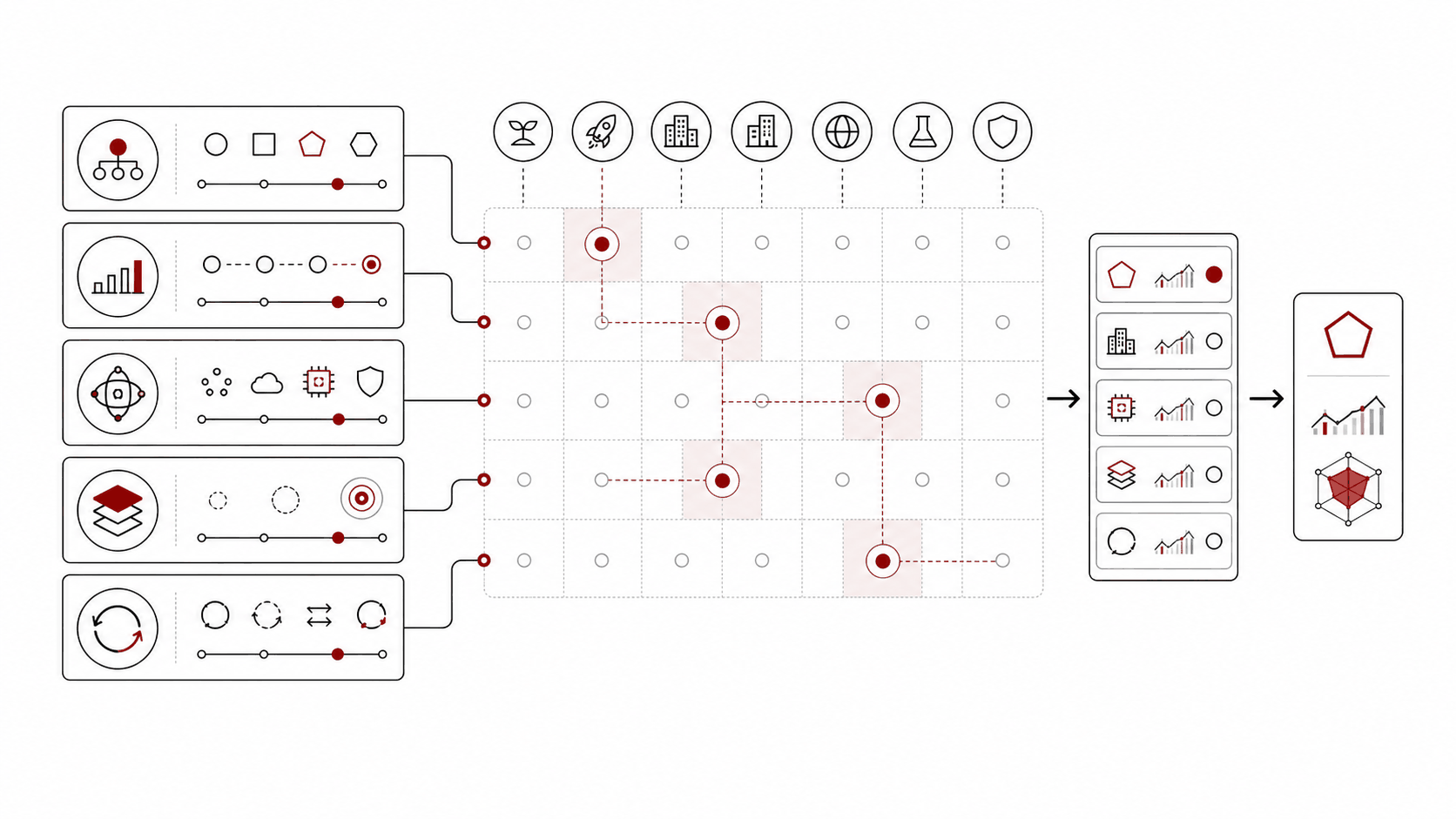
Inputs, outputs, and constraints
A senior candidate can explain why a role is a fit in operational terms, not just preference terms.
Weak targeting sounds like:
“I am open to backend, full-stack, platform, AI, fintech, startups, and big tech. I just want a senior role.”
Senior targeting sounds like:
“My strongest evidence is backend product infrastructure: APIs, migrations, reliability, and cross-team rollout. I can interview for general backend product roles, developer-platform roles close to application teams, and full-stack roles where backend depth matters. I should avoid pure infrastructure roles that expect deep Kubernetes or storage internals unless I have time to prepare that branch.”
Senior-level role choice includes:
- Product versus platform orientation.
- Backend, frontend, full-stack, mobile, data, infrastructure, or specialty depth.
- Application engineering versus systems or runtime engineering.
- Generalist versus specialist hiring.
- Senior versus staff-shaped scope.
- Hands-on IC versus tech-lead or quasi-managerial expectations.
- Startup versus enterprise operating model.
- Domain constraints such as payments, healthcare, security, compliance, AI, developer tools, or consumer scale.
The output is a target role thesis: a short statement that defines where you will apply, how you will position yourself, and which preparation branches matter.
Role-selection workflow and cadence
Use the “role surface, evidence fit, preparation cost” model.
| Lens | Question | Output |
|---|---|---|
| Role surface | What work will this role actually do? | Product, platform, infrastructure, full-stack, specialist, tech-lead-shaped, or domain-specific. |
| Evidence fit | What proof do I already have? | Projects, systems, incidents, migrations, leadership examples, metrics, and artifacts. |
| Preparation cost | What must I learn or rehearse to pass the loop? | Coding patterns, design domains, production topics, behavioral themes, specialty knowledge. |
A role is attractive when the evidence fit is strong and the preparation cost is reasonable for your timeline. A role can still be worth pursuing with a gap, but the gap should be explicit.
Do not ask only, “Would I like this job?” Ask:
- What interview rounds will this company probably run?
- Which senior signals will those rounds emphasize?
- What project stories and technical examples prove those signals?
- What missing knowledge would create a credible red flag?
- Is the role calibrated to senior, staff, tech lead, or manager-shaped expectations?
Decision points and trade-offs
Product roles versus platform roles
Product engineering roles usually emphasize user-facing outcomes, product constraints, delivery judgment, collaboration with product/design, experimentation, and pragmatic trade-offs. System design prompts may involve feeds, notifications, checkout, collaboration tools, messaging, or workflow features.
Platform roles usually emphasize leverage for other engineers or services: APIs, tooling, reliability, developer experience, deployment systems, observability, data infrastructure, service frameworks, or internal platforms. The interview may probe multi-team adoption, migration safety, operability, and long-term maintainability.
Both can be senior. The evidence shape differs.
| Role type | Strong evidence | Common gap |
|---|---|---|
| Product | Customer impact, feature delivery, pragmatic architecture, experimentation, cross-functional trade-offs. | Under-discussing reliability, data quality, or operational ownership. |
| Platform | Internal customer empathy, adoption strategy, migration planning, reliability, technical standards. | Under-discussing product value, prioritization, or usability of developer-facing systems. |
Backend, full-stack, and frontend expectations
Backend roles usually sample API design, data modeling, distributed systems basics, reliability, scaling, async processing, observability, and service ownership.
Full-stack roles vary widely. Some are backend-heavy roles with UI contribution. Others expect strong frontend architecture, product polish, accessibility, client performance, state management, and design collaboration. Do not assume “full-stack” means lighter backend interviews.
Frontend roles at senior level are not only component coding. They may probe rendering performance, accessibility, design systems, data loading, state consistency, experimentation, build tooling, security, and cross-device behavior.
Ask recruiters what the loop emphasizes. If they cannot tell you, infer from the job description, product surface, team name, and required technologies.
Application engineering versus infrastructure engineering
Application engineering usually sits close to product workflows, business logic, user journeys, integration boundaries, and delivery sequencing. Infrastructure engineering sits closer to runtime systems, compute, networking, storage, deployment, reliability, performance, and internal developer workflows.
The risk is crossing the boundary without preparation. A strong application backend engineer may underperform in a pure infrastructure loop if the interview expects deep systems trade-offs. A strong infrastructure engineer may underperform in a product loop if they ignore customer behavior, product sequencing, or UX consequences.
Generalist versus specialist hiring
Generalist senior roles expect broad strength across coding, design, production, collaboration, and learning speed. Specialist roles expect a sharper proof point.
Specialist examples:
- SRE or infrastructure: incident response, SLOs, capacity, automation, reliability, cloud/runtime depth.
- Security: threat modeling, secure design, abuse cases, privacy, incident handling.
- Data engineering: pipelines, correctness, lineage, backfills, orchestration, data quality.
- Machine learning systems: data/model serving boundaries, evaluation, observability, latency, drift, responsible rollout.
- Mobile: release constraints, offline behavior, performance, platform APIs, crash analysis.
Specialist roles punish vague interest. They need credible field evidence or a clear preparation branch.
Senior versus staff-shaped roles
Some postings say “senior” but describe staff-shaped scope: multi-team architecture, broad technical strategy, standards ownership, executive communication, or a mandate to influence several teams. Others say “senior” but expect strong hands-on delivery inside a small team.
Use the signals from Chapter 5 to calibrate altitude. If the role is staff-shaped and your evidence is primarily local senior ownership, you may still apply, but you should expect more project-depth, influence, and architecture probes.
Hands-on versus quasi-managerial roles
Some senior IC roles expect heavy coding. Others expect technical leadership, project sequencing, mentoring, and stakeholder coordination with less individual implementation. Both can be legitimate. Problems arise when the candidate wants one and the role expects the other.
Look for clues:
| Posting language | Likely expectation |
|---|---|
| “Build and own services,” “write production code,” “on-call rotation” | Hands-on senior IC. |
| “Drive technical direction,” “mentor the team,” “coordinate execution” | Tech-lead-shaped senior role. |
| “Partner with product leadership,” “roadmap ownership,” “manage priorities” | Quasi-managerial or lead-heavy role. |
| “Set standards across teams,” “platform strategy,” “technical vision” | Staff-shaped or principal-shaped role. |
Startup versus enterprise scope
Startup senior roles often reward breadth, ambiguity tolerance, product sense, speed, ownership, and willingness to work across boundaries. The interview may value pragmatic trade-offs and evidence of building under incomplete process.
Enterprise and regulated roles often reward reliability, migration discipline, compliance, stakeholder management, operational maturity, documentation, and risk control. The interview may probe governance, scale, integration complexity, data handling, and change management.
Neither is easier. They optimize for different failure modes.
Worked scenario
Nadia is a senior engineer with nine years of experience. Her strongest projects are:
- A billing-service migration with dual writes, reconciliation, and rollback.
- A notification platform that standardized preferences across email and SMS.
- Mentoring two engineers through ownership of service slices.
- Incident response work that reduced checkout provider failure impact.
She is considering four roles:
| Role | Surface | Evidence fit | Preparation cost | Decision |
|---|---|---|---|---|
| Senior Backend Engineer, commerce product team | APIs, payments, reliability, product delivery | Strong | Moderate coding and commerce design practice | Primary target |
| Senior Platform Engineer, developer infrastructure | Internal tooling, CI/CD, service templates | Medium | Needs deeper developer-platform stories | Secondary target |
| Staff Infrastructure Engineer, Kubernetes runtime | Runtime systems, multi-team strategy | Weak-medium | High systems depth and staff-scope gap | Do not prioritize |
| Senior Full-Stack Engineer, design-heavy collaboration app | Frontend architecture, product UX, backend APIs | Medium | Needs frontend performance and accessibility prep | Selective target |
A generic preparation plan would treat all four roles equally. A senior plan chooses a target cluster:
“Primary target: senior backend or product-infrastructure roles in commerce, billing, messaging, or workflow systems. Secondary target: platform roles close to application teams. Avoid pure runtime infrastructure and design-heavy frontend loops this cycle.”
That target cluster changes her preparation:
- System design practice: payments, notification systems, workflow engines, idempotency, consistency, retries, observability.
- Project stories: billing migration, notification platform, checkout incident, mentorship through service ownership.
- Coding practice: backend-friendly data structures, API-oriented practical coding, testing.
- Behavioral themes: ambiguity, cross-team rollout, incident ownership, stakeholder trade-offs.
- Resume positioning: reliability, migration safety, product infrastructure, measurable operational impact.
Nadia is not making herself less ambitious. She is reducing noise so the strongest evidence gets repeated across the campaign.
Recruiter interaction scenario
Recruiter: “What kinds of senior engineering roles are you targeting?”
Candidate: “I am primarily targeting senior backend and product-infrastructure roles. My strongest evidence is API and service ownership in billing, notifications, and checkout reliability. I am also open to platform teams when the platform is close to application developers.”
Annotation: Clear target cluster. The candidate is broad enough for opportunity but narrow enough to be credible.
Recruiter: “Are you open to full-stack?”
Candidate: “Yes, if the role values backend depth and product delivery. I can contribute in React, but I would not position myself as a frontend architecture specialist. If the loop is heavy on accessibility, rendering performance, and design systems, I would want to prepare for that explicitly.”
Annotation: Honest calibration. The candidate does not over-claim.
Recruiter: “This team needs someone who can lead projects. Is that a fit?”
Candidate: “Yes, for senior IC technical leadership. I have led migrations, written design docs, coordinated rollout across teams, and mentored engineers through implementation. I am not looking for a people-manager role where my primary work is staffing and performance management.”
Annotation: Distinguishes technical leadership from management.
Recruiter: “The team is at a startup. Things change quickly.”
Candidate: “That can fit if the role still values production discipline. I am comfortable with ambiguity and incremental delivery, but I would want to understand the on-call expectations, quality bar, and how the team decides which risks are acceptable.”
Annotation: Shows startup flexibility without pretending risk does not matter.
Recruiter: “What would make a role a poor fit?”
Candidate: “A pure infrastructure role requiring deep Kubernetes internals from day one would be a stretch for this search. I can learn that domain, but it is not where my current strongest senior evidence is.”
Annotation: Strong targeting. The candidate names a boundary.
Role-choice contrasts: weak, mid-level, and senior responses
| Prompt | Weak response | Mid-level response | Senior response |
|---|---|---|---|
| “What role are you looking for?” | “Anything senior.” | “Backend roles, mostly.” | “Senior backend/product-infrastructure roles where service ownership, reliability, migrations, and cross-team rollout are central.” |
| “Are you open to platform?” | “Sure, I can do anything.” | “Maybe, depending on the stack.” | “Yes, especially developer platforms close to application teams. Pure runtime infrastructure would require a different preparation branch.” |
| “Are you hands-on?” | “I can lead or code.” | “I still code but also mentor.” | “I want senior IC ownership: design, code, review, rollout, and mentor. I can coordinate projects, but I do not want my primary value to be people management.” |
| “Why this company size?” | “Startups are exciting” or “big companies are stable.” | “I like the product and team.” | “The operating model fits my evidence: I have delivered under ambiguity, but I also bring rollout and reliability discipline the team appears to need.” |
| “What are your gaps?” | “I can learn anything.” | “I may need to brush up on some tools.” | “For frontend-heavy loops, I need focused prep on accessibility and client performance. For infra-heavy loops, I need deeper runtime and capacity examples.” |
Failure modes
- Applying to every senior role with the same resume and same stories.
- Treating title as the role description.
- Ignoring whether the role is product, platform, infrastructure, or specialist.
- Saying “full-stack” while having no credible frontend or product-surface evidence.
- Saying “platform” while having no internal-customer, migration, or adoption examples.
- Pursuing staff-shaped roles without multi-team influence evidence.
- Pursuing lead-heavy roles while wanting only solo implementation.
- Pursuing hands-on roles while every recent story is coordination-only.
- Ignoring startup versus enterprise operating differences.
- Preparing algorithms and generic system design while the role is likely to probe incidents, migrations, data correctness, or domain constraints.
- Over-claiming openness in recruiter screens and then discovering late that the loop is a poor fit.
Interviewer red flags:
- “I am flexible” with no target thesis.
- “I just want to work on interesting problems” with no role evidence.
- “I have used the stack” instead of proving the work shape.
- “I can lead a team” when the role needs a senior IC.
- “I do not care what product it is” for a product engineering role.
Practice actions
Target cluster statement
20 minRole surface matrix
30 minEvidence fit inventory
25 minPreparation cost estimate
20 minRole-fit readiness gate
Score your role targeting from 0 to 4.
| Category | 0 | 2 | 4 |
|---|---|---|---|
| Target clarity | Applies to anything senior. | Has a broad function such as backend or full-stack. | Defines a target cluster with primary, secondary, and excluded roles. |
| Evidence fit | Cannot map projects to target role. | Has some relevant experience but weak positioning. | Can map multiple strong projects to the role’s expected work. |
| Level calibration | Uses title only. | Notices senior versus staff language. | Calibrates scope, authority, hands-on expectations, and leadership shape. |
| Specialty awareness | Ignores domain-specific bars. | Recognizes some specialty topics. | Names likely specialty probes and preparation branches. |
| Operating model fit | Treats startups and enterprises the same. | Has a preference but vague reasoning. | Connects company size, regulation, process, and ambiguity to personal evidence. |
| Recruiter screen readiness | Sounds unfocused or over-flexible. | Can state broad interests. | Can explain fit, boundaries, gaps, and role preferences crisply. |
| Preparation alignment | Generic study plan. | Some role-specific practice. | Preparation branches directly from the target cluster and likely loop. |
Readiness gate: score 21 or higher before beginning a serious application campaign. If target clarity or evidence fit is below 3, rewrite your target thesis before rewriting your resume.
One-page field reference
Field reference
Role targeting checklist
- Do not prepare for “senior software engineer” in the abstract.
- Choose a primary target cluster and a secondary cluster.
- Name roles you will not prioritize this cycle.
- Separate product, platform, application, infrastructure, generalist, and specialist expectations.
- Calibrate senior, staff-shaped, tech-lead-shaped, and manager-shaped scope.
- Decide whether you want hands-on coding, technical leadership, or a quasi-managerial role.
- Match startup, scale-up, enterprise, or regulated environments to your evidence.
- Map every target role to likely interview rounds and senior signals.
- Let role targeting drive resume bullets, story selection, system design practice, and specialty branches.