Chapter 13
The Senior Resume
A practical senior software engineer resume chapter with impact-first bullet construction, before-and-after rewrites, evidence selection, metric discipline, senior positioning, drills, and a self-review rubric.
Jump around the book
On this page
What the senior resume must accomplish
The senior resume is not a biography, a technology inventory, or a list of tickets completed. It is a compressed evidence packet. Its job is to make a recruiter, hiring manager, and interviewer believe that a senior loop is worth scheduling and that your stories are likely to support the target level.
For senior engineers, the resume must answer five questions quickly:
- What kind of senior engineer is this?
- What scope have they owned?
- What technical decisions and systems have they influenced?
- What changed because of their work?
- Is the evidence credible for this role and level?
The resume does not get you hired by itself. It shapes the first version of your hiring packet. It influences recruiter positioning, hiring-manager expectations, project-deep-dive topics, leveling conversations, and sometimes compensation banding.
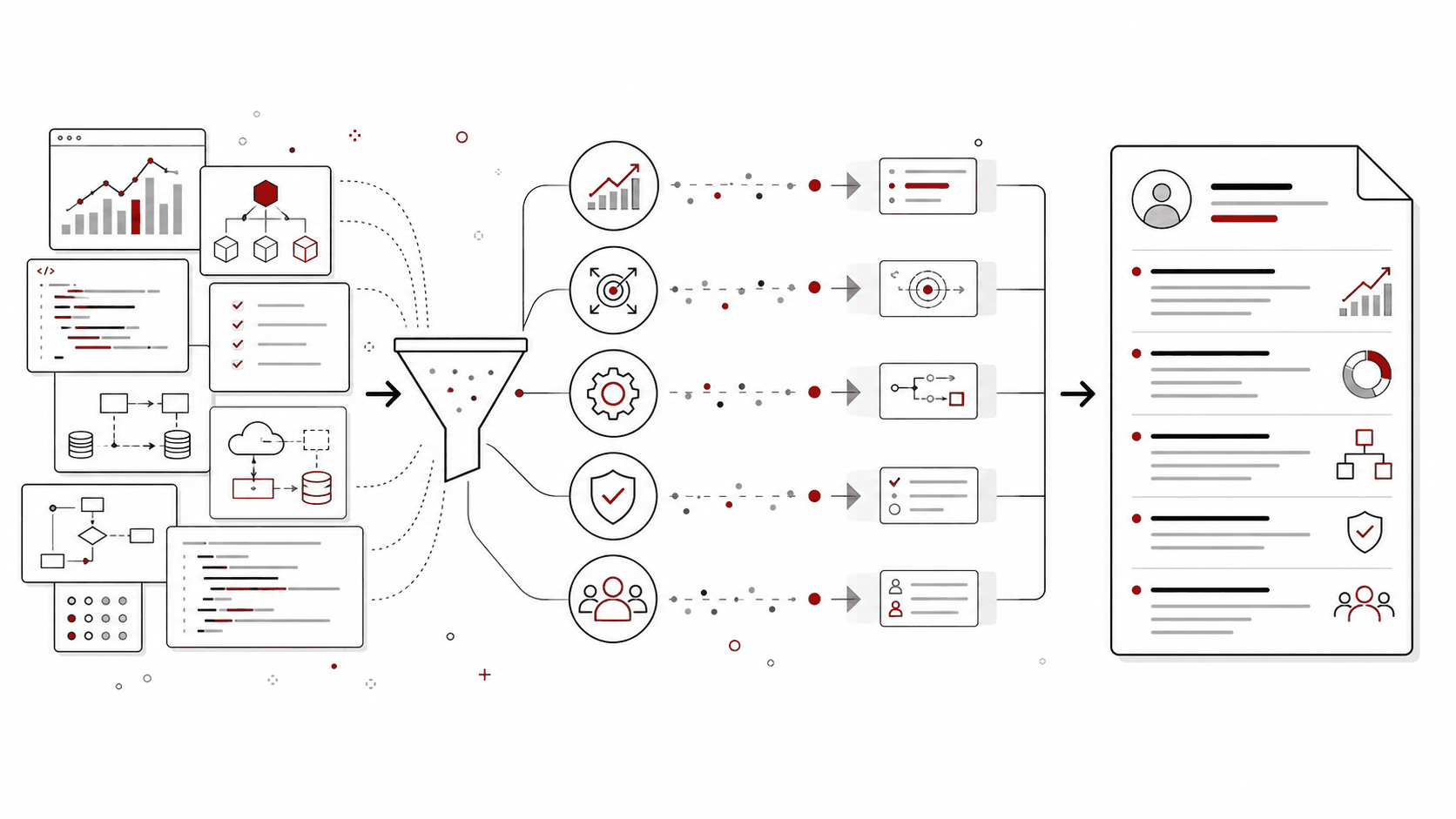
Who reads it and what they infer
A weak senior resume lists responsibilities:
Built APIs, fixed bugs, mentored junior engineers, worked with React, Node, Postgres, AWS, Docker, Kubernetes, Kafka, Redis, Terraform, and Datadog.
A stronger senior resume shows scope, action, trade-off, and result:
Owned the checkout retry redesign for 4M monthly transactions, introducing idempotency keys, provider-specific timeout budgets, and reconciliation dashboards that reduced duplicate-charge support tickets by 71%.
Senior resume evidence usually includes:
- impact-first bullets;
- scope and complexity;
- individual contribution inside team outcomes;
- architecture, migration, reliability, or operational improvements;
- business, customer, reliability, cost, or developer-productivity outcomes;
- credible metrics with baseline or context;
- leadership without inflated claims;
- technology choices only where they clarify the work;
- role-specific positioning based on the target job description.
The resume should create curiosity for the right interviews. A hiring manager should be able to point at a bullet and say, “I want to ask about that migration,” or “This looks relevant to our reliability problem.”
The evidence model
Use the “impact, mechanism, scope, proof” model.
| Element | Question | Example |
|---|---|---|
| Impact | What changed? | Reduced p95 latency, improved deploy safety, lowered incident rate, increased conversion, reduced support load. |
| Mechanism | How did you create the change? | Redesigned data model, introduced idempotency, migrated services, built observability, changed review process. |
| Scope | How large or important was the work? | Critical service, millions of users, multi-team migration, regulated workflow, high-traffic path. |
| Proof | Why should the reader believe it? | Metrics, baseline, time range, named artifact, adoption, operational result, business consequence. |
Not every bullet needs all four elements in full, but your strongest bullets should contain most of them.
Resume structure and selection rules
Start with the target role
Do not write one universal senior resume and send it everywhere. Use Chapter 11 to identify the role’s core competencies, then choose evidence accordingly.
For a backend commerce role, surface:
- payment, billing, or transaction correctness;
- APIs and data modeling;
- reliability and incident response;
- migration safety;
- cross-functional work with finance, risk, support, or product.
For a developer-platform role, surface:
- internal customer adoption;
- migration and tooling leverage;
- reliability of shared systems;
- standards and paved paths;
- developer productivity metrics.
For a frontend platform role, surface:
- architecture of client systems;
- performance and accessibility;
- design-system adoption;
- experimentation and product quality;
- collaboration with design and product.
The same experience can be positioned differently without becoming dishonest. You are choosing the most relevant true evidence.
Write bullets as senior evidence
A useful bullet usually has this shape:
Action + technical mechanism + scope/context + measurable or observable result.
Examples:
- “Led migration” is not enough.
- “Led migration of 18 services from synchronous billing callbacks to event-backed reconciliation, using dual writes and shadow validation to complete rollout with no invoice data loss” is evidence.
- “Improved performance” is not enough.
- “Reduced dashboard p95 load time from 2.8s to 900ms by replacing N+1 account queries with batched reads and cache invalidation tied to role changes” is evidence.
Use verbs that expose judgment:
- designed;
- owned;
- migrated;
- reduced;
- introduced;
- standardized;
- simplified;
- debugged;
- diagnosed;
- decomposed;
- negotiated;
- mentored;
- reviewed;
- rolled out;
- operated.
Avoid vague verbs when they hide contribution:
- helped;
- worked on;
- participated in;
- supported;
- involved in;
- responsible for;
- used.
“Responsible for” can be acceptable in a role summary, but bullets should show what you actually did.
Metrics need context
Metrics are useful when they are credible and relevant. They become weak when they are inflated, context-free, or impossible to attribute.
Good metric patterns:
- baseline to result: “reduced p95 latency from 1.6s to 420ms”;
- frequency change: “cut weekly duplicate-payment tickets to fewer than one per quarter”;
- scale: “served 12M monthly API requests”;
- adoption: “migrated 23 teams to a shared service template”;
- cost: “reduced annual cloud spend by $180K”;
- reliability: “raised successful deploy rate from 91% to 98%”;
- time: “shortened onboarding from three days to four hours.”
Weak metric patterns:
- “improved performance by 500%” with no baseline or measurement;
- “saved millions” with no causal connection;
- “increased productivity” without adoption or time saved;
- “owned a high-scale system” without traffic, users, money, or operational consequence.
If you do not have a metric, use an observable outcome:
- “enabled support to identify stuck renewals without engineering escalation”;
- “allowed three product teams to migrate without changing client contracts”;
- “removed the highest-severity alert from the on-call rotation after six quiet weeks”;
- “made rollback possible without data repair.”
Observable outcomes are better than fake precision.
Scope and complexity must be visible
Senior bullets should make the work’s difficulty legible. Complexity can come from:
- scale;
- correctness;
- security or privacy;
- data migration;
- legacy constraints;
- customer impact;
- operational risk;
- cross-team dependencies;
- product ambiguity;
- compliance or auditability;
- performance or cost pressure.
Compare:
Built notification service.
With:
Designed notification preference service for email and SMS across four product teams, adding consent checks, idempotent sends, and delivery-state visibility that reduced support escalations during campaign launches.
The second bullet shows product surface, multi-team use, compliance-like constraints, idempotency, and support impact.
Individual contribution must be precise
Senior work is collaborative. The resume should not erase the team, but it must identify your contribution.
Good patterns:
- “Owned the data migration plan for…”
- “Designed the API contract and rollout gates for…”
- “Reviewed service-specific adoption plans for…”
- “Paired with two engineers until they independently owned…”
- “Partnered with product and support to define…”
Avoid claiming the entire team outcome when your role was narrow. Also avoid under-claiming real leadership with “helped.”
Technology lists have limited value
Stacks help filtering, but long technology inventories rarely prove seniority. Use technology where it clarifies the mechanism or the role match.
Weak:
Technologies: Java, Kotlin, Go, Python, TypeScript, React, Node, Postgres, MySQL, Redis, Kafka, AWS, GCP, Kubernetes, Docker, Terraform, Datadog, Prometheus, GraphQL.
Stronger:
Backend engineer focused on commerce and product infrastructure: Go/Java services, relational data modeling, event-driven workflows, observability, migrations, and production ownership.
You can still include a concise skills section. Keep it honest, organized, and subordinate to evidence.
Leadership without inflation
Senior resumes often overcorrect into vague leadership language:
- “Drove technical strategy.”
- “Led architecture.”
- “Mentored junior engineers.”
- “Owned roadmap.”
These phrases need proof. A credible leadership bullet includes mechanism and result:
Established API review criteria for a 12-service migration, mentored three engineers through their service plans, and reduced repeated design-review defects from 14 in the first wave to 3 in the final wave.
Leadership is stronger when it shows changed behavior, not just senior-sounding activity.
Resume structure should help scanning
A practical senior resume usually uses:
- name, location or remote eligibility, contact, and relevant links;
- one-line positioning summary or no summary at all;
- selected skills grouped by domain, not a giant pile;
- experience in reverse chronological order;
- three to six bullets per recent role;
- fewer bullets for older roles;
- education and certifications only where relevant;
- optional selected projects, publications, or talks if they support the target role.
Keep formatting conservative. Applicant tracking systems and busy readers reward clarity.
Before-and-after rewrites
Rewrite 1: impact and mechanism
Before:
Worked on improving checkout reliability and reducing payment failures.
After:
Redesigned checkout retry handling with idempotency keys, provider-specific timeout budgets, and reconciliation alerts, reducing failed renewal support tickets by 43% over two quarters.
Why it works: the rewrite names the mechanism, domain, operational controls, metric, and time range.
Rewrite 2: scope and attribution
Before:
Led migration from monolith to microservices.
After:
Owned the order-domain extraction from a Rails monolith into three Go services, designing compatibility APIs and dual-write validation so 11 product teams migrated without customer-visible order-state regressions.
Why it works: “microservices” becomes a specific migration with personal ownership, architecture choices, dependent teams, and correctness outcome.
Rewrite 3: leadership without fluff
Before:
Mentored junior engineers and improved team quality.
After:
Created the team’s service-readiness checklist and coached two engineers through first-time ownership of on-call services; escaped deploy defects dropped from weekly to two in the next quarter.
Why it works: the rewrite shows the artifact, mentoring mechanism, ownership transfer, and quality result.
Rewrite 4: business outcome
Before:
Built reporting dashboard for enterprise customers.
After:
Built self-serve billing reports for enterprise admins, replacing manual finance exports and cutting average support turnaround for invoice disputes from two days to under four hours.
Why it works: the technical work is tied to customer and support impact.
Rewrite 5: credible no-metric outcome
Before:
Improved observability for search service.
After:
Added query-shape dashboards, saturation alerts, and runbook diagnostics for search, allowing on-call engineers to isolate slow-index incidents without paging the owning team.
Why it works: no fake metric, but a concrete operational outcome.
Annotated example: positioning a senior resume
Nadia is targeting senior backend commerce roles. Her original resume summary says:
Senior software engineer with experience in backend development, cloud systems, APIs, databases, microservices, agile, mentoring, and cross-functional collaboration.
This is true but generic. It could describe thousands of candidates.
After deconstructing her target roles, she rewrites it:
Senior backend engineer focused on commerce and product infrastructure: billing migrations, payment reliability, service ownership, relational data modeling, and cross-team rollout.
Original bullets:
- Built billing features in Go and Postgres.
- Worked with product managers and finance team.
- Improved reliability of payment system.
- Mentored engineers on the team.
Rewritten bullets:
- Owned subscription-renewal migration from legacy billing jobs to an event-backed workflow, using dual writes and shadow reconciliation to complete rollout for 1.8M active subscribers without invoice data loss.
- Redesigned payment retry and provider-timeout handling, reducing duplicate-charge support tickets by 71% and giving finance a daily reconciliation dashboard.
- Partnered with product, finance, and support to define customer-visible billing states for failed renewals, cutting manual escalation paths from seven to two.
- Mentored two engineers through ownership of billing service slices by writing design-review templates, pairing on rollout plans, and transferring on-call readiness.
The rewritten version changes the reader’s expectations. The likely project deep dive is now obvious. The system design preparation is clearer. The recruiter can position Nadia as a commerce backend candidate rather than a generic API engineer.
Review workflow: recruiter and hiring-manager critique pass
Use this critique pass after the first rewrite. Read each important bullet through the eyes of the people who will route, screen, and probe it. A good bullet should make role fit easier for the recruiter and create specific, fair follow-up paths for technical interviewers.
Resume bullet:
Reduced API p95 latency from 1.2s to 310ms for the account dashboard by replacing per-widget queries with a batched authorization-aware read model and cache invalidation on role changes.
What a recruiter sees:
Backend performance, measurable impact, probably relevant to API roles.
What a hiring manager sees:
Good. The candidate handled performance without ignoring authorization correctness. I want to ask how they validated cache invalidation and whether this was their design.
What a system design interviewer may probe:
Read models, caching, invalidation, authorization, latency measurement, rollout, and failure modes.
What a project-deep-dive interviewer may probe:
Personal ownership, alternatives considered, user impact, incidents, trade-offs, and what changed afterward.
That is a strong bullet because it creates useful interview paths.
Common weak, mid-level, and senior resume lines
| Intent | Weak line | Mid-level line | Senior line |
|---|---|---|---|
| Performance | “Improved app performance.” | “Reduced load time using caching.” | “Reduced dashboard p95 load time from 2.8s to 900ms by replacing N+1 reads with batched queries and invalidating cache on permission changes.” |
| Migration | “Helped migrate legacy system.” | “Migrated billing service to new architecture.” | “Owned billing migration compatibility layer, dual-write validation, and rollback gates for 14 services, completing cutover without invoice-state regressions.” |
| Reliability | “Added monitoring.” | “Built dashboards and alerts.” | “Introduced SLO dashboards, burn-rate alerts, and deploy rollback checks for checkout, reducing high-severity payment incidents from monthly to one in six months.” |
| Leadership | “Mentored junior developers.” | “Led code reviews and mentored team.” | “Created API design-review rubric and coached three engineers through first service ownership, reducing repeated review defects across the migration wave.” |
| Product impact | “Worked with product on new features.” | “Built enterprise reporting features.” | “Delivered self-serve export workflows for enterprise admins, replacing weekly manual operations and reducing support turnaround for audit requests from days to hours.” |
| Platform | “Built internal tools.” | “Improved developer tooling.” | “Built service-template generator adopted by 9 teams, standardizing health checks, tracing, deploy metadata, and ownership tags for new services.” |
Common defects and red flags
- Opening with a generic summary that hides your strongest evidence.
- Listing every technology you have touched.
- Writing bullets as responsibilities instead of outcomes.
- Using “helped” for work you actually owned.
- Claiming “led” without mechanism or result.
- Using metrics without baseline, time range, or credible attribution.
- Omitting production ownership for senior backend, platform, or infrastructure roles.
- Omitting product or customer outcomes for product engineering roles.
- Failing to separate team outcomes from personal contribution.
- Letting older, less relevant work take space from recent senior evidence.
- Tailoring keywords while leaving the evidence generic.
- Making every bullet sound equally important.
Reader red flags:
- “Responsible for microservices” with no service, decision, or impact.
- “Worked in agile environment” as a senior bullet.
- “Improved scalability” with no bottleneck or measurement.
- “Led architecture” without naming the architecture decision.
- “Mentored team” without showing ownership transfer or changed behavior.
Practice and rewrite exercises
Bullet evidence rewrite
30 minMetric credibility pass
20 minTechnology inventory cut
15 minRole-specific tailoring
25 minProject-deep-dive preview
20 minSelf-review rubric
Score your senior resume from 0 to 4.
| Category | 0 | 2 | 4 |
|---|---|---|---|
| Positioning | Generic senior engineer. | Broad function such as backend or full-stack. | Clear target shape tied to role, domain, and senior evidence. |
| Impact | Lists tasks. | Includes some outcomes. | Shows customer, business, reliability, cost, performance, or developer-productivity impact. |
| Mechanism | Uses vague verbs. | Names some technical work. | Explains architecture, migration, reliability, data, rollout, or operational mechanisms. |
| Scope and complexity | Work sounds small or context-free. | Some scale or complexity appears. | Makes ambiguity, scale, correctness, production, compliance, or cross-team complexity legible. |
| Attribution | Uses vague “we” or “helped.” | Names some ownership. | Separates personal contribution, team outcome, influence, and partner ownership credibly. |
| Metrics | No proof or inflated numbers. | Some metrics without context. | Metrics have baseline, time range, scale, or defensible observable outcomes. |
| Senior leadership | Leadership claims are generic. | Mentions mentoring or leading. | Shows mechanisms, artifacts, adoption, ownership transfer, or changed engineering behavior. |
| Role fit | Same resume for every role. | Light keyword tailoring. | Evidence order and bullet choice match the target job’s competency clusters. |
Readiness gate: score 26 or higher before using the resume for a serious senior campaign. If attribution, mechanism, or role fit is below 3, revise before applying.
One-page field reference
Field reference
Senior resume checklist
- Treat the resume as an evidence packet.
- Lead with the kind of senior engineer you are.
- Prefer impact-first bullets with mechanism, scope, and proof.
- Use credible metrics with baseline, time range, scale, or observable outcome.
- Make architecture, migration, reliability, production ownership, and business impact visible where relevant.
- Name personal contribution without erasing the team.
- Keep technology lists concise and role-relevant.
- Show leadership through artifacts, adoption, mentoring outcomes, standards, or changed behavior.
- Tailor evidence to the target role’s competency clusters.
- Keep only bullets you can defend in a project deep dive.