Chapter 17
Company Research and Interview Intelligence
A repeatable senior-engineer research method for turning public company information, recruiter details, role context, interviewer backgrounds, permitted tools, and logistics into focused interview preparation.
Jump around the book
On this page
What the research brief must accomplish
Company research is not trivia collection. It is preparation for judgment. A senior candidate should understand enough about the product, business, architecture pressures, culture, and current priorities to ask better questions, choose better examples, and frame technical trade-offs in the company’s context.
The goal is not to impress someone by reciting facts from the website. The goal is to build a working model:
- What does the company actually sell or operate?
- Who are the users and customers?
- What constraints likely shape the engineering work?
- What is the role probably being hired to change?
- Which system design domains are most likely?
- What senior signals will this company care about?
- What process, tooling, and logistics can you prepare for?
Good research makes your interview answers more relevant. Bad research produces generic flattery or overconfident guesses.
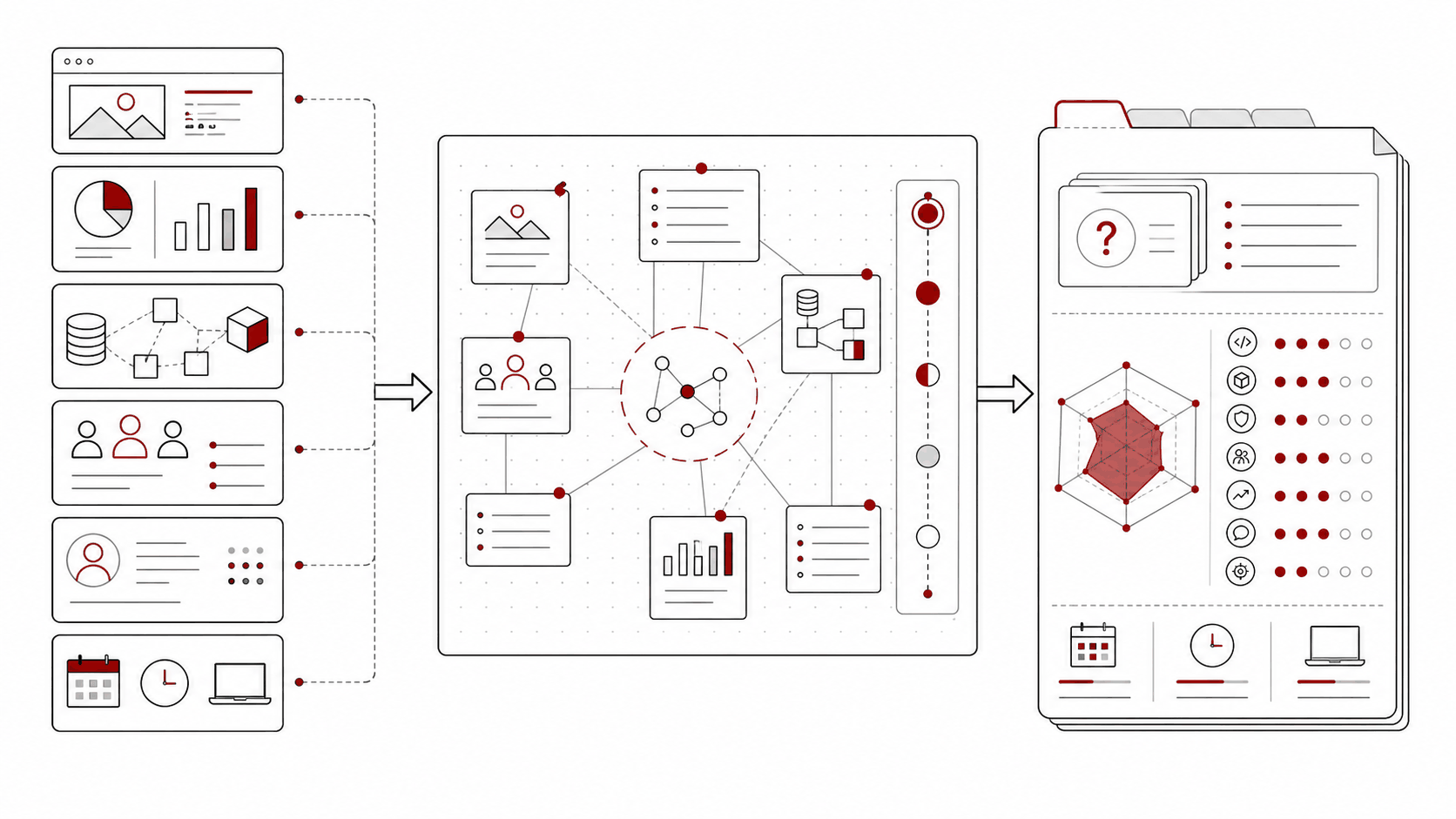
How research changes interview behavior
A weak candidate says:
“I like the mission and the company seems innovative.”
A stronger senior candidate says:
“The product appears to combine workflow depth, data correctness, and customer-facing reliability. The role description emphasizes migration and platform ownership, so I am preparing examples around rollout safety, API boundaries, observability, and cross-team adoption. I would like to understand whether the current priority is scaling usage, improving reliability, or reducing product-team dependency on the platform team.”
Senior research has five properties:
- It separates facts from hypotheses.
- It connects business model to engineering constraints.
- It converts the job description into likely interview domains.
- It produces specific questions for recruiters, hiring managers, and interviewers.
- It respects boundaries: public professional information is fair game; private personal digging is not.
Use Chapter 11 for role deconstruction. This chapter adds the company and loop intelligence around it.
The context-constraints-consequences model
Use the “context, constraints, consequences” model.
| Layer | Question | Interview use |
|---|---|---|
| Context | What does the company build, sell, and prioritize? | Makes motivation and role-fit answers specific. |
| Constraints | What technical, product, regulatory, operational, or organizational forces shape the work? | Improves system design assumptions and project story selection. |
| Consequences | What happens if engineering decisions fail? | Helps you discuss trade-offs in the company’s real risk language. |
Add one more discipline: mark every research item as fact, inference, or question.
| Label | Meaning | Example |
|---|---|---|
| Fact | Publicly stated or recruiter-confirmed. | “The role is on the commerce platform team.” |
| Inference | Reasonable conclusion from facts. | “Payment correctness and reconciliation may matter.” |
| Question | Something to validate. | “Is the immediate pain failed renewals, legacy migration, or launch velocity?” |
This prevents confident nonsense.
Research structure and selection rules
Product research identifies the user and workflow
Start with the product, not the stack.
Answer:
- Who uses the product?
- What job are they trying to complete?
- Is the product self-serve, sales-led, enterprise, marketplace, consumer, developer-facing, internal, or regulated?
- What are the critical workflows?
- Where would latency, reliability, correctness, privacy, or usability failure hurt?
- What integrations or ecosystem dependencies appear central?
For example, a scheduling product is not just calendars. It may involve availability, time zones, notifications, permissions, integrations, billing, enterprise admin, audit logs, and support tooling. Those details affect likely design prompts and project examples.
Business model points to engineering pressure
The business model often tells you what technical trade-offs matter.
| Business model | Likely engineering pressure |
|---|---|
| Consumer advertising | Scale, experimentation, feed quality, privacy, abuse, latency. |
| Subscription SaaS | Multi-tenancy, billing, permissions, integrations, reliability, admin workflows. |
| Marketplace | Matching, trust, payments, fraud, search, ranking, dispute handling. |
| Fintech | Correctness, auditability, idempotency, reconciliation, security, compliance. |
| Developer tools | API design, documentation, reliability, migration paths, backwards compatibility. |
| Enterprise platform | Role-based access, tenancy, compliance, data export, supportability, integrations. |
| Infrastructure | SLOs, capacity, operability, cost, failure isolation, internal adoption. |
| AI product | Evaluation, latency, cost, safety, data governance, model behavior, human review. |
Do not force a system design answer from the business model alone. Use it to choose better assumptions and questions.
Technical footprint is broader than stack
Research the technical footprint through public sources:
- engineering blog posts;
- conference talks;
- open-source repositories;
- job descriptions across related teams;
- docs and API references;
- status pages and incident write-ups;
- architecture talks or podcasts;
- public cloud, data, mobile, web, or infrastructure references;
- security, privacy, compliance, and trust pages.
Look for durable patterns:
| Signal | What it may imply |
|---|---|
| Public APIs and SDKs | Backwards compatibility, developer experience, versioning. |
| Status page and public incidents | Reliability expectations, operational maturity, customer impact. |
| Multiple data roles | Data platform, analytics, experimentation, governance. |
| Security or compliance pages | Access control, auditability, privacy, review process. |
| Heavy mobile hiring | Client release cycles, offline behavior, performance, telemetry. |
| Platform roles across teams | Internal customers, adoption, paved paths, migration work. |
| Many integration roles | Partner APIs, webhooks, identity, supportability. |
Keep this as hypotheses. Public tech signals can be stale.
Engineering culture research predicts behavioral themes
Culture is not the values page alone. Look for how the company describes work:
- design docs, RFCs, or architecture review;
- on-call and incident practices;
- code review norms;
- remote or async practices;
- product-engineering collaboration;
- staff or tech-lead career ladders;
- open-source governance;
- writing culture;
- customer support involvement;
- security and privacy posture.
Convert culture clues into behavioral preparation.
| Culture clue | Prepare a story about |
|---|---|
| Strong writing culture | Design docs, decision records, technical communication. |
| High ownership language | Ambiguity, end-to-end delivery, production responsibility. |
| Customer obsession | Product judgment, support feedback, trade-offs. |
| Platform leverage | Internal adoption, migration, standards, developer experience. |
| Fast experimentation | Metrics, rollout, reversibility, product learning. |
| Regulated domain | Compliance, risk review, auditability, responsible escalation. |
| Remote-first | Async communication, documentation, coordination across time zones. |
Current priorities explain why the role exists
Current priorities may appear in:
- earnings calls or investor materials;
- product launches;
- company blog posts;
- leadership interviews;
- recent acquisitions;
- hiring patterns;
- public roadmap language;
- release notes;
- trust or incident updates.
Ask:
- Is the company scaling a new product?
- Is it modernizing old infrastructure?
- Is it entering a regulated or enterprise market?
- Is it reducing cost?
- Is it recovering from reliability issues?
- Is it expanding internationally?
- Is it adding AI, data, payments, security, or platform capabilities?
Then connect the role to the likely business reason.
Example:
“The company has recently moved upmarket, and the role mentions enterprise admin and audit features. I should prepare examples around permissions, compliance-adjacent workflows, supportability, and cross-functional requirements.”
Role history gives hidden context
Try to learn why the role is open:
- new headcount;
- backfill;
- team growth;
- reorg;
- new product;
- migration or modernization;
- reliability or operational gap;
- staff-plus scope that has been hard to fill;
- replacement after unsuccessful hiring.
Ask the recruiter or hiring manager:
- “Is this a new role or a backfill?”
- “What changed that made this hire important now?”
- “What would success look like after six months?”
- “What has made this role hard to fill?”
- “Which problems are waiting for the person who joins?”
The answers change how you position evidence.
Likely system design domains can be inferred
You cannot know the prompt, but you can identify likely domains to practice.
| Company or role signal | Practice domains |
|---|---|
| Commerce, billing, payments | Checkout, subscriptions, invoices, ledger-ish workflows, reconciliation, idempotency. |
| Messaging or collaboration | Chat, notifications, presence, permissions, search, fanout. |
| Marketplace | Search, ranking, booking, payments, dispute workflows, trust and safety. |
| Developer platform | API gateway, webhooks, SDK delivery, CI/CD, observability, multi-tenant control plane. |
| Data product | Ingestion, streaming, analytics, freshness, backfills, lineage, access control. |
| Media | Upload, transcoding, storage, CDN, recommendations, rights, moderation. |
| Logistics | Routing, inventory, availability, event streams, real-time tracking, external integrations. |
| Security | Identity, authorization, audit logs, detection pipelines, response workflows. |
| AI product | Prompt or model orchestration, evaluation, caching, cost controls, safety review, data privacy. |
Do not memorize one design. Practice the domain constraints and trade-offs.
Interviewer backgrounds are context, not a script
It is fair to review public professional profiles of scheduled interviewers. Keep it respectful and practical.
Look for:
- role and team;
- technical domain;
- likely interview focus;
- public talks or writing;
- tenure at the company;
- whether they are a manager, staff engineer, product partner, or specialist.
Do not overfit. If an interviewer worked on search, they may still ask a general coding question. Use background to prepare relevant questions, not to manipulate the conversation.
Good use:
“I saw that you work on developer platform. I am curious how your team balances paved-road standards with product-team autonomy.”
Bad use:
“I read everything about you and tailored my answer to your last talk.”
Permitted tools and logistics are part of readiness
Confirm:
- video platform;
- shared editor or local IDE;
- language options;
- whether docs are allowed;
- whether notes are allowed;
- whether AI tools are allowed or prohibited;
- whether screen sharing is required;
- time zone and calendar details;
- expected round length;
- breaks between rounds;
- accessibility or accommodation process;
- whether project material may be prepared;
- backup contact if the meeting link fails.
Tool confusion should not consume interview energy.
Review workflow: repeatable research worksheet
Use this once per serious target company.
| Area | Facts | Inferences | Questions |
|---|---|---|---|
| Product | Users, workflows, product surface. | Critical user journeys and failure impact. | Which workflow is most important for this role? |
| Business model | Revenue model, customer type, market. | Engineering trade-offs tied to growth, cost, trust, or compliance. | What business priority drives the hire? |
| Technical footprint | Public stack, APIs, docs, incidents, open source. | Likely architecture constraints. | Which systems would this role own? |
| Engineering culture | Writing, on-call, review, remote, quality practices. | Behavioral themes and operating expectations. | How are technical decisions made? |
| Strategic priorities | Launches, hiring patterns, leadership messages. | Why now. | What changed recently? |
| Role history | New role, backfill, reorg, migration, team growth. | First-six-month problem. | What does success look like? |
| Design domains | Product and role clues. | Likely system design practice areas. | Is the design round domain-specific? |
| Interviewers | Public professional roles. | Likely focus and good questions. | What should I learn from each conversation? |
| Tools/logistics | Editor, IDE, docs, AI policy, schedule. | Prep environment and risk. | What is allowed and what is not? |
Annotated example: turning research into interview intelligence
Omar is interviewing for a senior backend role at a B2B SaaS company that sells workflow automation to finance teams.
Research facts:
- The product supports approvals, audit trails, integrations, and reporting.
- The role mentions platform modernization, enterprise customers, and reliability.
- The company has public docs for APIs and webhooks.
- Several recent roles mention data residency and permissions.
- The recruiter says the loop includes coding, system design, project deep dive, and behavioral.
Inferences:
- Multi-tenancy, permissions, auditability, webhooks, and integration reliability may matter.
- System design may involve workflow orchestration, event delivery, admin permissions, reporting, or integration platforms.
- Project stories involving migrations, correctness, operational ownership, or cross-functional delivery are likely more relevant than generic feature stories.
Questions:
- “Is the role focused on core workflow systems, integration reliability, or platform modernization?”
- “How does the team handle enterprise requirements like audit logs, data access, and permissions?”
- “Will the system design round use a domain close to the product?”
- “What does success look like six months after joining?”
Preparation changes:
- Omar chooses a project deep dive about migrating a workflow engine with compatibility constraints.
- He practices system design prompts around webhook delivery, approval workflows, and audit logging.
- He prepares behavioral stories about stakeholder alignment with finance, support, and security.
- He prepares reverse-interview questions about tenancy, customer escalation, and platform ownership.
Research did its job because it changed his preparation.
Annotated research-to-question conversation
Hiring manager: “Why are you interested in this team?”
Candidate: “The product seems to sit in a space where workflow correctness and customer trust matter. The role description emphasizes platform modernization and enterprise readiness, so I am assuming the work involves more than feature delivery. My background in migrations and reliability-sensitive backend systems looks relevant, but I would like to understand which part of the platform is under the most pressure.”
Annotation: Strong. The candidate distinguishes facts from assumptions and asks a useful question.
Hiring manager: “What do you know about our technical environment?”
Candidate: “Only what is public, so I would treat this as a hypothesis. Your docs suggest APIs and webhooks are central, and several postings mention permissions and data residency. That makes me think integration reliability, tenant isolation, and auditability are important. I would be interested in where the current architecture is working well and where it is limiting the team.”
Annotation: Senior. The candidate avoids pretending to know private architecture.
Interviewer: “Do you have questions for me?”
Candidate: “I saw from the schedule that you work on platform infrastructure. I am curious how the team decides when to build a shared platform capability versus leaving autonomy with product teams. In my last role, that boundary was where most migration risk appeared.”
Annotation: Good use of interviewer background. The question is professional and relevant.
Recruiter: “Any logistics questions before the onsite?”
Candidate: “Yes. Could you confirm whether the coding round allows a local IDE, whether documentation is allowed, and whether AI tools are prohibited? I also want to confirm there is a break between the two technical rounds.”
Annotation: Practical. Tool and schedule clarity reduce avoidable failure.
Common weak, mid-level, and senior research moves
| Need | Weak move | Mid-level move | Senior move |
|---|---|---|---|
| Company interest | Reads the home page and praises the mission. | Knows the product category. | Connects product workflow and business model to likely engineering constraints. |
| Technical prep | Searches for the company’s stack. | Reads engineering blog posts. | Extracts architecture pressures, likely design domains, and questions to validate. |
| Culture prep | Repeats values-page language. | Mentions remote or ownership culture. | Prepares stories matching operating norms: writing, on-call, customer focus, review, or cross-team influence. |
| Role history | Does not ask why role exists. | Asks if the role is new. | Asks what changed, what success means, and what made hiring necessary now. |
| Interviewer research | Ignores interviewers or over-personalizes. | Checks titles. | Uses public professional context to prepare relevant questions without overfitting. |
| Logistics | Assumes tools and format. | Confirms schedule. | Confirms tools, docs, AI policy, breaks, accessibility, and backup plan. |
Common defects and red flags
- Collecting facts without turning them into preparation decisions.
- Reciting company trivia instead of discussing engineering constraints.
- Treating inferences as facts.
- Overfitting to one blog post or one interviewer background.
- Ignoring business model and customer type.
- Researching only the technology stack.
- Missing logistics such as tool policy, time zone, or interview length.
- Using private, personal, or inappropriate information about interviewers.
- Asking questions whose answers are already obvious from the job description.
- Preparing generic system design prompts unrelated to the company’s domain.
Interviewer red flags:
- “I love your mission” with no product or engineering specificity.
- “I saw you use Kubernetes, so I prepared Kubernetes” without role context.
- “I know your architecture” based only on stale public material.
- No questions about the team, role, or first-six-month expectations.
- Surprise at basic logistics that could have been confirmed earlier.
Practice and rewrite exercises
Thirty-minute company brief
30 minSystem design domain map
25 minRole history questions
15 minInterviewer question prep
20 minLogistics checklist
10 minSelf-review rubric
Score your company research from 1 to 5.
| Dimension | 1 - Weak | 3 - Usable | 5 - Senior-ready |
|---|---|---|---|
| Product understanding | Knows only brand or mission. | Understands product category. | Understands users, workflows, failure impact, and product constraints. |
| Business model | Ignored. | Knows customer type. | Connects revenue model and market to engineering pressure. |
| Technical footprint | Stack keyword search. | Reads public engineering material. | Extracts likely architecture constraints and design domains with uncertainty marked. |
| Culture and operating model | Repeats values. | Notices basic norms. | Prepares stories and questions around decision-making, ownership, on-call, writing, review, and collaboration. |
| Role history | Unknown. | Knows new role or backfill. | Understands why now, first-six-month success, and hidden hiring context. |
| Interview intelligence | Generic preparation. | Knows round types. | Maps rounds, interviewer roles, tools, policies, logistics, and likely signals. |
| Research discipline | Confuses guesses with facts. | Some hypotheses marked. | Separates facts, inferences, and questions throughout. |
Readiness gate: score 28 or higher before final rounds. If product understanding or role history is below 4, your answers will likely sound generic.
One-page field reference
Field reference
Company research checklist
- Start with product users and critical workflows.
- Identify the business model and customer type.
- Convert business model into likely engineering pressure.
- Read public engineering material for constraints, not trivia.
- Look for signals in APIs, docs, status pages, open source, incidents, and job postings.
- Research engineering culture through decision-making, on-call, writing, review, and remote norms.
- Identify current strategic priorities and ask why this role exists now.
- Mark every item as fact, inference, or question.
- Infer likely system design domains from product and role clues.
- Use interviewer backgrounds only as professional context.
- Confirm tools, docs, AI policy, timing, breaks, and backup logistics.
- Let research change your project examples, practice prompts, and questions.