Chapter 7
Anatomy of a Modern Interview Loop
Learn what each stage of a modern senior software engineering interview loop is sampling, how rounds connect, and how to prepare without overfitting to a single company's process.
Jump around the book
On this page
Why this concept changes preparation
A modern senior interview loop is a sampling system. Each stage collects a different kind of evidence, and the final decision comes from the pattern across the loop. Understanding that anatomy helps you prepare for the actual evaluation instead of reacting to each calendar invite as a surprise.
The loop may include:
- recruiter screen;
- hiring-manager conversation;
- online assessment;
- coding screen;
- practical coding;
- debugging or code review;
- low-level design;
- system design;
- project deep dive;
- behavioral or values interview;
- product or cross-functional interview;
- executive, founder, or bar-raiser conversation;
- references and background checks.
Not every company runs all of these. Startups may compress the loop into three conversations. Large companies may separate every signal into a dedicated round. Some teams emphasize live coding and system design. Others care heavily about project depth, production judgment, or cross-functional collaboration.
The underlying question is the same: can the company gather enough independent evidence to trust you at the senior level?
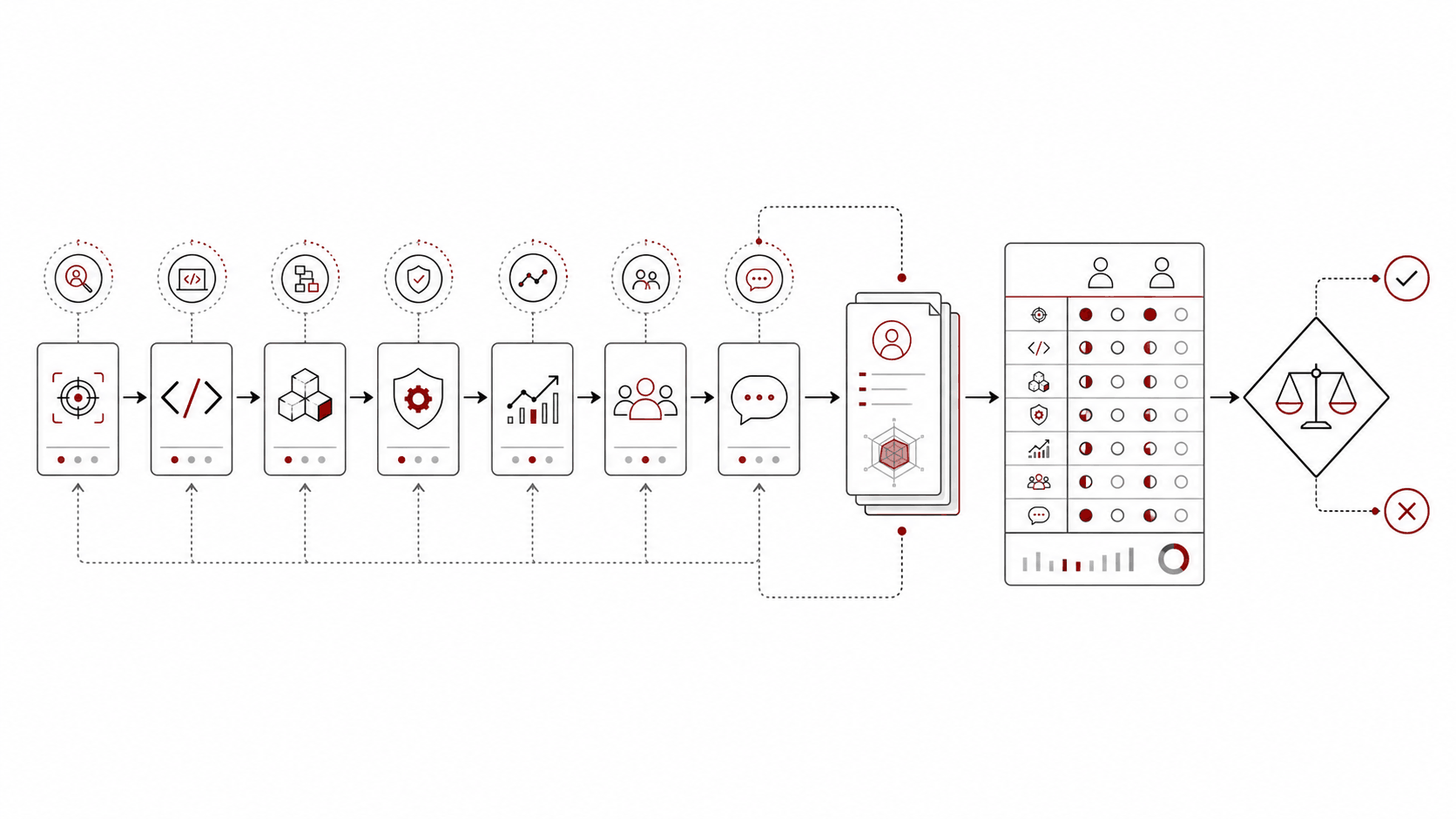
Senior-level loop management
Senior-level candidates manage the loop as a whole. They do not treat the recruiter screen, coding round, and behavioral interview as unrelated performances.
They:
- Ask early what stages are expected and what each round emphasizes.
- Calibrate the target level, team shape, and role responsibilities.
- Prepare evidence for every likely signal, not only the technical rounds they prefer.
- Keep answers consistent across rounds without sounding scripted.
- Use each stage to learn more about the company and adjust preparation.
- Recover from uneven performance by strengthening later rounds rather than spiraling.
- Track what the company has already heard so later answers add depth instead of repetition.
Senior loop management is especially important because senior hiring decisions often involve contradiction. One interviewer may see strong design judgment. Another may worry about coding speed. A hiring manager may love your ownership story. A bar raiser may probe whether the scope is truly senior. Your job is to produce enough coherent evidence that the final discussion has more reasons to hire than reasons to hesitate.
The funnel-sample-debrief model
Use the “funnel, sample, debrief” model.
| Phase | What happens | Candidate objective |
|---|---|---|
| Funnel | Recruiter, hiring manager, resume review, initial screen. | Establish role fit, level plausibility, logistics, and motivation. |
| Sample | Technical and behavioral rounds collect independent evidence. | Make the right senior signals visible in each format. |
| Debrief | Interviewers compare notes, resolve contradictions, and decide hire/no-hire/level. | Leave clear, consistent evidence that survives written feedback. |
The debrief matters even though you are not in the room. Interviewers do not only remember whether they liked you. They write feedback, assign ratings, and advocate for or against the hire. Clear evidence travels better than charm or vague confidence.
Prepare each round with three questions:
- What signal is this round likely to own?
- What evidence would a senior interviewer be able to write down?
- What failure mode would create doubt even if the rest of the loop is strong?
How the model appears across rounds
The loop model is practical only when you can recognize what each stage is likely to own. Use the sections below to decide what evidence to prepare, what risk each round can create, and how later rounds can reinforce earlier signals.
Recruiter screen
The recruiter screen filters for alignment and logistics. It may feel informal, but it can shape leveling and scheduling.
Likely topics:
- role interest and target scope;
- location, work authorization, notice period, and availability;
- compensation expectations;
- current search status;
- high-level experience match;
- interview process and accommodations.
Senior evidence:
- concise career narrative;
- clear target role and level;
- realistic compensation and timeline communication;
- thoughtful questions about the loop and team.
Common risk: sounding unfocused. “I am open to anything senior” is weaker than “I am targeting senior backend or platform roles where I can own service reliability and cross-team migrations.”
Hiring-manager conversation
The hiring manager evaluates role fit, scope, motivation, and likely day-one impact.
Likely topics:
- current and past scope;
- why this role and team;
- project ownership;
- collaboration style;
- strengths, growth areas, and work preferences;
- seniority calibration.
Senior evidence:
- problem-area ownership;
- sound technical judgment;
- clear personal attribution;
- interest in the team’s actual work;
- mature self-assessment.
Common risk: answering only as a technician or only as a coordinator. A senior IC should show both hands-on judgment and influence.
Online assessment
Online assessments are constrained coding samples. They often test correctness, speed, edge cases, and basic algorithmic fluency.
Senior evidence:
- accurate implementation;
- good edge-case handling;
- readable code despite time pressure;
- attention to input constraints.
Common risk: treating the assessment as beneath you. A senior candidate can still be rejected for weak code.
Coding screen
Coding screens test problem framing, implementation, testing, and communication in a live setting.
Senior evidence:
- clarifies constraints before coding;
- starts from a correct approach;
- writes readable code;
- tests representative and edge cases;
- explains complexity;
- recovers from bugs without flailing.
Common risk: silently coding for 25 minutes and leaving the interviewer with no process evidence.
Practical coding, debugging, and code review
These rounds test whether you can work in a codebase, not only solve isolated puzzles.
Likely tasks:
- extend a small application;
- refactor a module;
- debug failing tests;
- review a pull request;
- improve an API;
- reason about maintainability or production risk.
Senior evidence:
- understands existing structure before changing it;
- isolates the issue;
- improves tests;
- makes small, coherent changes;
- explains trade-offs between quick fix and durable fix;
- identifies operational or user impact.
Common risk: rewriting too much. In a practical round, restraint is a senior signal.
Low-level design
Low-level design sits between coding and system design. It tests APIs, object boundaries, data modeling, extensibility, and correctness.
Senior evidence:
- defines responsibilities and interfaces clearly;
- chooses simple abstractions;
- handles edge cases and state transitions;
- discusses testing strategy;
- avoids premature generalization.
Common risk: turning low-level design into either code trivia or a distributed systems lecture.
System design
System design tests architectural judgment under ambiguity.
Senior evidence:
- clarifies product requirements and non-functional requirements;
- estimates scale only where it affects decisions;
- defines APIs, data model, and core flows;
- compares alternatives;
- covers failure, observability, security, cost, and evolution;
- communicates trade-offs at the right altitude.
Common risk: drawing a memorized architecture. Interviewers want your judgment, not a poster of services.
Project deep dive
Project deep dives test whether your real work shows senior-level scope.
Senior evidence:
- clear context and stakes;
- personal decisions and contribution;
- technical depth;
- alternatives considered;
- production and rollout risk;
- impact metrics;
- influence across people or systems;
- specific reflection.
Common risk: using “we” for every important decision. Team humility is good; unscorable attribution is not.
Behavioral or values interview
Behavioral rounds test leadership, influence, ownership, conflict, learning, and fit with the company’s operating norms.
Senior evidence:
- specific stories;
- direct personal agency;
- balanced view of conflict;
- measurable or observable outcomes;
- lessons that changed future behavior.
Common risk: generic answers such as “I communicate early” or “I mentor junior engineers” without proof.
Product or cross-functional interview
Some senior roles include product, customer, support, security, design, data, or operations stakeholders.
Senior evidence:
- understands trade-offs beyond code;
- can discuss customer impact;
- negotiates scope responsibly;
- communicates risk without hiding behind engineering jargon;
- respects partner constraints.
Common risk: acting as if non-engineering concerns are interruptions rather than part of senior ownership.
Executive, founder, or bar-raiser conversation
This round often tests calibration, judgment, motivation, and company-level risk. The interviewer may not go deep on implementation, but they can still identify fuzzy thinking.
Senior evidence:
- crisp career narrative;
- credible interest in the company;
- mature level calibration;
- examples of judgment under ambiguity;
- ability to engage in strategic conversation without losing engineering substance.
Common risk: performing certainty. Senior leaders often trust candidates who can name risks, constraints, and open questions.
References and background checks
References usually validate patterns: ownership, collaboration, scope, reliability, and integrity.
Senior evidence:
- references can describe specific work and impact;
- your self-description matches what others say;
- there are no surprises about role, title, dates, or contribution.
Common risk: choosing references who like you but cannot speak to senior-level engineering evidence.
Examples and counterexamples
Nadia is targeting a Senior Infrastructure Engineer role at a scale-up. The recruiter describes the loop:
- Recruiter screen.
- Hiring-manager conversation.
- Live coding screen.
- Debugging and code review.
- System design.
- Project deep dive.
- Values interview.
Nadia maps the loop:
| Round | Round emphasis | Her preparation artifact |
|---|---|---|
| Recruiter screen | Role fit and communication | 90-second career narrative and compensation boundaries |
| Hiring manager | Scope, motivation, level calibration | Two infrastructure ownership stories |
| Coding | Coding fluency | Timed implementation drills with tests |
| Debugging/code review | Production judgment and practical engineering | Incident-style debugging practice and review checklist |
| System design | Architecture and production judgment | 45-minute design mocks with reliability checkpoints |
| Project deep dive | Senior scope and influence | Migration story with decision log and metrics |
| Values | Leadership and reflection | Story bank for conflict, failure, mentoring, and ambiguity |
Her preparation changes immediately. Without the loop map, she would have spent most of her time on generic algorithm drills. With the map, she keeps coding warm but prioritizes production debugging, reliability-oriented design, and project-depth evidence.
She also plans consistency. Her service migration story appears in the hiring-manager conversation as a short scope example, in the project deep dive as a technical narrative, and in the values round only if asked about conflict or influence. She does not repeat the same answer verbatim. She reuses the same evidence at different levels of detail.
Annotated loop-management conversation
Recruiter: “The process is a recruiter call, a hiring-manager call, one coding round, one system design round, a project deep dive, and a values interview. Any questions?”
Candidate: “Yes. For the system design round, is the team more interested in product architecture, infrastructure reliability, or both?”
Annotation: Good. The candidate asks a question that changes preparation.
Recruiter: “Both, but reliability is important for this team.”
Candidate: “That helps. I will prepare examples around reliability and migrations. For the project deep dive, should I expect to present one project in depth or compare several?”
Annotation: Strong. The candidate is learning the expected evidence shape.
Recruiter: “Usually one in depth.”
Candidate: “Great. I have a service migration that covers design, rollout, incident prevention, and cross-team coordination. I will use that unless the hiring manager points me toward a different area.”
Annotation: Senior. The candidate is planning signal continuity across the loop.
Hiring manager: “Tell me what you are looking for next.”
Candidate: “I am looking for a senior infrastructure role where I can stay hands-on with reliability and platform work while owning ambiguous service boundaries. I am not trying to move into people management right now.”
Annotation: Clear role calibration. It reduces later mismatch risk.
Hiring manager: “Our loop includes a code review round. How recently have you done that kind of work?”
Candidate: “Every week. My review focus is usually correctness, deploy safety, operational visibility, and whether the change creates future migration risk. I can also go deep on API boundaries and tests.”
Annotation: The candidate translates daily work into round-specific evidence.
Loop-management quality by maturity
| Prompt | Weak response | Mid-level response | Senior response |
|---|---|---|---|
| “What do you want to know about the process?” | “Nothing, sounds good.” | “How many rounds are there?” | “Which rounds are live, which signals does each round emphasize, and what senior-level scope is the team calibrating for?” |
| “How will you prepare for this loop?” | “I will practice coding and review system design.” | “I will practice each round type.” | “I will map each round to its primary signal, prepare artifacts for those signals, and keep evidence consistent across conversations.” |
| “Tell me about yourself.” | Long career chronology. | Relevant summary of recent roles. | Concise narrative connecting past scope, senior evidence, and target role. |
| “How do you handle a bad round?” | “I hope the next one goes better.” | “I try to stay calm.” | “I avoid over-correcting. I make the next round’s primary signal clean and, where appropriate, show recovery and reflection without relitigating the previous round.” |
| “Do references matter?” | “Only after the offer.” | “They confirm employment and fit.” | “They validate patterns: ownership, collaboration, judgment, and whether my self-description matches how others experienced my work.” |
Implications for reader decisions and failure modes
- Preparing for a generic loop instead of the actual loop.
- Treating the recruiter screen as administrative only.
- Failing to ask what each round emphasizes.
- Repeating the same project story in every conversation without adapting depth.
- Contradicting yourself across rounds about scope, ownership, or motivation.
- Ignoring practical coding, debugging, or code review because they seem less prestigious than system design.
- Under-preparing behavioral rounds because “the technical rounds matter more.”
- Over-optimizing for one company format and losing general readiness.
- Treating a bar-raiser or founder conversation as casual.
- Choosing references who cannot validate senior engineering behavior.
Interviewer concerns that can emerge from loop pattern:
- strong code but weak collaboration;
- strong strategy but little hands-on detail;
- strong project story but weak current coding fluency;
- strong design vocabulary but weak production ownership;
- strong charisma but inconsistent evidence.
Practice drills
Loop inventory
20 minRound evidence card
30 minStory reuse map
20 minRecruiter question rehearsal
10 minContradiction audit
25 minDiagnostic self-check rubric
Score your loop readiness from 1 to 5.
| Dimension | 1 - Weak | 3 - Competent | 5 - Senior-ready |
|---|---|---|---|
| Process clarity | Does not know the stages. | Knows most stages. | Knows stages, format, timing, tools, and likely signal ownership. |
| Signal mapping | Treats all rounds the same. | Maps obvious technical rounds. | Maps every round to primary and secondary senior signals. |
| Evidence preparation | Relies on improvisation. | Has examples for major rounds. | Has scoreable artifacts for coding, design, projects, leadership, and role fit. |
| Consistency | Stories and claims drift across rounds. | Mostly consistent. | Career narrative, resume, stories, and references reinforce the same senior case. |
| Round adaptation | Repeats answers verbatim. | Adjusts some detail by round. | Changes depth and emphasis while preserving truth and attribution. |
| Recovery | A weak round derails the loop. | Can continue after mistakes. | Recovers by producing clean signal in later rounds without defensiveness. |
| Reverse evaluation | Asks generic questions only. | Learns some team context. | Uses the loop to assess team, scope, engineering culture, and risk. |
Interpretation:
- 7-17: You are likely to be surprised by the loop.
- 18-27: You can proceed, but need stronger signal mapping and artifacts.
- 28-35: You are prepared to manage the loop as a senior candidate.
A one-page field reference
Field reference
Modern loop checklist
- Ask what stages are included, what is live, and what each round emphasizes.
- Map every round to primary and secondary senior signals.
- Prepare a concise career narrative for recruiter and hiring-manager calls.
- Keep coding readiness current even if your strongest evidence is architecture.
- Treat practical coding, debugging, and code review as production judgment rounds.
- Prepare one deep project story and several shorter behavioral stories.
- Use the same evidence consistently, but adjust depth by round.
- Leave interviewers with written-feedback-friendly evidence: decisions, trade-offs, impact, and reflection.
- Choose references who can validate senior ownership, collaboration, and judgment.
- Use the loop to evaluate the company as well as to be evaluated.