Chapter 18
Run the Application as a Campaign
A practical senior-engineer chapter on referrals, recruiter relationships, application tracking, batching interviews, sequencing target companies, limiting simultaneous loops, and preserving preparation time through the offer stage.
Jump around the book
On this page
What this process controls
The application process is an execution problem. Senior candidates often fail it the same way teams fail projects: unclear targets, too much work in progress, weak tracking, poor sequencing, and no protected time for the work that actually matters.
A senior job search should not be a panic spray of resumes. It should be a campaign:
- choose role categories deliberately;
- prioritize target companies;
- use referrals where they improve signal;
- build recruiter relationships professionally;
- track applications, stages, risks, and follow-ups;
- batch interviews without overloading yourself;
- sequence companies so practice and priority are aligned;
- preserve preparation time between technical rounds;
- keep enough pipeline to avoid desperation without creating chaos.
This is delivery judgment applied to your own search.
Inputs, outputs, and constraints
A weak campaign is reactive:
“I applied to 80 roles, forgot which ones replied, scheduled three onsites in one week, and had no time to prepare for the company I wanted most.”
A stronger campaign is controlled:
“I am running three tiers of targets. I warm up with lower-risk loops, keep two to three active technical processes at once, use referrals for priority companies, track leak points in the funnel, and block preparation time before system design and project deep dives.”
Senior-level campaign execution has six properties:
- Clear role thesis from Chapter 10.
- Target company tiers and sequencing.
- Referral and recruiter strategy instead of cold-only volume.
- A simple tracker that drives actions.
- Batching that creates momentum without cognitive overload.
- Regular review of funnel leaks and corrective actions.
The campaign should reduce randomness. It cannot remove rejection, market constraints, or interviewer variance, but it can prevent avoidable self-inflicted failure.
The pipeline-throughput-quality model
Use the “pipeline, throughput, quality” model.
| Lens | Campaign question | Failure if ignored |
|---|---|---|
| Pipeline | Do enough relevant opportunities enter the process? | You depend on one company and negotiate from weakness. |
| Throughput | Are applications, screens, and loops moving at a sustainable pace? | Processes stall or collide. |
| Quality | Are you preserving preparation and targeting enough to perform well? | You get interviews but underperform in the rounds that matter. |
The trap is maximizing one lens. Too much pipeline creates overload. Too much quality control creates no interviews. Too much throughput leaves no preparation time.
Campaign workflow and cadence
Start with target tiers
Do not treat every company the same. Create tiers.
| Tier | Meaning | How to use it |
|---|---|---|
| Tier 1 | Strong fit and high priority. | Use referrals, custom resume pass, company research, careful scheduling. |
| Tier 2 | Good fit, useful opportunity. | Apply with moderate tailoring, prepare seriously if screen converts. |
| Tier 3 | Practice, exploration, or opportunistic fit. | Use for calibration, warm-up loops, and market signal. |
| Exclude | Poor fit or unacceptable constraints. | Do not spend energy unless facts change. |
Tiering is not arrogance. It is resource allocation. Your preparation time is finite.
Referrals improve routing, not competence
A referral can help your application reach the right reviewer and add credibility. It does not replace fit or interview performance.
Good referral request:
Hi Maya, I am applying for the Senior Backend Engineer role on the Commerce Platform team. My recent work in billing migration and payment reliability looks relevant. Would you be comfortable referring me or pointing me to the right recruiter? I can send a two-line summary and resume.
Two-line referral summary:
Senior backend engineer focused on commerce/product infrastructure, including billing migration, payment retry reliability, and production ownership. Interested in the Commerce Platform role because it appears to need hands-on service ownership and migration safety.
Referral etiquette:
- Make the ask specific.
- Provide the role link and a short summary.
- Do not pressure weak contacts.
- Do not ask someone to overstate knowledge of your work.
- Thank them and keep them updated if useful.
- Do not ask for confidential interview content.
Recruiter relationships are long-lived assets
Recruiters remember candidates who are clear, responsive, and professional. They also remember chaos.
Good recruiter hygiene:
- reply promptly;
- state constraints early;
- keep compensation and location consistent;
- update them if another offer accelerates timing;
- decline respectfully when the role is not aligned;
- send short post-call follow-ups;
- avoid disappearing after scheduling.
Useful follow-up:
Thanks for the call. My understanding is that this is a hands-on senior backend role focused on checkout reliability and migration work, remote US is supported, the target compensation band is aligned, and the next step is a 60-minute coding round followed by system design and project deep dive. I am available Tuesday or Thursday afternoon next week.
This reduces miscommunication and gives the recruiter a clean note.
Track the campaign in one place
Use a spreadsheet, database, notes app, or simple table. The tool matters less than the fields.
Minimum tracker:
| Field | Purpose |
|---|---|
| Company and role | Identifies the opportunity. |
| Tier | Controls effort and scheduling priority. |
| Source | Referral, inbound recruiter, outbound recruiter, cold application. |
| Status | Applied, screen, hiring manager, technical, onsite, offer, rejected, paused. |
| Owner/contact | Recruiter, referrer, hiring manager, coordinator. |
| Next action and date | Prevents dropped follow-ups. |
| Role thesis | One line of fit. |
| Compensation/logistics | Band, remote, authorization, notice, constraints. |
| Process | Rounds, tools, policies, timeline. |
| Prep focus | Coding, design domain, project story, behavioral themes. |
| Risks | Level mismatch, compensation gap, scheduling overload, weak evidence. |
| Outcome and lesson | Converts rejection into campaign improvement. |
If you cannot answer “what is my next action?” for each active process, the tracker is not doing its job.
Batch interviews, but do not overload loops
Batching creates momentum. It helps you compare companies, negotiate timelines, and avoid restarting preparation from zero every few weeks. But too many simultaneous loops degrade performance.
Practical limits for most senior candidates:
- two to three active technical loops at once;
- one onsite or final loop per week when possible;
- at least one preparation block before each system design or project deep dive;
- avoid same-day technical rounds at different companies unless there is no alternative;
- avoid stacking your highest-priority company immediately after a draining loop.
If you are employed full-time, the limit may be lower. If you are between roles and have high preparation capacity, the limit may be higher. The principle is the same: active loops consume focus.
Sequence targets deliberately
Bad sequencing:
- first interview in months is your top-choice company;
- all priority companies happen in the same week;
- practice companies are so irrelevant they teach you nothing;
- offer timelines are too far apart to compare.
Better sequencing:
- Warm-up: one or two lower-risk screens or technical rounds to calibrate.
- Core wave: several Tier 2 and selected Tier 1 companies once your narrative and technical rhythm are stable.
- Priority wave: highest-fit companies when preparation, project stories, and process confidence are strongest.
- Offer alignment: coordinate timelines so serious offers can be compared without excessive pressure.
Do not over-engineer. Markets are messy. Sequencing is a steering mechanism, not a guarantee.
Preserve preparation time
Preparation time is part of the campaign budget. Protect it explicitly.
Preparation blocks should cover:
- role-specific resume and narrative pass;
- company research brief;
- coding warm-up in the interview language;
- system design domains likely for the company;
- project deep dive selection and rehearsal;
- behavioral stories aligned to the role;
- logistics and tool setup;
- rest before long loops.
Scheduling rule:
If accepting a slot means you will enter a senior technical round underprepared, ask for a later slot.
Professional phrasing:
I want to give this round the right preparation. Could we schedule it for Thursday or Friday rather than tomorrow? That timing works better on my side and should not slow the process much.
Avoid excessive simultaneous loops
Too many loops produce predictable failure:
- weak company research;
- repeated context switching;
- rushed project deep dives;
- no time to correct coding or design mistakes;
- missed follow-ups;
- fatigue during onsite rounds;
- poor offer negotiation because timelines are chaotic.
Signs you have too much work in progress:
- you cannot explain each active role’s fit in one sentence;
- you forget which process uses which tool;
- you are reusing generic answers across different companies;
- your coding and design practice stops entirely;
- every scheduling email feels urgent;
- you are sleeping less to keep up.
Pause new applications when technical loops need attention.
Decision points and trade-offs in the application funnel
Use this funnel to inspect where the campaign is leaking.
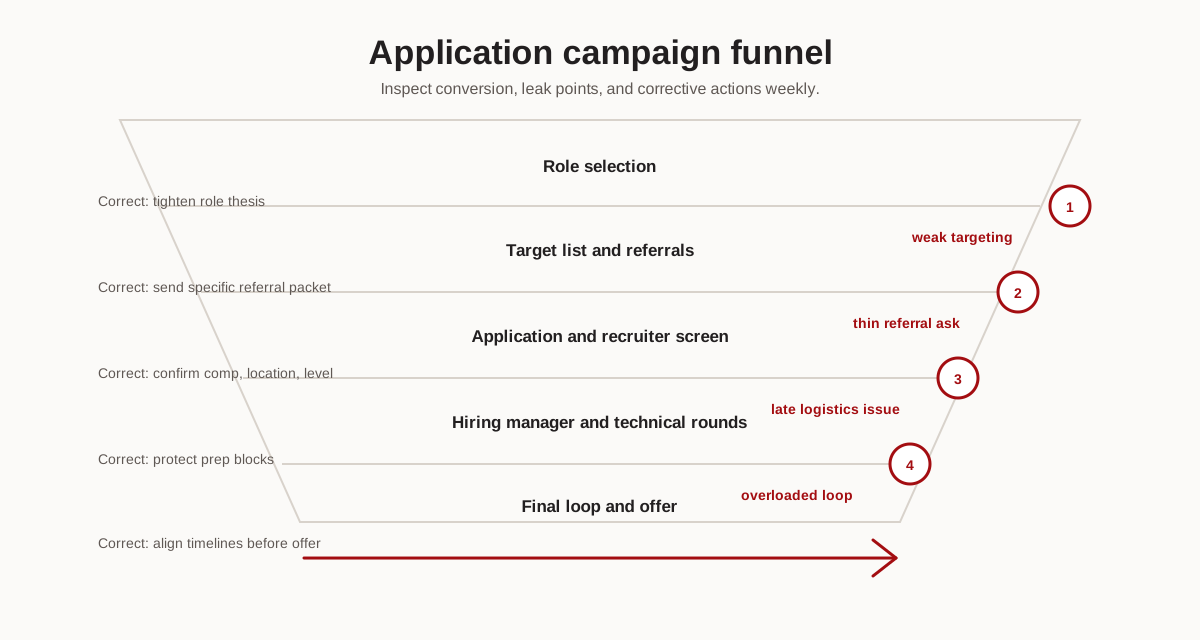
| Funnel stage | Healthy output | Common leak point | Corrective action |
|---|---|---|---|
| Role selection | Clear target role categories and exclusion rules. | Applying to roles that do not match evidence or constraints. | Revisit role thesis, level calibration, and must-have logistics. |
| Target list | Tiered company list with priority and source. | Too many random targets or only dream companies. | Build Tier 1, Tier 2, Tier 3, and exclude lists. |
| Referral or sourcing | Warm paths for priority roles. | Cold-only volume, vague referral asks. | Send specific referral requests with role link and two-line summary. |
| Application | Tailored resume and clean submission. | Generic resume, weak keywords, missing evidence. | Use job deconstruction to reorder bullets and match competency clusters. |
| Recruiter screen | Fit, logistics, level, comp, and process confirmed. | Compensation, location, authorization, or level mismatch discovered late. | Prepare recruiter screen worksheet and ask direct questions. |
| Hiring manager | Role problem and success criteria understood. | Candidate cannot connect background to team need. | Prepare role thesis, first-six-month questions, and evidence anchors. |
| Technical rounds | Coding, design, and project stories match the bar. | Underprepared due to overloaded schedule or generic practice. | Limit active loops, schedule prep blocks, and practice role-specific domains. |
| Final loop | Consistent senior signal across interviewers. | Contradictory narrative, fatigue, weak reverse questions. | Rehearse narrative, project deep dive, behavioral stories, and company questions. |
| Offer | Level, scope, compensation, and team fit are clear. | Timelines do not align or offer is evaluated in isolation. | Communicate timelines early and keep enough pipeline for comparison. |
Review the funnel weekly. Do not only count applications. Count stage conversion and quality.
Worked scenario
Elena is a senior frontend-platform engineer targeting design-system and product-infrastructure roles.
Initial campaign:
- applies to 55 roles in two weeks;
- gets five recruiter screens;
- schedules four technical screens in three days;
- performs poorly in two coding rounds;
- forgets to ask about hybrid requirements;
- discovers late that her top company expects weekly office attendance;
- has no time to prepare a design-system project deep dive.
The problem is not effort. It is campaign design.
Revised campaign:
| Change | Result |
|---|---|
| Defines Tier 1 as remote-first frontend platform or product infrastructure. | Stops spending time on generic frontend feature roles. |
| Uses referrals for six priority companies. | Gets two hiring-manager conversations instead of only cold applications. |
| Limits active technical loops to three. | Preserves coding and system design practice blocks. |
| Sequences two Tier 2 loops before top-choice companies. | Warms up narrative and round mechanics. |
| Adds tracker fields for remote policy and tool format. | Avoids late logistics mismatches. |
| Blocks one project-deep-dive rehearsal before each onsite. | Improves senior signal and consistency. |
After four weeks, she has fewer applications but better loops: two Tier 1 onsites, one Tier 2 final, and clearer evidence about which companies value her platform experience.
Annotated scheduling scenario
Recruiter: “How active is your search right now?”
Candidate: “I am in two active technical loops and speaking with a few teams at the recruiter stage. I am trying to keep the process focused so I can prepare properly for each round. If this role is a strong fit, I can make time next week for a screen and the following week for technical rounds.”
Annotation: Strong. The candidate communicates activity without sounding chaotic.
Recruiter: “Can you interview tomorrow?”
Candidate: “I could make tomorrow work for a short recruiter call. For a technical screen, I would prefer Thursday or Friday so I can prepare the right environment and give the round proper focus.”
Annotation: Good boundary. The candidate protects performance without refusing progress.
Referrer: “What role are you applying for?”
Candidate: “Senior Backend Engineer, Commerce Platform. My relevant background is billing migration, payment retry reliability, and production ownership. I can send the role link and a two-line summary if you are comfortable referring me.”
Annotation: Clear and easy for the referrer to act on.
Hiring manager: “Why this role and not a broader platform role?”
Candidate: “For this search, I am prioritizing roles where platform discipline is close to customer-facing product workflows. I have done broader coordination, but my strongest evidence is hands-on service ownership in reliability-sensitive systems.”
Annotation: Strong campaign focus. The candidate knows what they are optimizing for.
Common weak, mid-level, and senior campaign moves
| Area | Weak move | Mid-level move | Senior move |
|---|---|---|---|
| Applications | Applies everywhere. | Applies to broadly relevant roles. | Builds tiers, exclusion rules, and role-specific positioning. |
| Referrals | Asks “can you refer me?” with no context. | Sends resume and role link. | Sends role link, two-line fit summary, and low-pressure ask. |
| Recruiters | Treats each conversation as isolated. | Replies and schedules. | Builds consistent relationships with clear constraints and follow-up notes. |
| Tracking | Uses inbox memory. | Tracks company and status. | Tracks source, tier, stage, next action, process, prep focus, risks, and lessons. |
| Batching | Takes every available slot. | Groups interviews by week. | Limits active loops and protects prep blocks before high-signal rounds. |
| Sequencing | Starts with top company. | Mixes companies randomly. | Warms up, then runs priority companies when readiness is strongest. |
| Prep time | Prepares only after scheduling. | Does general practice. | Reserves role-specific practice, research, project deep dives, and rest. |
Failure modes and red flags
- Measuring campaign health by application count alone.
- Applying to roles with obvious level, location, or compensation mismatch.
- Depending on one dream company.
- Running too many simultaneous loops and degrading performance.
- Asking for referrals without making the fit easy to understand.
- Forgetting follow-ups, recruiter names, round formats, or tool policies.
- Letting urgent scheduling consume preparation time.
- Reusing the same narrative for roles with different scope.
- Ignoring rejection patterns instead of fixing the funnel leak.
- Taking late-stage interviews before clarifying compensation and logistics.
Campaign red flags:
- Many applications, few recruiter screens: targeting, resume, or referral problem.
- Many screens, few hiring-manager calls: role alignment, compensation, logistics, or narrative problem.
- Many technical screens, few onsites: coding, design, or process performance problem.
- Many onsites, no offers: leveling, project depth, behavioral consistency, or role-fit problem.
- Offers but poor fit: targeting and reverse-interview problem.
Practice actions
Target tiering
30 minReferral packet
20 minCampaign tracker setup
25 minLoop load audit
15 minFunnel leak review
20 minTracker and readiness gate
Score your application campaign from 1 to 5.
| Dimension | 1 - Weak | 3 - Usable | 5 - Senior-ready |
|---|---|---|---|
| Targeting | Random or title-based. | Broad role category. | Clear tiers, exclusion rules, and role thesis. |
| Referral strategy | No referrals or vague asks. | Uses referrals occasionally. | Uses specific, low-friction referral packets for priority roles. |
| Recruiter management | Reactive or inconsistent. | Responds and schedules. | Keeps constraints, timeline, and follow-ups clear across relationships. |
| Tracking | Inbox memory. | Basic status list. | Tracker drives next actions, prep focus, risks, and lessons. |
| Batching | Too many or too few active loops. | Some scheduling control. | Sustainable work in progress with protected preparation time. |
| Sequencing | Priority companies happen by chance. | Some warm-up before major loops. | Deliberate warm-up, core wave, priority wave, and offer alignment. |
| Funnel improvement | Repeats the same mistakes. | Notices rejection patterns. | Diagnoses leaks and changes targeting, resume, narrative, or preparation. |
Readiness gate: score 28 or higher before scaling applications. If tracking or batching is below 4, add process control before adding more companies.
One-page field reference
Field reference
Application campaign checklist
- Optimize for high-quality loops, not maximum applications.
- Define target role categories and exclusion rules.
- Tier companies into priority, good fit, practice, and exclude.
- Use referrals for priority roles with a role link and two-line fit summary.
- Treat recruiter relationships as long-lived professional relationships.
- Track company, role, tier, source, stage, contact, next action, process, prep focus, risks, and outcome.
- Keep two to three active technical loops unless your schedule clearly supports more.
- Sequence warm-up, core wave, priority wave, and offer alignment.
- Preserve preparation blocks before coding, system design, project deep dive, and final loops.
- Pause new applications when active loops threaten preparation quality.
- Review funnel leaks weekly and change one thing at a time.