Chapter 8
How Interviewers Score Candidates
Learn how senior engineering interviewers turn observed behavior into ratings, how debriefs and hiring committees resolve conflicting signals, and how to produce evidence that survives the scoring process.
Jump around the book
On this page
Why this concept changes preparation
Interview scoring converts observed performance into credible written evidence. That is different from whether an interviewer enjoyed the conversation, found you smart, or believed you probably know the material.
Most companies use some combination of competency rubrics, anchored ratings, independent feedback, debrief discussion, hiring committee review, and leveling calibration. The names vary, but the underlying question is stable:
What did the candidate do or say that proves they can operate at the target level?
This chapter matters because candidates often optimize for the wrong audience. They try to impress the person in the room, but the final decision may be made later by people reading notes, comparing ratings, and asking whether the evidence meets the senior bar.
Your goal is not to manipulate the scorecard. Your goal is to make your real senior evidence easy to observe, quote, compare, and defend.
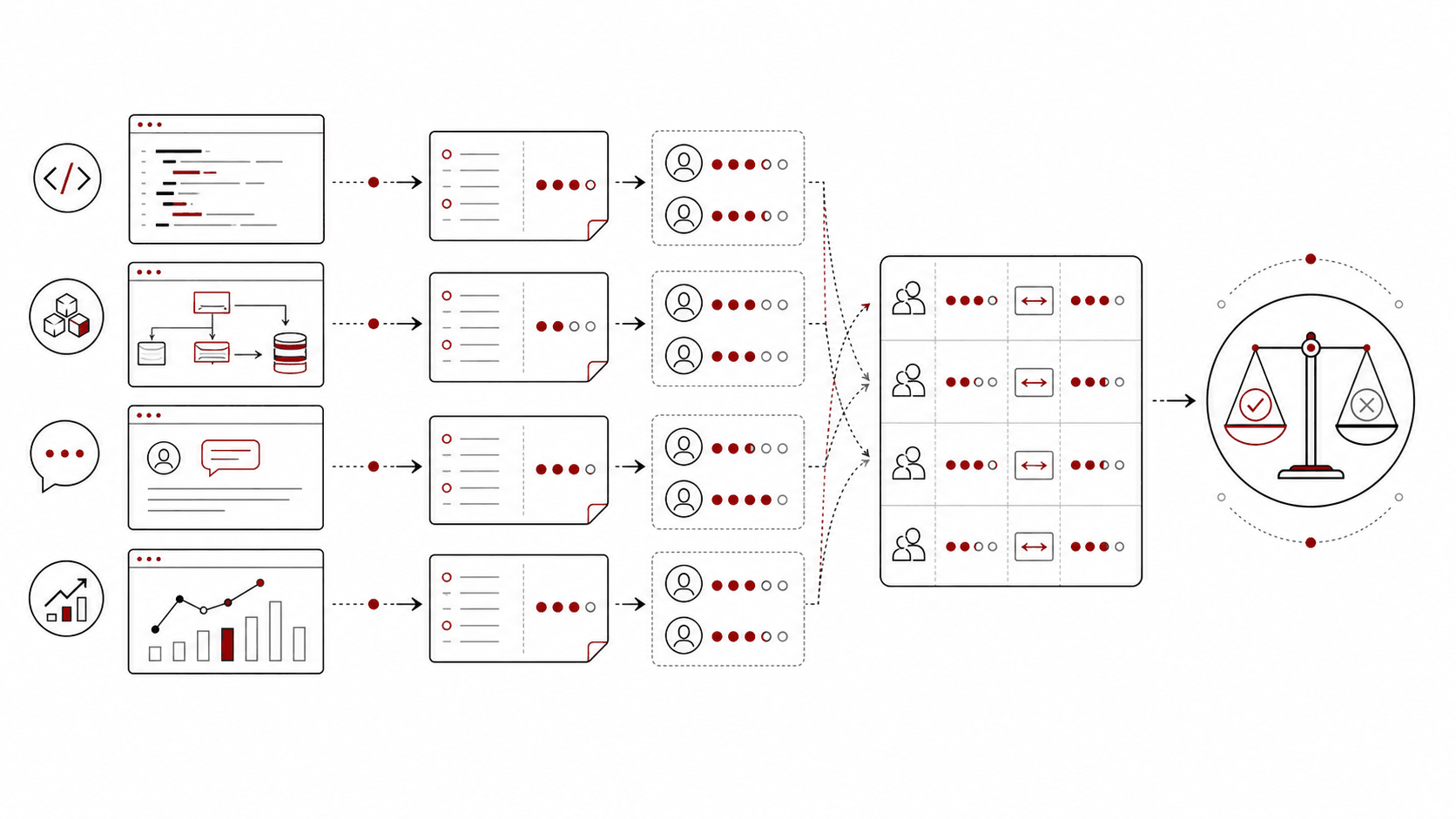
Senior-level score awareness
Senior-level candidates understand scoring without becoming mechanical. They know that interviewers need evidence in four forms:
- Behavior: what you did in the round.
- Reasoning: why you made a decision.
- Artifact: code, design, story, test, trade-off, or plan.
- Level signal: why the artifact meets senior expectations rather than mid-level expectations.
For example, “candidate discussed caching” is weak evidence. “Candidate rejected cache-as-source-of-truth because stale entitlement data could grant unauthorized access; chose database authority with short-lived cache and explicit invalidation on role change” is stronger evidence. It gives behavior, reasoning, artifact, and level signal.
Senior candidates also avoid leaving the interviewer to infer too much. If you made a trade-off, name it. If you accepted risk, bound it. If you owned a project, specify your contribution. If you learned from a failure, state what changed afterward.
The interviewer scoring model
Use the “observation, anchor, decision” model.
| Step | What happens | Candidate implication |
|---|---|---|
| Observation | Interviewer records what you did, said, built, or failed to address. | Make important reasoning visible. |
| Anchor | Interviewer maps evidence to a rubric or level expectation. | Show senior-level scope, judgment, and independence. |
| Decision | Interviewers combine ratings into hire/no-hire and level recommendation. | Produce consistent evidence across the loop. |
The scoring process is not purely mathematical. A single excellent rating may not overcome a severe red flag. A mild weakness may be acceptable if other rounds produce strong adjacent evidence. Contradictions are discussed. Level is debated. Interviewers ask whether the candidate’s evidence is strong enough, current enough, and relevant to the role.
That means the best preparation is not “learn what words score points.” It is “practice producing unambiguous evidence under the conditions each round creates.”
How scoring appears across rounds
Scoring is not a single hidden number. Each round creates written evidence around a few owned signals, and the final decision depends on whether those notes support the target level.
Competency rubrics
A competency rubric defines the behaviors expected for a skill or level. For senior engineers, rubrics often include:
- problem decomposition;
- coding correctness and maintainability;
- system design trade-offs;
- production and operational awareness;
- ownership and impact;
- collaboration and influence;
- communication and learning.
Rubrics protect against pure gut feel, but they do not remove judgment. Interviewers still decide whether your example is deep enough, current enough, and personally attributable enough.
Anchored ratings
Anchored ratings attach meaning to scores. A simplified scale might look like this:
| Rating | Meaning |
|---|---|
| Strong no hire | Evidence shows major risk for the level or role. |
| No hire | Evidence is below the expected bar. |
| Lean no hire | Some useful evidence, but unresolved concerns remain. |
| Lean hire | Meets the bar with some reservations. |
| Hire | Clear evidence for the role and level. |
| Strong hire | Evidence is unusually strong or raises level confidence. |
The exact labels vary. What matters is the anchor. “Hire” is not “nice conversation.” It means the interviewer can defend the rating with evidence.
Independent interviewer feedback
Many companies ask interviewers to submit written feedback before discussing the candidate. This reduces groupthink and preserves independent signal ownership.
Implication for candidates: each round must stand on its own. Do not assume one interviewer will explain your strengths to another. If the coding interviewer did not see tests, the system design interviewer cannot usually fix that gap.
Signal ownership
Some rounds own specific signals. A coding interviewer may be responsible for coding fluency. A system design interviewer may own architecture and production judgment. A hiring manager may own role fit and scope. A behavioral interviewer may own leadership and values evidence.
Implication for candidates: do not bury critical evidence in the wrong round. You can mention leadership during coding if relevant, but you still need clean code. You can mention architecture in a behavioral story, but your system design round must still show architectural judgment.
Debriefs
A debrief is where interviewers compare evidence. They may discuss:
- rating differences;
- repeated strengths;
- repeated concerns;
- whether a weak round was an outlier;
- whether the candidate fits the target level;
- whether the role has enough support for the candidate’s gaps;
- whether to reject, hire, down-level, or gather more signal.
Debriefs are evidence negotiations. Specific examples travel well. Vague impressions do not.
Hiring committees
Larger organizations may route packets to a hiring committee. The committee may include people who never met you. They review feedback, resume, level recommendation, and sometimes compensation or team match context.
Implication for candidates: your evidence must survive secondhand reading. Clear project metrics, precise ownership, and concrete trade-offs are easier to defend than personality impressions.
Leveling discussions
Senior candidates are often evaluated on both hire/no-hire and level. A company may believe you are hireable but not at the advertised level. Or it may believe you show senior scope but not staff scope.
Leveling evidence includes:
- ambiguity handled;
- scope and complexity;
- decision authority;
- production ownership;
- cross-team influence;
- impact;
- independence;
- ability to raise others’ effectiveness.
The same story can score differently depending on how you present it. “I built the billing retry worker” sounds narrower than “I owned the retry redesign for recurring payments, including idempotency, finance reconciliation, rollout, and support-state changes.”
Strong-hire versus weak-hire evidence
Strong-hire evidence is specific, role-relevant, and hard to dismiss:
- working code with thoughtful tests and clear complexity;
- design trade-offs tied to requirements and failure modes;
- project stories with personal decisions, metrics, and reflection;
- behavioral examples showing influence without blame;
- calm recovery after challenge.
Weak-hire evidence may be positive but thin:
- good conversation but few artifacts;
- familiar vocabulary without decisions;
- team outcomes without attribution;
- design that works only on the happy path;
- leadership claims without conflict, cost, or consequence.
Contradictory signals
Contradiction is common in senior loops:
- strong project depth, weak live coding;
- strong coding, weak system design;
- strong architecture, weak production judgment;
- strong communication, vague personal ownership;
- strong leadership, unclear hands-on engineering.
Interviewers ask whether the contradiction is explainable, role-relevant, and risky. A senior backend role may tolerate less frontend depth. It may not tolerate poor production judgment. A platform role may tolerate moderate algorithm rust. It may not tolerate weak debugging or operational reasoning.
Examples and counterexamples
Consider two candidates in a system design round for a feature flag platform.
Candidate A gives a polished architecture:
- API service;
- database;
- cache;
- SDK;
- event stream;
- dashboard;
- metrics.
They speak confidently and move quickly. But they do not ask about evaluation latency, consistency, blast radius, audit requirements, targeting complexity, or rollback. When asked about failure, they say, “We can add monitoring and retries.”
Possible feedback:
Candidate produced a plausible high-level architecture but did not clarify key requirements before choosing components. Production discussion remained generic. Concern for senior level: limited treatment of consistency, blast radius, auditability, and operational failure.
Candidate B starts slower:
“Before choosing storage, I want to separate control-plane writes from SDK evaluation reads. A feature flag outage can either block releases or break runtime behavior, so I need to know latency, default behavior, and consistency expectations.”
They design a control plane, evaluation data model, SDK cache, streaming updates, fallback behavior, audit log, and staged rollout. They compare strongly consistent reads against local evaluation, explain stale flag risk, and define metrics for propagation delay and evaluation errors.
Possible feedback:
Candidate framed control-plane versus data-plane requirements clearly, identified latency and consistency trade-offs, designed local SDK evaluation with bounded staleness, and discussed fallback behavior, auditability, propagation metrics, and rollout risk. Strong senior signal in architecture and production judgment.
The difference is not that Candidate B used more components. The difference is that Candidate B produced scoreable reasoning.
Annotated scoring conversation
Interviewer: “How do you think interviewers score a senior candidate?”
Candidate: “They score observable evidence against the role. In a coding round, that is not just whether I know the pattern; it is whether I clarify constraints, produce correct code, test it, and explain complexity. In a project round, it is whether my work shows senior scope, judgment, impact, and attribution.”
Annotation: Strong. The candidate understands evidence by round.
Interviewer: “What do you mean by attribution?”
Candidate: “If I say ‘we migrated billing,’ that is not enough. I need to identify what I owned, such as the idempotency model, rollback criteria, or reconciliation plan, and what others owned. Precise attribution is more credible than claiming the whole result.”
Annotation: Senior. The candidate knows how scorecards treat team stories.
Interviewer: “What if one interviewer gives a weak rating?”
Candidate: “It depends on the concern. If the weak rating is coding correctness for a hands-on role, that is serious. If it is a narrower concern, like not knowing a specific tool, other rounds may offset it if they show strong fundamentals. I would not assume one strong round cancels one weak round; debriefs look at role risk.”
Annotation: Good calibration. The candidate avoids simplistic compensation logic.
Interviewer: “How would this change how you answer?”
Candidate: “I would make decisions explicit. Instead of saying ‘I added retries,’ I would say what failure mode the retry handles, how I avoided duplicate side effects, what the backoff policy protects, and how we observed retry exhaustion.”
Annotation: Excellent. The candidate translates scoring awareness into better evidence.
How scoring-aware answers differ by maturity
| Prompt | Weak response | Mid-level response | Senior response |
|---|---|---|---|
| “How are candidates scored?” | “The interviewer decides if they like you.” | “They rate coding, design, and culture fit.” | “They map observed behavior to anchored competencies, submit feedback, compare signals in debrief, and calibrate hire/no-hire plus level.” |
| “What makes feedback strong?” | “Positive comments.” | “Specific examples from the interview.” | “Specific behavior tied to level: decisions, trade-offs, artifacts, impact, ownership, and recovery under challenge.” |
| “Can one strong round compensate for a weak one?” | “Yes, if it is strong enough.” | “Sometimes.” | “Only if the weak signal is not core to the role and the rest of the loop provides credible adjacent evidence. Some floor failures do not compensate well.” |
| “How do you show senior level?” | “Use senior terminology.” | “Talk about complex projects.” | “Show scope, ambiguity, decision quality, production ownership, influence, impact, and reflection with precise attribution.” |
| “How do you handle contradictions?” | “Hope they believe the better round.” | “Explain that the weak round was unusual.” | “Produce consistent evidence in later rounds and be ready to discuss the gap honestly if asked, without excuses or defensiveness.” |
Implications for reader decisions and failure modes
- Assuming interviewers score confidence instead of evidence.
- Giving answers that are pleasant but unquotable.
- Hiding key reasoning and expecting the interviewer to infer it.
- Treating the scorecard as a script to game.
- Using “we” so broadly that personal contribution cannot be evaluated.
- Describing impact without baseline, metric, or observable outcome.
- Claiming senior ownership while missing production, rollout, or failure details.
- Dismissing a weak coding or design round as irrelevant to a senior role.
- Becoming defensive when probed on level or contribution.
- Giving different versions of the same project across rounds.
High-risk debrief concerns:
- “I liked them, but I cannot point to senior-level evidence.”
- “They may be a strong mid-level engineer, but I did not see independent ownership.”
- “The design was fluent but missed operational risk.”
- “The project sounded impressive, but attribution was unclear.”
- “They needed too much prompting to recover.”
Practice drills
Feedback-friendly rewrite
20 minScorecard replay
30 minAttribution sharpening
15 minContradictory signal plan
20 minAnchor calibration
15 minDiagnostic self-check rubric
Score whether your interview evidence is easy to score.
| Dimension | 1 - Weak | 3 - Competent | 5 - Senior-ready |
|---|---|---|---|
| Observability | Important reasoning is hidden. | Some decisions are visible. | Key decisions, assumptions, tests, trade-offs, and reflections are explicit. |
| Specificity | Uses vague claims and broad outcomes. | Gives examples with partial detail. | Gives concrete context, action, artifact, metric, and consequence. |
| Attribution | Personal contribution is unclear. | Separates some personal and team work. | Precisely names what you owned, influenced, built, reviewed, and changed. |
| Level signal | Could describe a strong mid-level engineer. | Shows some senior scope. | Shows ambiguity, ownership, production judgment, influence, and durable impact. |
| Consistency | Stories drift across rounds. | Mostly consistent with minor gaps. | Resume, stories, and live answers reinforce the same senior case. |
| Recovery | Mistakes create defensiveness or collapse. | Accepts correction but loses structure. | Uses correction to update the model and preserve scoreable progress. |
| Debrief durability | Interviewer would rely on impressions. | Interviewer has some concrete notes. | Interviewer can defend a rating with clear examples and quotes. |
Interpretation:
- 7-17: Your evidence may be too vague to survive debrief.
- 18-27: You have usable material but need sharper attribution and anchors.
- 28-35: Your answers are likely to produce strong written feedback if delivered clearly.
A one-page field reference
Field reference
Scoring-aware interview checklist
- Interviewers score observable behavior, not private intent.
- Make decisions, assumptions, trade-offs, tests, and recovery visible.
- Tie evidence to the round’s owned signal.
- Use precise attribution: what you decided, built, reviewed, coordinated, influenced, and learned.
- Give level evidence: ambiguity, scope, production ownership, delivery risk, influence, and impact.
- Strong feedback is concrete enough to survive debrief and committee review.
- One strong signal may not offset a floor failure in coding, communication, ownership, or production judgment.
- Contradictory signals are resolved by role relevance, severity, and supporting evidence.
- Do not game the scorecard. Produce real evidence clearly.