Chapter 9
Why Experienced Engineers Fail
A senior-interview failure taxonomy for experienced engineers, with concrete corrections for clarifying before solving, showing thought process, making trade-offs, proving ownership, and recovering after hints.
Jump around the book
On this page
Why this concept changes preparation
Experienced engineers rarely fail senior interviews because they have never solved hard problems. They fail because the interview samples a narrow surface and the candidate does not make the right evidence visible inside that surface.
The mismatch is understandable. Real engineering work rewards patience, context, asynchronous writing, existing trust, deep codebase familiarity, and weeks of iteration. Interviews compress that into a prompt, a clock, a stranger, and a scoring rubric. The candidate may be capable in the real environment and still produce weak interview evidence.
This chapter is about the common translation failures:
- Solving before clarifying.
- Hiding thought process.
- Overengineering to prove seniority.
- Replaying memorized architecture.
- Treating tests as optional.
- Giving weak personal attribution.
- Describing impact vaguely.
- Blaming other people or the organization.
- Ignoring production, operations, security, cost, or rollout.
- Refusing to make trade-offs.
- Talking continuously without steering the conversation.
- Collapsing after a hint, correction, or challenge.
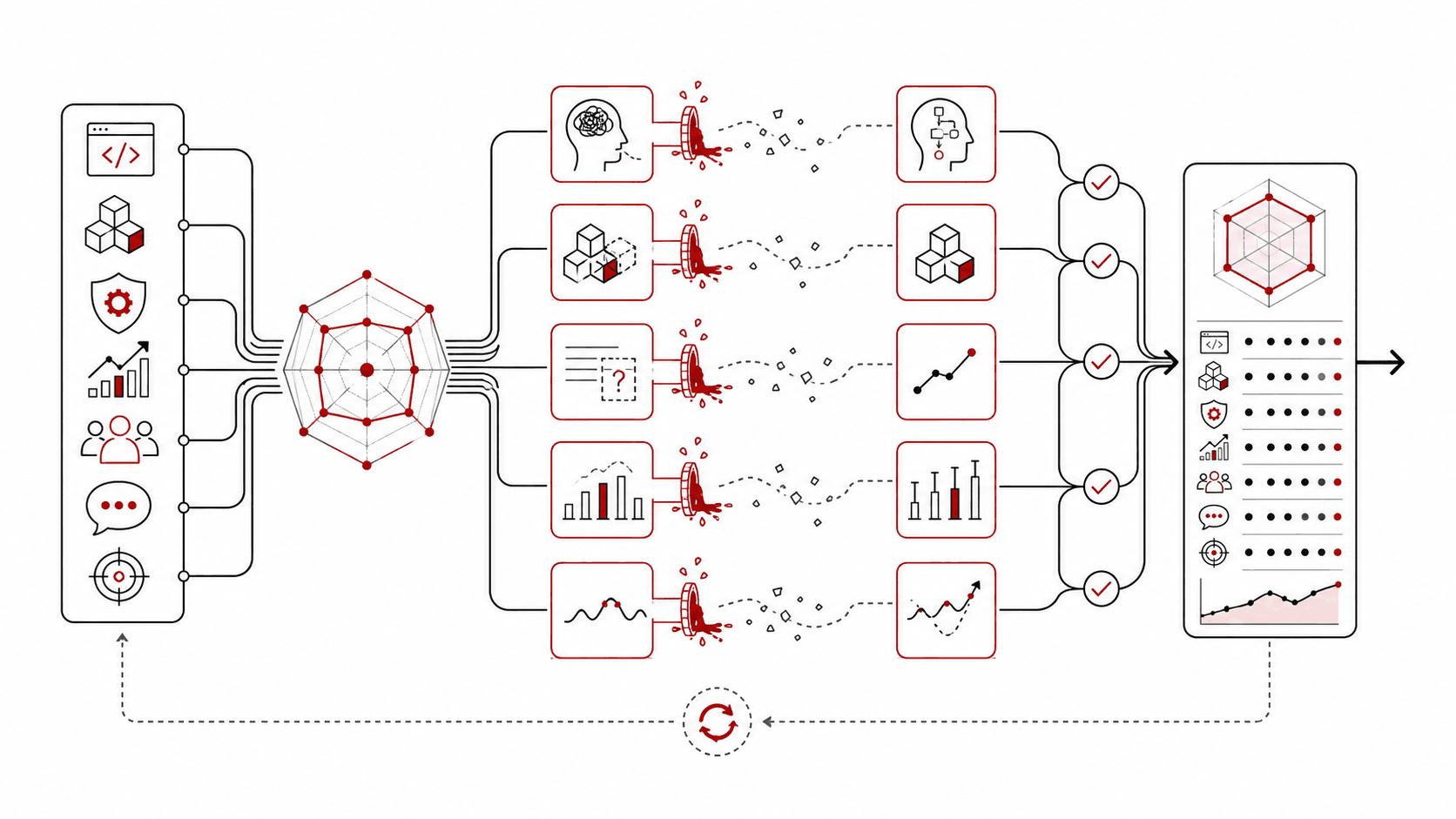
Senior-level recovery mindset
Senior-level candidates do not merely avoid mistakes. They make their reasoning inspectable.
In a coding round, they clarify constraints, choose a simple plan, write readable code, test edge cases, and explain complexity without turning the round into a lecture.
In a system design round, they start from requirements and constraints before drawing components. They name the main trade-offs, choose a design appropriate to scale and risk, and bring production concerns into the conversation without waiting to be prompted.
In a project deep dive, they separate team outcomes from personal contribution. They can say what they owned, what others owned, where they influenced, which alternatives they rejected, what changed afterward, and what they would do differently now.
In a behavioral or hiring-manager round, they show judgment without blame. They can discuss conflict, failure, ambiguity, and leadership with specificity and reflection.
The important distinction is that senior performance is not flawless. It is recoverable. A senior candidate can revise an assumption, accept a hint, narrow scope, or abandon an overcomplicated path while preserving structure and credibility.
The experienced-engineer failure model
Use the “failure is signal loss” model.
| Failure pattern | What the candidate may think | What the interviewer may score |
|---|---|---|
| Solving before clarifying | “I can infer the obvious requirements.” | Weak problem framing and premature commitment. |
| Hidden reasoning | “This is obvious from my experience.” | Low communication signal and hard-to-score decisions. |
| Overengineering | “I need to show senior architecture.” | Poor judgment, weak scope control, and unnecessary complexity. |
| Memorized design | “This is the standard architecture.” | Pattern recall without adaptation. |
| No tests | “The code is simple enough.” | Risky implementation habits and weak correctness discipline. |
| Vague impact | “The project was clearly important.” | Insufficient evidence of delivery and product judgment. |
| Blame | “The context explains why it was hard.” | Low ownership and poor reflection. |
| No production awareness | “This is only an interview exercise.” | Senior bar risk for operational judgment. |
| Poor recovery | “The hint means I am failing.” | Fragility under feedback. |
The correction is not to perform a rigid script. The correction is to expose the right layer of reasoning at the right time:
- Frame the problem.
- State the assumption.
- Choose a path.
- Explain the trade-off.
- Validate the result.
- Reflect when new information changes the answer.
How failure patterns appear across rounds
Experienced candidates rarely fail for one universal reason. The same underlying habit can surface as weak framing in coding, overbuilt architecture in design, vague ownership in a project deep dive, or defensive communication in a behavioral round.
Experience can create stale interview habits
An experienced engineer may have gone years without live coding, drawing a design from a blank prompt, or explaining a project to someone with no context. Real senior work often happens through documents, reviews, incident retrospectives, planning meetings, and production systems. Interview rounds sample those skills indirectly.
The gap is not moral failure. It is a format gap. Treat it as one.
Seniority increases the penalty for weak framing
A junior candidate may be forgiven for needing heavy prompting around ambiguity. A senior candidate is expected to ask:
- Who are the users?
- What are the success criteria?
- What scale or constraints matter?
- What can be deferred?
- What failure mode would be unacceptable?
- Which decision is reversible?
If you skip this step, the interviewer may not see a fast engineer. They may see someone who creates rework.
Overengineering is not seniority
Senior candidates sometimes reach for distributed queues, microservices, sharding, caching layers, event streams, state machines, and workflow engines because they want to prove depth. Those tools can be right. They can also be evidence of poor scope control.
A senior answer often starts with the simplest design that satisfies the stated constraints, then names the threshold where more machinery becomes justified.
Example:
“For the initial volume, a relational table plus a background worker is enough. I would introduce a durable queue when request latency, retry isolation, or burst handling becomes the main constraint.”
That sentence shows more senior judgment than drawing a complex platform immediately.
“We” is not enough
Engineering is collaborative, so “we” is often accurate. But interviewers also need to know your agency.
A strong answer uses both:
- “The team migrated the service in three phases.”
- “I owned the compatibility plan, designed the dual-write validation, and reviewed the rollback criteria.”
- “The data platform team owned the index changes.”
Precise attribution builds trust. It also prevents both under-claiming and over-claiming.
Hints are part of the round
A hint is not always a rejection signal. Interviewers use hints to see whether you can incorporate feedback. Treat a hint as new information.
Useful recovery language:
- “That constraint changes the shape of the solution.”
- “I was optimizing for the wrong bottleneck. Let me revise.”
- “Good point. I need to make the write path idempotent before retries are safe.”
- “I can simplify this. The heavy part is not justified at the scale we assumed.”
Examples and counterexamples
Prompt:
“Design a system that lets users schedule email notifications for future delivery.”
Experienced Candidate A starts drawing:
“I would have an API service, a Kafka topic, scheduler workers, Redis, Postgres, a notification service, an email provider abstraction, retries, and a dashboard.”
The components are plausible, but the answer loses signal. The candidate has not clarified whether this is a consumer reminder feature, a transactional system, a marketing platform, or an internal admin tool. They have not asked about expected volume, delivery precision, cancellation, user preferences, provider limits, compliance, idempotency, or failure handling. The interviewer has to drag out the senior reasoning.
Experienced Candidate B starts with framing:
“I want to clarify the product shape before choosing machinery. Are these user-created reminders where a few minutes of delay is acceptable, or transactional messages with strict delivery expectations? I will assume user-created reminders at moderate scale unless you want the higher-integrity version.”
Then they propose:
- API to create, update, cancel, and inspect scheduled notifications.
- Persistent schedule records with idempotency keys.
- A worker that claims due records in batches with leases.
- Provider abstraction with retry policy and terminal failure states.
- User preference and unsubscribe checks at send time.
- Metrics for due backlog, send latency, provider failures, and duplicate suppression.
- A later path to a queue or partitioned scheduler if volume or precision requires it.
Candidate B’s design may be less flashy, but it produces stronger evidence. The interviewer can score framing, architecture, production judgment, trade-offs, and communication.
Annotated failure-and-recovery conversation
Interviewer: “Tell me about a project that did not go well.”
Candidate: “We had a checkout performance project where the first release reduced median latency but increased p99 latency during payment-provider slowdowns. My part was the backend aggregation layer. I made a batching decision that helped normal traffic but amplified tail latency when one provider degraded.”
Annotation: Strong start. The candidate names a real failure and personal contribution without blaming the environment.
Interviewer: “What did you miss?”
Candidate: “I optimized for average request count and did not model the slowest dependency as the controlling factor. We also had p95 dashboards, but not a p99 alert tied to checkout completion. In hindsight, the design review should have included dependency isolation and timeout behavior as explicit requirements.”
Annotation: The answer identifies the decision, measurement gap, and review gap.
Interviewer: “How did you respond?”
Candidate: “We split the provider calls so one slow provider could not hold the whole aggregation response, added per-provider timeout budgets, and returned partial payment options when allowed. I also added a load test scenario with provider latency injection. The fix was not just code; it changed the release checklist for checkout-adjacent work.”
Annotation: Strong recovery evidence: mitigation, production testing, and durable team practice.
Interviewer: “Was there disagreement?”
Candidate: “Yes. Product was worried that partial options would confuse users. That was valid. We agreed on a fallback that showed the most reliable options first and logged suppressed options for follow-up. It was not the most complete UI, but it protected conversion during provider incidents.”
Annotation: The candidate makes a product trade-off and avoids portraying disagreement as obstruction.
Interviewer: “What would you do differently now?”
Candidate: “I would insist on dependency-specific failure tests before launch and I would make tail latency the primary metric for checkout, not an afterthought. I would still batch some requests, but only where the slowest dependency cannot dominate the user path.”
Annotation: Specific reflection. The lesson is operational and actionable.
Failure patterns by candidate maturity
| Prompt | Weak response | Mid-level response | Senior response |
|---|---|---|---|
| “Why do experienced engineers fail interviews?” | “Interviews are broken and random.” | “They may be rusty or nervous.” | “They fail when real ability does not translate into visible evidence: unclear framing, hidden reasoning, weak time control, vague ownership, or poor recovery.” |
| “How would you approach this design?” | “I have built this before, so I would use Kafka and microservices.” | “I would draw the usual services and then discuss scaling.” | “I would clarify product semantics, scale, reliability, and compliance first, then choose the simplest architecture that satisfies those constraints and name when it needs to evolve.” |
| “Tell me about your impact.” | “It was a very important project.” | “We improved latency and reliability.” | “I owned the read-path redesign that moved p95 latency from 900 ms to 280 ms for the main dashboard, while the infrastructure team owned capacity changes.” |
| “What happened when you got stuck?” | “I usually do not get stuck.” | “I asked for help and figured it out.” | “I named the uncertainty, tested the smallest assumption, used the hint to revise the model, and preserved time for validation.” |
| “Why did the project fail?” | “Leadership changed priorities.” | “Requirements were unclear.” | “The priority shift mattered, but my miss was not establishing a decision owner for scope trade-offs before implementation began.” |
Implications for reader decisions and failure modes
Watch for these patterns in your own practice:
- Starting implementation or architecture before clarifying the problem.
- Narrating every thought without summarizing or steering.
- Keeping important decisions silent because they feel obvious.
- Using a memorized system design template without adapting to requirements.
- Adding complex infrastructure before showing the baseline.
- Treating testing as a final flourish rather than part of correctness.
- Discussing production only when the interviewer asks.
- Giving project stories where your personal contribution is impossible to identify.
- Using metrics without baseline, time range, or causal connection.
- Blaming product, management, legacy code, or another team without naming your own agency.
- Rejecting hints or becoming visibly discouraged by them.
- Ending answers without reflection or a decision.
Interviewer red flags:
- “I would just scale it horizontally” with no bottleneck.
- “We did not have time for tests” with no risk mitigation.
- “The architecture was obvious” with no alternatives.
- “The team failed to execute” with no personal accountability.
- “I can talk about production if needed” instead of surfacing it naturally.
Practice drills
Failure taxonomy replay
25 minBaseline before machinery
15 minAttribution split
20 minHint recovery
15 minDiagnostic self-check rubric
Score each dimension from 0 to 4.
| Dimension | 0 | 2 | 4 |
|---|---|---|---|
| Clarification | Starts solving immediately. | Asks obvious questions but misses success criteria or constraints. | Frames users, goals, constraints, assumptions, and unacceptable failures before committing. |
| Reasoning visibility | Gives conclusions only. | Explains some choices after prompting. | Makes decisions, alternatives, and trade-offs visible at the right level of detail. |
| Scope control | Overbuilds or underbuilds. | Chooses plausible components with uneven justification. | Starts with a fit-for-purpose baseline and names evolution thresholds. |
| Correctness and testing | Skips validation. | Tests happy paths or mentions tests generically. | Tests edge cases, failure paths, and assumptions that matter to the round. |
| Ownership evidence | Uses vague “we” or over-claims. | Gives some personal action. | Separates team outcome, personal contribution, influence, and other owners precisely. |
| Production judgment | Treats operations as extra. | Mentions metrics or rollback generically. | Integrates failure, observability, security, cost, rollout, and support implications. |
| Recovery | Freezes, argues, or apologizes repeatedly. | Accepts hints but loses structure. | Uses new information to revise calmly and preserve forward motion. |
Readiness gate: no repeated 0 or 1 in any dimension across two practice rounds. For a senior loop, one brittle pattern can dominate otherwise strong experience.
One-page field reference
Field reference
Experienced engineer failure checklist
- Experience is raw material; interviews score visible evidence.
- Clarify before solving.
- State assumptions before depending on them.
- Start with the simplest design that satisfies the constraints.
- Add complexity only when a named constraint requires it.
- Make tests, failure modes, rollout, observability, and cost visible when relevant.
- Use “we” for team outcomes and “I” for your specific decisions.
- Quantify impact with baseline, change, and scope.
- Treat hints as new information.
- Recover by restating the constraint, revising the plan, and continuing.
- After practice, ask: Which senior signal did I hide?