Chapter 16
The Recruiter Screen
A senior-engineer guide to recruiter screens: role alignment, location, work authorization, compensation expectations, notice periods, level calibration, process questions, and communicating constraints professionally.
Jump around the book
On this page
What this call establishes
The recruiter screen is not a technical interview, but it is part of the hiring signal. It establishes the first official version of your candidate packet: what role you want, why this company makes sense, what level you appear to fit, whether logistics are workable, and whether the loop is worth scheduling.
Senior candidates sometimes treat the recruiter screen as administrative. That is a mistake. The recruiter may not judge your architecture depth, but they can influence whether you reach the hiring manager, how you are positioned, what level is requested, and whether practical constraints become concerns.
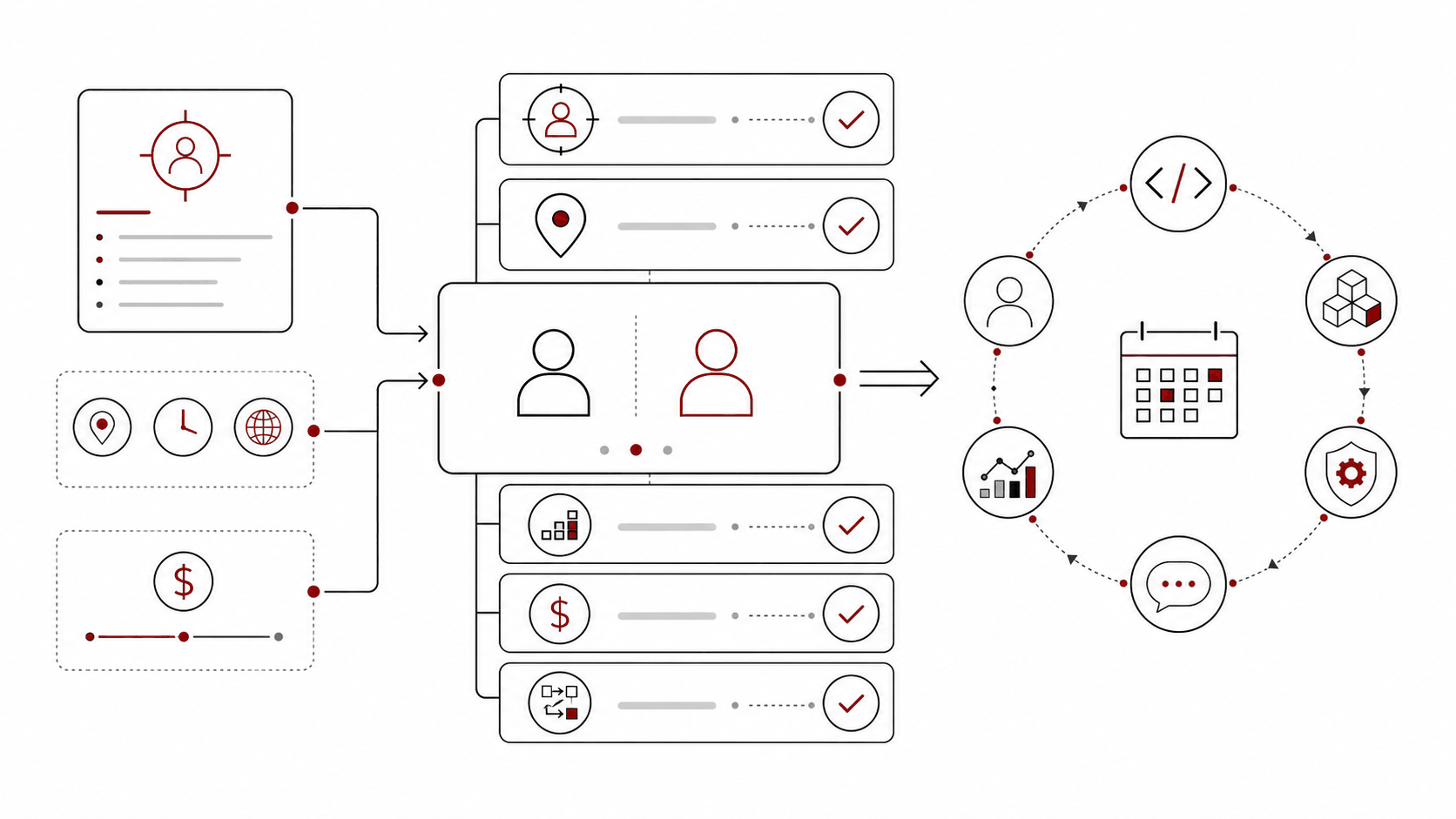
The recruiter screen gives the company an early read on whether you can:
- explain your target role without rambling;
- connect your background to the role’s likely needs;
- clarify logistics early;
- discuss compensation without anchoring carelessly;
- ask useful questions about level and process;
- communicate constraints without sounding difficult or uncertain;
- leave the recruiter with a clean, credible summary to pass forward.
What senior-level performance looks like
A weak recruiter screen sounds either passive or evasive:
“I am open to anything senior. Compensation depends. I can probably make the process work. What do you think I should prepare?”
A stronger senior screen sounds focused:
“I am targeting senior backend roles where I can own reliability-sensitive product systems. My strongest recent evidence is billing workflow migration and production ownership. Before we go deeper, I would like to confirm the role’s level, remote policy, compensation range, and whether the loop includes coding, system design, and a project deep dive.”
Senior-level performance has six properties:
- You enter with a role thesis from Chapter 10.
- You describe your background through two or three evidence anchors from Chapter 15.
- You validate level and scope before investing deeply.
- You handle compensation, location, authorization, and notice period directly.
- You ask process questions that improve preparation.
- You keep constraints factual and solution-oriented.
The recruiter should leave the call able to say:
“This candidate is a senior backend engineer focused on product infrastructure and reliability. They are interested in hands-on senior IC scope, they are within our compensation band, logistics are workable, and they are prepared for a loop with coding, system design, and project depth.”
That summary is a useful outcome.
The operating model
Use the “fit, logistics, level, process” model.
| Lens | What to confirm | Why it matters |
|---|---|---|
| Fit | Team, role shape, work type, domain, senior evidence. | Prevents a generic conversation and helps the recruiter position you. |
| Logistics | Location, remote policy, work authorization, time zone, start date, notice period. | Avoids late failure on non-technical constraints. |
| Level | Title, level band, scope, hands-on expectation, down-level risk. | Keeps your evidence and compensation expectations aligned. |
| Process | Rounds, timing, interviewer types, tools, policies, evaluation criteria. | Turns the next stage into targeted preparation instead of guesswork. |
Do not try to win the job on this call. Try to remove ambiguity. A clean recruiter screen creates better conditions for the technical loop.
Essential knowledge
Role alignment should be specific
When the recruiter asks what interests you, do not repeat the job description. Name the work shape.
Useful structure:
I am targeting [role shape] because my strongest evidence is [two evidence anchors]. This role looks aligned because it appears to involve [role-specific work]. I would like to confirm [open question].
Example:
I am targeting senior backend roles where correctness, reliability, and product delivery overlap. My strongest recent work is a billing retry redesign and a notification migration. This role looks aligned because it seems to combine customer-facing workflows with platform-quality reliability. I would like to understand whether the main need is new feature delivery, migration, or operational maturity.
This is better than “the mission is exciting.” It gives the recruiter words they can use with the hiring manager.
Logistics are not afterthoughts
Clarify hard constraints early:
| Topic | What to say |
|---|---|
| Location | “I am based in Austin and can work remotely in US time zones. I am not looking to relocate for this search.” |
| Hybrid policy | “I can support one office visit per quarter, but not a weekly hybrid schedule.” |
| Work authorization | “I am authorized to work in the US and do not require sponsorship.” Or: “I require employer sponsorship, so I want to confirm whether the team can support that before we continue.” |
| Time zone | “I can overlap with Pacific hours until 5 p.m. Pacific, but not a standing late-evening schedule.” |
| Start date | “I have a four-week notice period after signing. I could discuss a shorter transition only if needed.” |
| Travel | “Occasional team travel is fine. Regular customer travel would need more discussion.” |
State constraints plainly. Do not apologize for them and do not hide them until offer stage.
Compensation needs a prepared range
Compensation conversations vary by company and jurisdiction. Some recruiters provide the band; others ask for expectations first. Senior candidates should know their target range, walk-away range, equity preferences, and trade-offs before the call.
Good compensation framing:
I am targeting total compensation in the range of [range], depending on level, equity structure, location policy, and benefits. Before anchoring too tightly, could you share the approved band for this role and level?
If you are flexible:
I care most about role fit and level, but I do not want to waste your time if the band is far from market. For the right senior scope, I am generally looking around [range] total compensation. How does that compare with the approved range?
If the range is too low:
That is lower than the range I am targeting for this search. If there is flexibility at a higher level or with equity, I am open to understanding it. If not, it may be better to stay in touch for a more aligned role.
Do not bluff. Do not give a number you would resent accepting. Do not say “open” if you are not open.
Level calibration starts here
Recruiters often know the approved level, but they may not know the full technical nuance. Your job is to ask level questions that expose scope.
Useful questions:
- “Is this calibrated as senior IC, staff-shaped senior, tech lead, or manager-adjacent?”
- “How hands-on is the role expected to be in the first six months?”
- “What scope would distinguish a strong senior hire from a down-leveled candidate?”
- “Is the team hiring for service ownership, migration leadership, platform strategy, or feature delivery?”
- “Are there multiple levels open for this role, or is the team targeting one specific level?”
- “How is leveling decided: before onsite, after onsite, or through a hiring committee?”
Connect this to Chapter 12. You are not asking for special treatment. You are trying to match evidence to the bar.
Process questions should improve preparation
Ask for the structure, not secret answers.
High-value process questions:
- “What are the planned stages after this call?”
- “Will there be an online assessment, live coding, system design, practical coding, project deep dive, or behavioral round?”
- “How long is each round, and what tools are used?”
- “Are candidates allowed to use their own IDE, documentation, notes, or AI tools?”
- “Is the system design round product-specific, infrastructure-focused, or general?”
- “Does the project deep dive expect slides, a document, or a verbal walkthrough?”
- “Will there be a hiring-manager call before the technical loop?”
- “What is the expected timeline from screen to final decision?”
- “Who should I contact if scheduling creates preparation conflicts?”
This is not about gaming the interview. It is about avoiding avoidable ambiguity.
Constraints should not weaken candidacy
Constraints become concerns when they sound unplanned, defensive, or absolute without context.
| Constraint | Weak phrasing | Stronger phrasing |
|---|---|---|
| Scheduling | “I am very busy, so it may be hard.” | “I can schedule two interview blocks per week and prefer 48 hours between technical rounds.” |
| Compensation | “I need a lot more than that.” | “My target range is higher than this band. Is there level or equity flexibility?” |
| Remote | “I cannot come in.” | “I am targeting remote roles. I can support planned onsite visits, but not a weekly office cadence.” |
| Notice period | “I cannot start soon.” | “My notice period is four weeks after signing, which lets me transition responsibly.” |
| Sponsorship | “I need sponsorship, is that a problem?” | “I require sponsorship. Can this team support that for this role and location?” |
| Competing loops | “I have a lot going on.” | “I am in two active loops, so I would like to understand your timeline and keep scheduling realistic.” |
The pattern is factual constraint plus workable path.
A recruiter screen worksheet
Use this before every serious screen.
| Field | Notes |
|---|---|
| Role thesis | One sentence naming target role shape and strongest evidence. |
| Evidence anchors | Two or three projects that prove fit. |
| Logistics | Location, remote/hybrid, authorization, time zone, travel, notice period. |
| Compensation | Target range, floor, preferred mix, questions about level and band. |
| Level questions | Scope, hands-on expectation, level band, down-level risk. |
| Process questions | Rounds, timing, tools, policies, interviewer types, timeline. |
| Constraints | Scheduling limits, prep time, travel, competing loops, start date. |
| Decision after call | Continue, pause, clarify with hiring manager, or decline. |
Write your answers down. The point is not to recite them. The point is to prevent improvising on issues that affect the entire search.
Worked example
Priya is targeting senior backend roles in payments and product infrastructure. A recruiter contacts her about “Senior Software Engineer, Commerce Platform.”
Her preparation:
| Topic | Prepared position |
|---|---|
| Role thesis | Senior backend engineer focused on reliability-sensitive product workflows. |
| Evidence anchors | Subscription migration, payment retry redesign, on-call ownership for checkout. |
| Logistics | Remote US, no relocation, authorized to work, four-week notice. |
| Compensation | Targeting $260K to $310K total compensation depending on level and equity. |
| Level | Wants hands-on senior IC, open to tech-lead-shaped scope if coding remains real. |
| Process | Needs to know whether loop includes coding, system design, project deep dive, and tool policy. |
During the call, she says:
“The role looks aligned with my recent work. I have been owning backend commerce systems where correctness and operational reliability matter. Before we go too far, I would like to confirm the shape: is this primarily service ownership and migration work, or broader platform strategy across teams?”
The recruiter says the team needs someone to stabilize checkout services and lead a migration out of a legacy billing path. Priya continues:
“That sounds close to my strongest evidence. I would be interested if the role remains hands-on. Could you share the expected interview stages and the level band?”
The recruiter describes live coding, system design, project deep dive, behavioral, and hiring manager. Priya asks whether the project deep dive needs slides and whether her own IDE is allowed for coding. She then handles compensation:
“For the right senior scope, I am targeting total compensation roughly in the $260K to $310K range depending on equity and level. Is that within the approved band?”
The band is compatible. The recruiter moves her forward with a clear note: senior backend commerce candidate, strong migration and reliability evidence, remote US, authorized, four-week notice, compensation aligned.
That is a successful recruiter screen.
Annotated recruiter-screen conversation
Recruiter: “Can you tell me a little about yourself?”
Candidate: “I am a senior backend engineer focused on product infrastructure. My strongest recent work has been billing workflow reliability, notification migration, and production ownership. I am looking for a hands-on senior IC role where service design, rollout safety, and operational quality matter.”
Annotation: Strong. The candidate gives role shape, evidence, and target scope quickly.
Recruiter: “Why are you interested in this role?”
Candidate: “The posting suggests the team is working on commerce workflows with reliability and migration concerns. That matches my background. I would like to understand whether the immediate priority is new product delivery, stabilizing existing systems, or moving off legacy paths.”
Annotation: Senior. The answer is specific and turns interest into discovery.
Recruiter: “What compensation are you looking for?”
Candidate: “I am targeting total compensation in the $260K to $310K range for the right senior scope, depending on level, equity structure, and benefits. Could you share the approved range for this role?”
Annotation: Good. The candidate gives a range and asks for the band.
Recruiter: “The role is hybrid in New York. Is that okay?”
Candidate: “I am targeting remote roles in this search and I am not planning to relocate. I can support planned onsite visits, but weekly hybrid would not be a fit. If the team has a remote version of this role, I would be interested.”
Annotation: Clear. The candidate does not weaken the constraint or sound apologetic.
Recruiter: “The loop includes coding, system design, and behavioral interviews.”
Candidate: “That makes sense. Could you clarify whether the coding round uses a shared editor or allows a local IDE, and whether the design round tends to be product-domain-specific? I want to prepare in the right way.”
Annotation: Appropriate. The question requests process information, not answers.
Recruiter-screen response quality
| Prompt | Weak response | Mid-level response | Senior response |
|---|---|---|---|
| “What are you looking for?” | “Anything senior.” | “Backend roles with interesting problems.” | “Senior backend roles where I own reliability-sensitive product systems and remain hands-on in design, code, and operations.” |
| “Why this role?” | “It looks exciting.” | “It matches my stack.” | “The role appears to need migration safety, service ownership, and product-facing reliability, which match my recent billing and notification work.” |
| “Compensation expectations?” | “I am flexible.” | “Around market for senior.” | “I am targeting [range] total compensation depending on level and equity. Could you share the approved band?” |
| “Can you work hybrid?” | “Maybe, it depends.” | “I prefer remote.” | “I am targeting remote roles. Planned onsite visits are fine; weekly hybrid is not a fit for this search.” |
| “When can you start?” | “Pretty soon.” | “Probably a few weeks.” | “I have a four-week notice period after signing so I can transition responsibly.” |
| “What questions do you have?” | “What should I study?” | “What is the interview process?” | “Which rounds are planned, what tools are used, how is level decided, and what is the team’s main first-six-month problem?” |
Failure modes and red flags
- Treating the recruiter as irrelevant and giving careless answers.
- Sounding open to any role, level, domain, location, or compensation.
- Hiding hard constraints until late in the process.
- Giving compensation numbers you have not thought through.
- Asking for secret interview questions instead of process structure.
- Being defensive about level, sponsorship, gaps, or remote requirements.
- Over-explaining career history before the recruiter can place you.
- Claiming staff-level scope while asking for a hands-on senior role and sounding uninterested in implementation.
- Failing to ask whether the role is still open, funded, and actively interviewing.
- Accepting a schedule that damages preparation for later rounds.
Recruiter red flags:
- The level, team, or role scope cannot be described.
- Compensation band is unavailable or far below your target.
- Remote, authorization, or travel constraints are vague despite being critical.
- The process changes repeatedly without explanation.
- The recruiter pressures you to schedule too many technical rounds without preparation time.
Timed drills
Recruiter screen script
25 minConstraint phrasing
20 minCompensation range check
20 minProcess question bank
15 minPost-call decision
10 minSelf-scoring rubric
Score your recruiter screen readiness from 1 to 5.
| Dimension | 1 - Weak | 3 - Usable | 5 - Senior-ready |
|---|---|---|---|
| Role alignment | Generic or opportunistic. | Names broad function. | Names target role shape and evidence anchors clearly. |
| Logistics | Constraints are unclear or hidden. | Most constraints known. | Location, authorization, time zone, travel, and start date are stated cleanly. |
| Compensation | Unprepared or evasive. | Has a rough number. | Has target range, floor, trade-offs, and asks for approved band. |
| Level calibration | Relies on title. | Asks basic level questions. | Tests scope, hands-on expectations, decision authority, and down-level risk. |
| Process discovery | Asks “what should I study?” | Gets high-level steps. | Confirms rounds, tools, timing, policies, and evaluation criteria. |
| Constraint communication | Apologetic, rigid, or vague. | Mostly factual. | Factual, professional, and paired with workable options. |
| Follow-through | Leaves next steps ambiguous. | Knows next stage. | Sends concise follow-up and schedules without sacrificing preparation. |
Readiness gate: score 28 or higher before running a serious application campaign. If compensation or logistics is below 4, fix it before taking more calls.
One-page field reference
Field reference
Recruiter screen checklist
- Enter with a one-sentence role thesis.
- Use two or three evidence anchors, not a full biography.
- Confirm location, remote policy, work authorization, time zone, travel, and notice period.
- Know your compensation target range and floor before the call.
- Ask for the approved compensation band and level band.
- Clarify whether the role is senior IC, staff-shaped, tech-lead-shaped, or manager-adjacent.
- Ask which rounds are planned and how long each round takes.
- Confirm tools, permitted resources, AI policy, and logistics.
- State constraints factually and pair them with workable options.
- Do not schedule so aggressively that you damage technical preparation.
- After the call, write down fit, logistics, level, process, and next action.