Chapter 12
Level Calibration
A practical guide for senior engineers to calibrate roles, postings, recruiter conversations, resumes, and interview answers against senior, staff-shaped, tech-lead-shaped, and hands-on expectations.
Jump around the book
On this page
Why this concept changes preparation
Level calibration is the ability to estimate what bar a company is actually hiring against. The advertised title is only the starting point. The real bar is shaped by scope, ambiguity, system complexity, operational responsibility, influence, decision authority, company stage, compensation band, and the team problem behind the opening.
Senior candidates get into trouble when they calibrate by title alone:
- They apply to staff-shaped senior roles and underprepare influence evidence.
- They apply to hands-on senior roles with mostly coordination stories.
- They pursue specialist roles without enough domain depth.
- They accept down-level framing too late because they did not test the bar early.
- They overstate their scope and create credibility problems in project deep dives.
Level calibration is not about ego. It is about alignment. You want the role, resume, stories, recruiter screen, and interview answers to point at the same level.
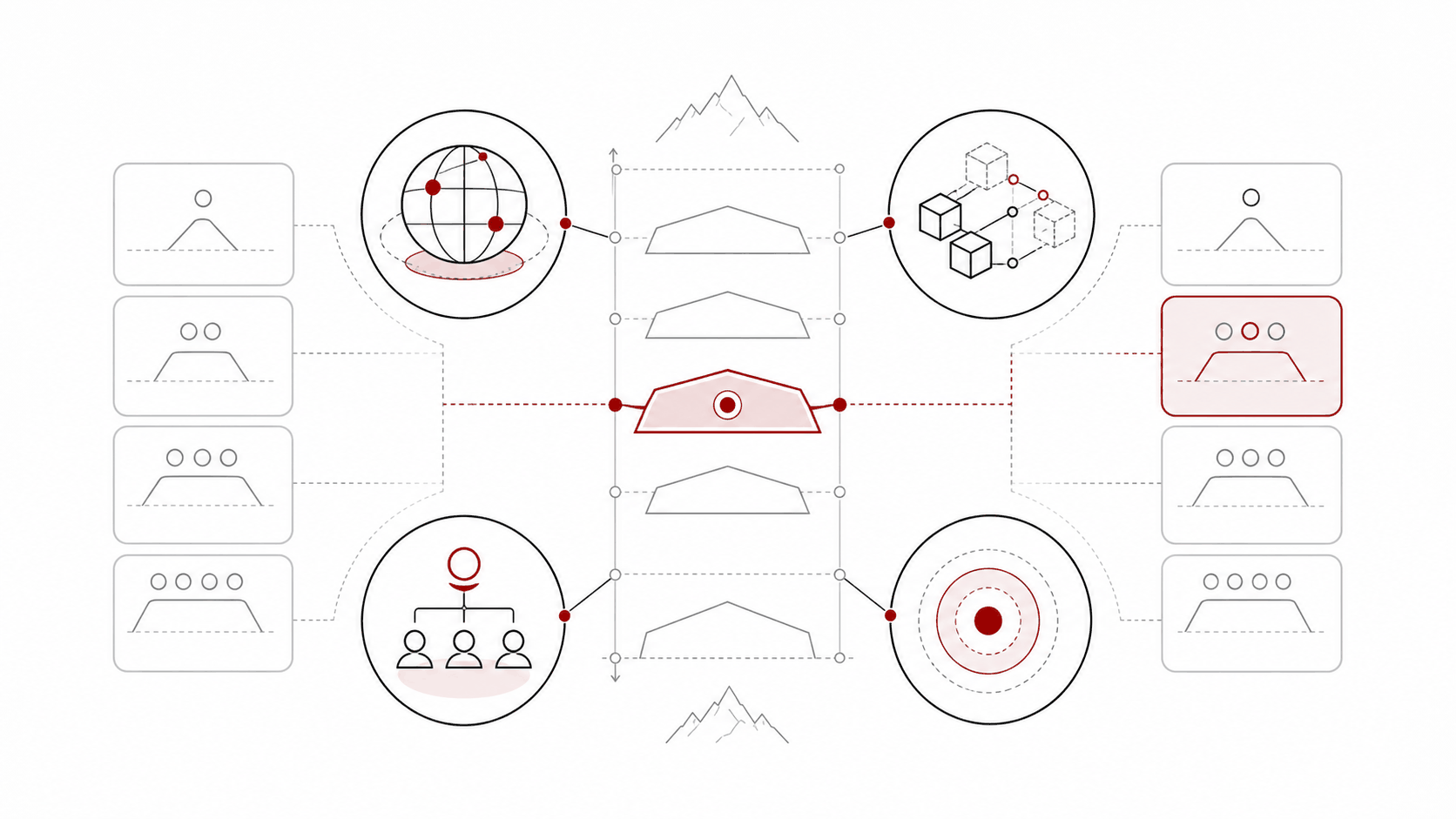
Senior-level calibration behavior
A senior candidate can discuss level with precision and without defensiveness.
Weak calibration sounds like:
“I am a senior engineer because I have nine years of experience.”
Better calibration sounds like:
“My strongest senior evidence is owning backend services through design, implementation, rollout, operation, and cross-team migration. I have led team-level technical direction and mentored engineers. I have some multi-team influence, but I would not claim a broad staff-engineer platform mandate yet.”
Senior-level calibration has five properties:
- It uses evidence, not tenure.
- It distinguishes title, compensation level, and actual work.
- It separates team-local senior ownership from multi-team staff scope.
- It names hands-on implementation and leadership without pretending they are the same skill.
- It identifies down-level risk before the company does.
This matters because leveling is often decided from a packet: resume, recruiter notes, hiring-manager notes, interview feedback, project depth, and compensation expectations. Your evidence must support the level you request.
The scope-complexity-authority-consequence model
Use the “scope, complexity, authority, consequence” model.
| Lens | Calibration question | Senior-level evidence |
|---|---|---|
| Scope | How large is the area of ownership? | Owns a service, feature area, migration, or problem area with limited supervision. |
| Complexity | What technical and organizational complexity is present? | Handles ambiguous requirements, trade-offs, dependencies, production constraints, and evolution. |
| Authority | What decisions can the person make or influence? | Makes design, sequencing, rollout, and risk decisions; influences peers and adjacent teams. |
| Consequence | What happens if the work fails? | Understands customer, operational, financial, security, compliance, or team productivity impact. |
As level increases, the same dimensions expand. A mid-level engineer may own tasks inside a project. A senior engineer owns a meaningful slice and its trade-offs. A staff engineer often shapes direction across teams or systems. A manager owns people, staffing, performance, and delivery systems.
How level signals appear across rounds
Level calibration is visible across the whole loop. Recruiter screens test whether your target level is plausible, hiring-manager conversations test scope fit, project deep dives test ownership altitude, and technical rounds test whether the hands-on evidence supports the title.
Tenure is weak evidence
Years of experience can make senior scope more plausible, but they do not prove it. Interviewers will ask what you owned, decided, changed, operated, and influenced.
Better evidence than tenure:
- ambiguous problem framed into a plan;
- architecture decision with alternatives and consequences;
- production service ownership;
- migration or rollout with risk controls;
- incident response that changed future practice;
- cross-team technical alignment;
- mentoring that resulted in durable ownership by others;
- measurable customer, business, reliability, cost, or developer-productivity impact.
Scope has altitude
Scope is not only the size of the codebase or the number of users. It is the altitude of responsibility.
| Level shape | Typical scope | Risk if misrepresented |
|---|---|---|
| Mid-level | Tasks, features, components, well-framed slices. | Claims seniority but needs too much direction. |
| Senior | Services, feature areas, migrations, production ownership, technical decisions inside a team or adjacent teams. | Sounds staff-level without enough breadth, or mid-level if attribution is too narrow. |
| Staff-shaped | Multi-team architecture, standards, strategic migrations, broad influence, technical direction. | Over-claims if examples are team-local. |
| Tech-lead-shaped | Sequencing, review, alignment, mentoring, delivery coordination plus technical depth. | Appears hands-off if implementation evidence is thin. |
| Manager-shaped | Staffing, performance, prioritization systems, team health, delivery through people. | Misaligned if the candidate wants senior IC work. |
Use Chapter 5 as the detailed role taxonomy. This chapter focuses on applying that taxonomy to targeting and interview evidence.
Decision authority matters
A senior engineer does not need unilateral authority over everything. They do need credible authority over important decisions.
Examples:
- choosing a data model and defending consistency trade-offs;
- setting rollout gates for a migration;
- deciding when to reject a shortcut because of operational risk;
- negotiating scope with product when reliability or compliance is at stake;
- defining service ownership boundaries;
- designing review criteria or migration standards;
- influencing an adjacent team to adopt a contract or deprecation plan.
If your stories mostly say “I helped implement,” the level may read lower. If your stories only say “I led alignment” but never show technical decision quality, the role may read managerial or program-management-heavy.
Operating responsibility raises the bar
Senior roles often include production ownership. The company wants to know whether you understand the consequences of systems after launch.
Operating responsibility includes:
- on-call participation or ownership;
- observability and alert quality;
- deploy safety and rollback;
- incident response and post-incident changes;
- SLOs or reliability targets;
- support workflows and customer-visible states;
- security, privacy, compliance, and cost controls.
A candidate can be strong technically and still under-level if they talk only about building, not operating.
System complexity is contextual
Complexity is not proved by naming distributed systems. It is proved by explaining constraints.
Strong complexity evidence includes:
- high write or read volume that changes architecture;
- consistency or correctness requirements;
- migrations with compatibility periods;
- multiple clients or integration partners;
- regulatory or audit constraints;
- failure modes with customer or financial consequence;
- long-lived systems that require evolution without breaking users;
- organization boundaries that make simple technical choices harder.
Do not inflate complexity. Interviewers trust candidates who can say, “This was not globally massive, but the correctness and rollout constraints made it senior-level.”
Influence must be attributable
Leadership and influence are senior signals, but they must be concrete.
Weak:
“I influenced the team to improve quality.”
Stronger:
“After two incidents from inconsistent retry behavior, I wrote the retry/idempotency standard, reviewed the first three service migrations, and paired with two engineers until they could apply it independently. Within a quarter, duplicate payment support tickets dropped from weekly to rare.”
The stronger version shows trigger, artifact, mechanism, adoption, and result.
Down-level risk is not always unfair
Companies down-level for many reasons:
- project scope sounds team-local while the target level expects multi-team influence;
- coding performance is below the hands-on bar;
- system design misses production risk;
- examples lack personal attribution;
- recent work is coordination-heavy;
- domain depth is too shallow for a specialist role;
- the company has a narrower definition of the title.
Your response should be evidence-based. If the company sees you as senior rather than staff, ask what evidence was missing. If the gap is real, decide whether the role is still useful. If the gap reflects mismatch, keep the relationship professional and move on.
Diagnostic calibration worksheet
Before the recruiter screen, score the role and yourself.
| Dimension | Role appears to require | My strongest evidence | Risk |
|---|---|---|---|
| Scope | Service, problem area, platform capability, multi-team strategy. | Projects or responsibilities at that altitude. | Scope too narrow, too broad, or unclear. |
| Complexity | Technical, organizational, product, regulatory, or operational complexity. | Specific constraints handled. | Complexity claims are vague. |
| Decision authority | Design, sequencing, rollout, standards, roadmap, risk acceptance. | Decisions personally made or influenced. | Mostly execution, not judgment. |
| Production ownership | On-call, SLOs, incidents, support, cost, security, compliance. | Operational examples with consequences. | Built but did not operate. |
| Influence | Mentoring, cross-team alignment, standards, stakeholder negotiation. | Mechanisms and adoption evidence. | Leadership claims without artifacts. |
| Hands-on depth | Coding, review, debugging, design detail. | Recent implementation or technical review. | Too coordination-heavy. |
| Level language | Senior, staff-shaped, lead-heavy, manager-shaped. | Matching story set. | Title mismatch or down-level risk. |
If two or more rows show high risk, treat the role as selective rather than primary unless you have time to build the missing evidence.
Examples and counterexamples
Marcus has eight years of experience. His resume says “Senior Software Engineer” at a logistics company. He is considering a role titled “Senior Platform Engineer.”
Posting clues:
- “Define service standards across product engineering.”
- “Lead migration to a shared deployment platform.”
- “Partner with engineering managers to improve developer velocity.”
- “Own reliability and adoption metrics for internal tooling.”
- “Contribute code to platform services and review designs.”
Calibration:
| Dimension | Interpretation |
|---|---|
| Scope | Broader than one team; likely platform influence across product teams. |
| Complexity | Migration, developer experience, reliability, adoption, org boundaries. |
| Authority | Standards and migration direction, probably not just implementation. |
| Consequence | Developer productivity and deploy reliability across teams. |
| Level risk | Staff-shaped senior or senior-plus platform lead. |
Marcus’s evidence:
- Strong: owned deployment pipeline improvements for two services; reduced rollback time; wrote runbooks.
- Medium: influenced three teams to adopt a release checklist.
- Weak: has not defined platform standards across a large organization.
- Weak: recent coding is real but less central than coordination.
Positioning:
“I am a strong fit for a senior platform role close to product teams, especially deployment reliability and migration execution. I have some cross-team influence, but I would want to understand whether this role expects organization-wide platform strategy from day one or senior ownership inside a defined migration.”
Preparation:
- Project deep dive on deployment migration, with adoption and rollback metrics.
- System design around deployment platform or service template.
- Behavioral stories about influencing teams without authority.
- Recruiter question about whether the company calibrates this as senior, staff, or tech lead.
Marcus should not pretend he has already been a broad staff platform architect. He should show the strongest true version of his senior evidence and validate whether the role’s altitude fits.
Annotated hiring-manager transcript
Hiring manager: “What level of scope are you looking for?”
Candidate: “I am looking for senior IC scope where I own a service or problem area end to end: design, implementation, rollout, operation, and mentoring. I am open to cross-team influence when it is tied to a concrete technical problem.”
Annotation: Clear senior IC calibration.
Hiring manager: “Have you operated at staff level?”
Candidate: “I have some staff-shaped examples, such as driving a migration standard across three teams. I would not claim broad organization-level technical strategy as my steady-state role yet. If this role requires that from day one, I would want to understand the expectations carefully.”
Annotation: Mature. The candidate does not over-claim.
Hiring manager: “This role needs someone to lead a migration.”
Candidate: “That is aligned. In my last migration, I owned the compatibility plan, rollout gates, and incident response path. I also reviewed service-specific plans from two adjacent teams. The evidence I would bring is migration safety and adoption, not just implementation.”
Annotation: Strong evidence tied to level.
Hiring manager: “How hands-on do you want to be?”
Candidate: “Hands-on enough to make and review technical decisions credibly. I expect to write code, review designs, and debug production issues. I do not want a role where my primary contribution is status coordination.”
Annotation: Prevents misalignment with quasi-managerial roles.
Level-calibration quality by maturity
| Prompt | Weak response | Mid-level response | Senior response |
|---|---|---|---|
| “What makes you senior?” | “I have eight years of experience.” | “I lead projects and mentor people.” | “I own ambiguous service and migration work through design, implementation, rollout, operation, and cross-team alignment, with measurable impact.” |
| “Is this role staff-level?” | “The title says senior.” | “It mentions strategy, so maybe.” | “The language is staff-shaped if strategy and standards span multiple teams; if the migration is bounded, it may be senior platform ownership.” |
| “Would you accept a down-level?” | “No, I am senior.” | “It depends on compensation.” | “I would want to understand the evidence gap. If the work and growth path are right, I can consider it, but I will not accept a mismatch created by unclear scope.” |
| “How hands-on are you?” | “I can still code.” | “I code when needed.” | “Recent examples include designing the service boundary, implementing the migration path, reviewing risky changes, and debugging rollout issues.” |
| “Do you have cross-team influence?” | “I work with many teams.” | “I attend cross-team meetings.” | “I changed an API contract used by four teams, negotiated rollout windows, wrote compatibility guidance, and reviewed each team’s adoption plan.” |
Implications for reader decisions and red flags
- Equating years of experience with level.
- Treating title as reliable across companies.
- Claiming staff-level scope from team-local examples.
- Claiming leadership with no mechanism, artifact, or adoption.
- Hiding weak hands-on evidence for roles that require coding.
- Over-indexing on coordination stories for senior IC roles.
- Ignoring production ownership in level evidence.
- Failing to ask recruiters how the company distinguishes senior from staff or lead.
- Accepting a role whose real work is manager-shaped when you want IC growth.
- Treating down-level conversations as personal insults instead of evidence discussions.
Interviewer red flags:
- “I led the project” but cannot name the technical decisions.
- “I set strategy” but strategy means ticket prioritization inside one sprint.
- “I influenced architecture” but only attended meetings.
- “I owned the service” but cannot discuss incidents, alerts, rollback, or support impact.
- “I want staff scope” but cannot describe multi-team trade-offs.
Practice drills
Evidence-by-level inventory
30 minDown-level risk statement
15 minHands-on proof check
20 minRecruiter level questions
10 minDiagnostic self-check rubric
Score your level calibration from 0 to 4.
| Category | 0 | 2 | 4 |
|---|---|---|---|
| Evidence over tenure | Relies on years and titles. | Gives some examples. | Proves level through scope, decisions, production ownership, influence, and impact. |
| Scope clarity | Cannot define ownership altitude. | Names project ownership loosely. | Separates task, service, problem-area, multi-team, staff-shaped, and manager-shaped scope. |
| Technical depth | Leadership stories lack technical detail. | Has some design or implementation detail. | Shows recent hands-on judgment through code, design, review, debugging, or operation. |
| Production responsibility | Built systems only. | Mentions operating systems. | Explains on-call, incidents, SLOs, rollback, observability, support, cost, or compliance. |
| Influence evidence | Claims collaboration. | Describes meetings or mentoring. | Shows mechanisms, artifacts, adoption, and changed behavior. |
| Role calibration | Uses title only. | Notices some scope clues. | Calibrates senior, staff-shaped, tech-lead-shaped, hands-on, specialist, and manager-shaped expectations. |
| Down-level readiness | Reacts defensively. | Can discuss concerns generally. | Can ask for evidence gaps and respond with precise examples or make a clear decision. |
Readiness gate: score 22 or higher before negotiating level or interviewing for staff-shaped senior roles. If technical depth or production responsibility is below 3, strengthen your story set before the project deep dive.
One-page field reference
Field reference
Level calibration checklist
- Do not calibrate by title alone.
- Use scope, complexity, authority, and consequence.
- Prove level with decisions, artifacts, trade-offs, production ownership, influence, and impact.
- Separate senior IC, staff-shaped, tech-lead-shaped, and manager-shaped expectations.
- Keep hands-on evidence current for hands-on roles.
- Do not inflate team-local scope into organization-wide strategy.
- Ask early how the company distinguishes senior from staff or lead.
- Treat down-level risk as an evidence question.
- Align resume, recruiter screen, project stories, and compensation expectations to the same level.