Production Data Systems Handbook / Chapter 52
Case Study: Analytics Warehouse and Revenue Reporting
Build trustworthy revenue reporting by making lineage, semantic ownership, ingestion contracts, quality checks, and reconciliation explicit.
Preparing audio…
Audio edition
Case Study: Analytics Warehouse and Revenue Reporting
Three Numbers Reach the Board Packet
At 16:40 on the last working day before the board meeting, the finance lead removes the revenue chart from the packet. The chart says June recurring revenue was $4.61 million. The close workbook says $4.38 million. Sales operations has already circulated $4.82 million.
All three totals came from company systems. None survived the first question: revenue according to which event, at which grain, under whose definition, and for what state of the close?
Sales operations counted signed orders and amendments. Product analytics summed the current monthly value of active subscriptions. Finance used recognition entries approved for the June close. A large customer had upgraded on June 18, received a service credit on June 26, and had its contract start date corrected in July. Each pipeline placed those facts in a different month. Two dashboards joined historical transactions to the customer’s current segment and plan. One billing export arrived six hours late, but every dashboard still rendered to the cent.
This is not a query dispute. It is a chain-of-custody failure. A revenue number becomes fit for executive use only when its sources, grain, time basis, transformations, definition, close state, and reconciliation evidence travel with it. The warehouse can make the number fast to query. It cannot decide what the number means.
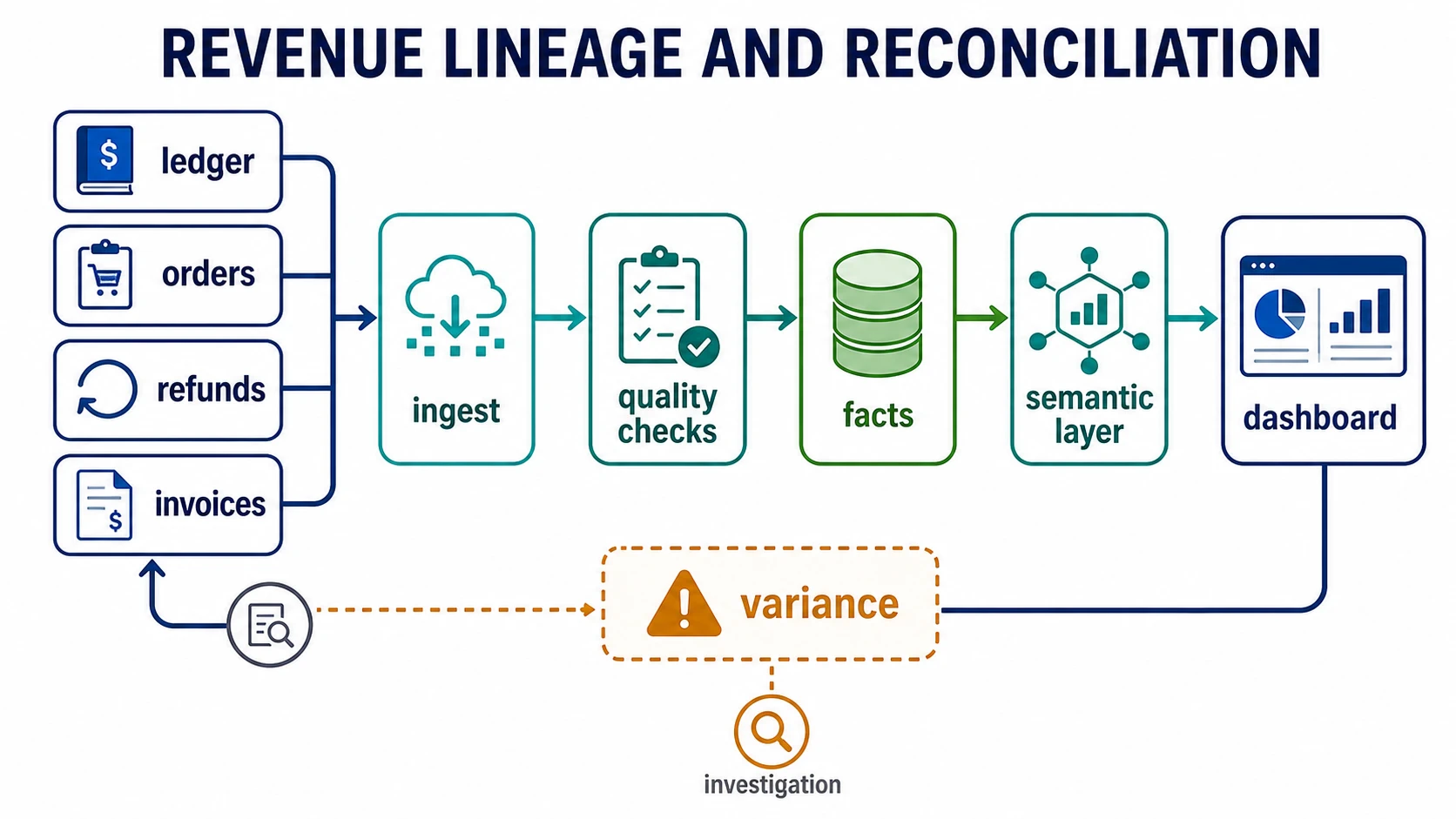
Name What Each Number Measures
The team begins by retiring the label revenue from the investigation. It is too broad to diagnose anything.
The $4.82 million sales number is June bookings: the value of signed orders and approved contract amendments attributed to the month. The contract system owns whether an order was signed and which version superseded it. Bookings can describe future commercial commitment, but they do not prove that the company invoiced, collected, or recognized the amount.
The $4.61 million product number is an operational estimate of monthly recurring revenue. It is derived from subscription state, plan history, discounts, cancellations, and entitlement changes. The subscription service owns whether the customer may use a feature now. It does not own the finance treatment of a service credit or a backdated contract correction.
The $4.38 million finance number is recognized revenue for the closed period. Its authority is the finance-controlled ledger and the close process that approved the entries. It is not a live measure of product access, cash collection, or pipeline momentum.
Once the names are precise, the contradiction shrinks. The three totals answer different questions. The real defect is that the board chart called one of them simply “revenue” and offered no way to discover which question it answered.
The source-truth map follows facts rather than systems as a whole. The contract system owns signed orders and amendments. Billing owns issued invoice lines, voids, and credit notes. The payment or ledger path owns settled cash. The subscription service owns entitlement and subscription transitions. The historical price catalog owns the price and package that applied at the time. The customer master owns account hierarchy and segment history. The finance ledger owns recognition entries and closed-period adjustments.
These boundaries do not make the warehouse less useful. They tell it what kind of copy it holds. A modeled invoice fact is derived from billing authority; an MRR aggregate is derived from subscription and price history; a closed revenue view is derived from ledger entries and finance approval. Every copy keeps the source identifier, source version, business timestamp, ingestion timestamp, and transformation version needed to trace it home.
Follow One Customer Through the Disagreement
The investigation takes the large June upgrade as its test case. One customer is more revealing than another aggregate query because it forces each pipeline to expose its choices.
The signed amendment increased the annual contract value on June 18. Sales therefore included the amendment in June bookings. Product activated the higher tier that day and calculated the customer’s new monthly run rate. Billing issued a prorated invoice line, then a service credit after a support incident. In July, finance approved a correction that moved part of the service period out of June.
At least five grains are present:
- one contract amendment;
- one version of an invoice line;
- one subscription state transition;
- one customer in one reporting month;
- one finance-approved recognition entry.
Joining these rows without naming their grain creates multiplication that can look legitimate. An invoice line joined to several subscription events may be counted several times. A customer-month fact hides the sequence of an upgrade, credit, and correction. A current customer dimension rewrites the June segment after an account reclassification in July. A current plan name makes an old invoice appear to have been sold under a package that did not yet exist.
The team therefore keeps event-level and document-level facts at their natural grains, then derives customer-month aggregates explicitly. Historical reports use dimension values effective for the event or close. A separate restated view may answer how today’s segmentation classifies the past, but its title must say so. Convenience is allowed; invisible rewriting is not.
This is the first durable lesson from the dispute: semantic arguments often conceal grain and time arguments. Before debating a formula, state what one row means and which clock assigns it to a period.
Make Ingestion Capable of Saying “Not Ready”
The late billing export explains part of the gap. The warehouse loaded contracts, subscriptions, and customer changes on schedule, then published while billing was incomplete. Precision survived; completeness did not.
Revenue ingestion needs a publish contract for every source. The contract names the extraction method—change stream, batch export, API pull, file delivery, or controlled manual adjustment—and the expected cadence, timezone, cutoff, and completion signal. That signal might be an export manifest, source watermark, record count, checksum, control total, or finance-approved close file. “The job succeeded” is insufficient if the job received only seven of eight pages.
Identity and mutation behavior belong in the same contract. The pipeline must know the source key and version, how retries are deduplicated, and whether a change appears as an update, reversal, void, deletion, backdated correction, or new compensating entry. It must preserve event time separately from processing time. Schema rules cover required fields, decimal precision, currency representation, document status, and enum changes. Replay rules explain how to rebuild one source, customer, or period from retained input.
Change data capture is useful when durable database changes carry enough context. A finance-approved batch may be the stronger boundary when the source publishes a closed export. An external system may leave an API or file as the only practical path. The mechanism matters less than whether completeness, identity, ordering, mutation, and replay are explicit.
For executive reporting, missing input is a visible state, not a warning buried in a job log. The June view remains withheld until required sources have declared completeness. Exploratory users may see a preliminary estimate, but the interface names the missing source and last successful watermark. A polished partial number must never masquerade as a closed one.
Give Business Language an Owner
With complete inputs and stable grains, the team can define the metrics. The semantic layer is where modeled data becomes business language, and each consequential term needs an owner.
Finance owns recognized revenue and its close treatment. Revenue operations owns bookings. Product analytics owns trial conversion and may own an operational MRR estimate. Ownership includes the authority to define the metric for a named audience, not ownership of every input fact.
A definition states its grain, inclusions, exclusions, adjustment treatment, and time basis. For MRR, the team decides how trials, internal accounts, one-time fees, usage charges, discounts, credits, cancellations, reseller accounts, and mid-month changes behave. For recognized revenue, it identifies the ledger entries and finance approval that make a period publishable. Every definition has an effective date and worked cases for an upgrade, downgrade, refund, cancellation, and backdated correction.
Definitions need versions because meaning changes. A pricing model, reseller program, currency policy, or customer hierarchy can force a legitimate revision. The system records whether a new definition applies prospectively, restates history, or creates a parallel series. A dashboard that silently adopts the newest formula for every past month destroys the ability to explain what the board previously saw.
The immediate fix for the packet is modest. The chart becomes “Recognized revenue — June closed,” displays the close date and semantic version, and links to its owner and reconciliation record. Bookings and operational MRR remain available under their own names. Agreement is not the goal; intelligible difference is.
Reconcile Before Release
Quality checks protect the path at several boundaries. Arrival checks establish that required manifests, watermarks, counts, and control totals exist. Schema checks reject missing identifiers, unknown currencies, invalid document states, or unsafe numeric changes. Uniqueness and referential checks expose duplicate lines and orphaned customers, contracts, plans, or accounting periods. Transformation checks constrain when negative amounts, reversals, credits, voids, and corrections are valid.
Those checks can prove that the pipeline behaved as designed and still leave the design wrong. Reconciliation tests the derived answer against the authority for the same scope. Invoice totals tie to billing by period, currency, document status, product, and adjustment class. Settled payments tie to settlement or ledger records. Recognized revenue ties to finance-approved entries. Subscription counts tie to product state for the stated cutoff.
The difference itself becomes data. The team opens a variance ledger and classifies each amount as timing, cutoff, currency, tax, credit, refund, discount, manual adjustment, definition, source omission, or defect. A classified timing difference may be acceptable in a preliminary view. A finance-approved adjustment may be legitimate. An unexplained variance blocks release even when it falls below a convenient percentage; a small transformation defect can expand with the next region or pricing model.
The June investigation now has a repeatable trace. Reviewers select five customers, including the upgraded account, and move from source documents to raw landing records, modeled facts, semantic output, and dashboard total. If a row cannot be followed or a difference cannot be classified, lineage is incomplete.
Close signoff joins the technical and business evidence. The finance owner confirms the treatment, the data owner confirms source readiness and transformation results, and the dashboard owner confirms the published definition, snapshot, and access surface. The evidence is attached to the period rather than reconstructed after the next disagreement.
Closed Does Not Mean Immutable Truth
Revenue facts continue to arrive after first publication. Refunds settle late. Contracts are corrected. Invoices are voided. Currency inputs change under a defined policy. Known mistakes are found. A trustworthy system must accept correction without allowing ordinary refreshes to rewrite history silently.
The team gives every reporting period a state. An open period changes as normal events arrive and shows source freshness. A preliminary period is under close review, and material or unexplained variances block executive publication. A closed period points to a finance-approved snapshot, transformation version, semantic version, and reconciliation record. A corrected period names the prior snapshot, reason, approver, affected metrics, and communication.
Reprocessing starts from retained raw inputs and source metadata. A rebuild writes a candidate result beside the published snapshot, then produces a difference report. Reviewers decide whether each difference is late-arriving truth, an approved definition change, or a defect fix. Only the correction workflow can replace or amend a closed result.
This avoids two equally weak habits. Freezing every published value forces known corrections into private spreadsheets. Recomputing all history on every run makes prior reports impossible to reproduce. Mutable source history, versioned transformations, explicit period state, and controlled publication preserve both correction and accountability.
Restrict the Surfaces, Not the Explanation
Revenue data exposes contract terms, discounts, customer identity, payment events, support adjustments, compensation inputs, and other sensitive commercial or personal facts. Access therefore narrows as users move toward raw detail.
Raw landing data is available to the data platform and designated source owners for replay, audit, and diagnosis. Modeled facts are available to finance, analytics engineering, and approved operational owners, with row and column restrictions where the data requires them. Governed semantic metrics can reach a wider business audience. Executive or external reporting uses a separate publication path with close status, signoff, audit history, and correction controls.
Restriction must not make the number mysterious. A business user may lack access to an invoice row while still being able to see the metric owner, plain-language definition, input systems, freshness, close state, semantic version, and reconciliation status. Governance should reduce unauthorized exposure without restoring “trust us” as the analytical method.
Metric lifecycle is part of the same work. Owners announce breaking definition changes, retire obsolete dashboards, and review both access and usage. A bookmark is not a reason to keep publishing a stale definition forever.
The Revenue Data Product Record
Before an executive or finance-facing metric is released, its record must let a skeptical reviewer answer these questions:
- What decision does the metric support, and who has authority to publish it for that audience?
- Which system owns each input fact, and what identifiers and completion signals arrived?
- What does one fact row and one published aggregate mean?
- Which events, adjustments, currencies, and dates are included or excluded?
- Which semantic and transformation versions produced this result?
- Are all required sources ready, and is the period open, preliminary, closed, or corrected?
- Which quality gates ran, what did the result reconcile to, and how were variances classified?
- Which raw inputs and snapshots make replay and explanation possible?
- Who may inspect raw, modeled, semantic, and executive surfaces?
- Who owns correction, communication, cost, retention, and retirement?
This is a compact data product record, not a second warehouse. It should live beside the metric in the catalog, model repository, or dashboard so that ownership and evidence remain easier to find than an unofficial copy.
Close June Again
The team reruns the June close as a release drill. It freezes the window and records the timezone, currency basis, and cutoff. Billing, payments, credits, subscriptions, contracts, customer history, exchange rates, and finance adjustments each provide a completion signal. The pipeline runs identity, schema, referential, freshness, and transformation checks before any executive view can publish.
Reviewers then reconcile billing, settlement, subscription, and recognition totals to their respective authorities. They classify the variance ledger and trace the five selected customers end to end. The large upgrade now explains three intentional outcomes: June bookings include the signed amendment; operational MRR reflects the product change under its stated proration rule; recognized revenue follows the corrected service period and approved credit.
Finance approves the candidate snapshot. The system records the snapshot ID, semantic version, transformation version, source watermarks, approvers, and closed status. Only then does the executive chart return to the packet.
The three original totals have not been forced into one. They have been given honest names, boundaries, and uses. The board receives one closed number for its stated question; sales and product retain different measures for theirs. If a late correction arrives, the correction path will show what changed and why.
A revenue number is trustworthy when disagreement can be investigated without private spreadsheets or institutional memory. Its authority comes from traceable facts, explicit meaning, and a release process that can withhold, reproduce, reconcile, and correct it. The next case moves those obligations across regions and tenant boundaries, where every analytical copy becomes part of the placement and recovery promise.