Production Data Systems Handbook / Chapter 43
Security, Privacy, Compliance, and Abuse Resistance
Design data-system protection across every copy, operator path, log, backup, export, audit trail, deletion workflow, and abuse surface.
Preparing audio…
Audio edition
Security, Privacy, Compliance, and Abuse Resistance
Protection Follows the Data
The account-deletion job says complete. The primary user row is gone, and the support console no longer finds the account. Yet the same phone number remains in a failed-job payload, a fraud feature, a warehouse table, a debug trace, and a backup that can restore all of them. Nothing broke during deletion. The job removed exactly the copies it knew about.
Security, privacy, compliance, and abuse resistance are not separate review boxes added after the database design is finished. They are properties of the data system. Protection has to travel with the fact through collection, modeling, storage, queues, caches, derived stores, logs, traces, metrics, exports, notebooks, support tools, backups, restores, audits, and incidents.
The durable rule is simple: every copy is a control surface. If the system creates, moves, observes, exports, restores, or investigates a sensitive fact, the design must say who can reach that copy, why the copy exists, how long it remains, how it is protected, how it is audited, how deletion reaches it, and how abuse would be noticed.
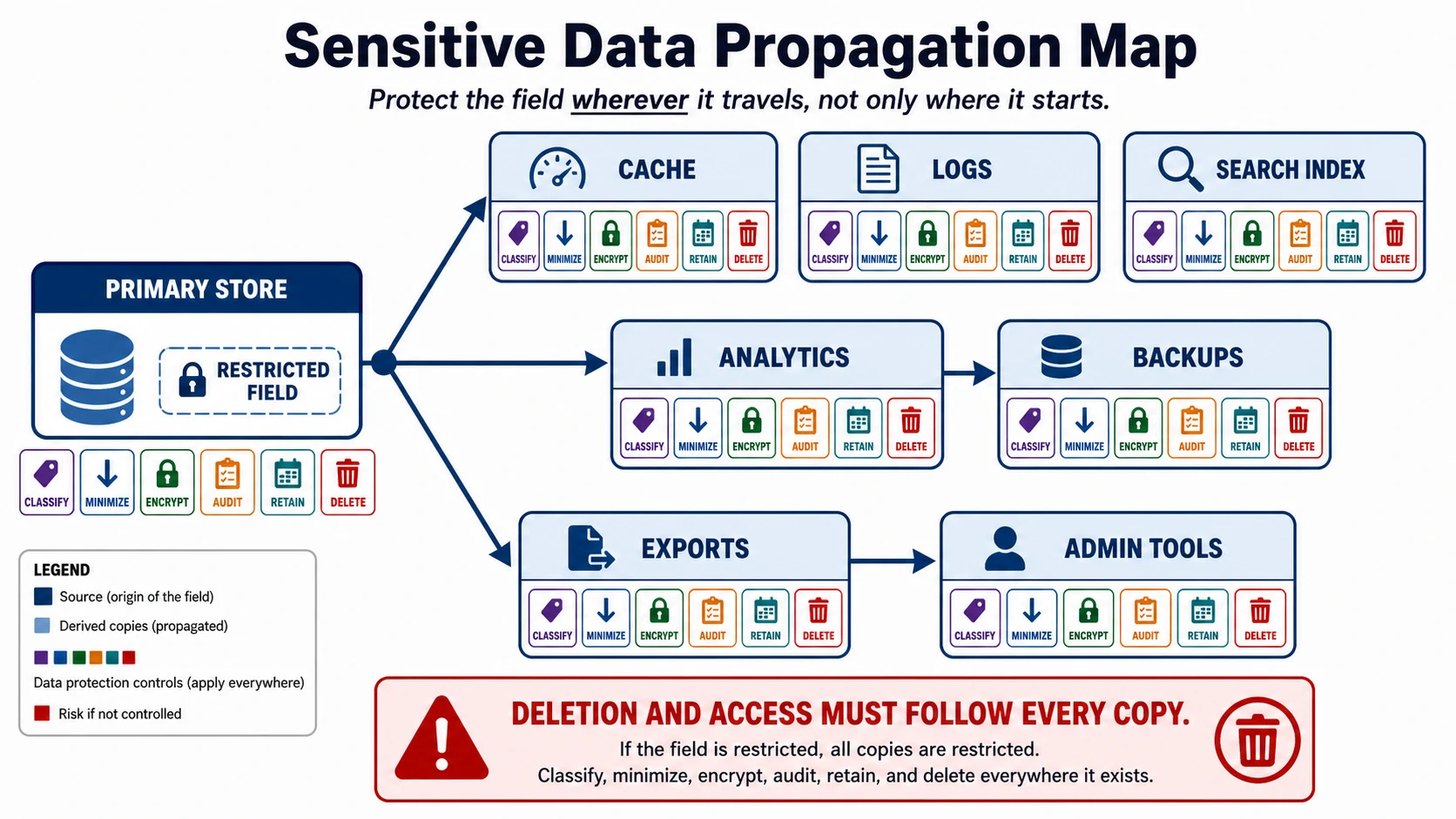
The Protection Boundary
A data-system protection boundary is wider than the database account list. It includes all identities and paths that can create, read, mutate, copy, infer, or restore protected data. Users, operators, services, batch jobs, business-intelligence tools, data science notebooks, support tools, incident workspaces, export jobs, and backup processes all belong inside the review.
Start with one sensitive field rather than a whole platform. Suppose a signup flow collects a phone number for account recovery and abuse prevention. The primary user table is only the first stop. The value may also enter a verification provider request log, an event stream, a fraud feature, an account-search index, a support timeline, a data warehouse, a failed-job queue, a trace attribute, a dead-letter payload, a backup snapshot, and a customer export. Each copy has a different access path and a different failure mode.
That map should change engineering decisions. The account-search index may store only the last four digits or a keyed lookup token. The support timeline may show a masked value unless a higher permission is granted. The event stream may separate operational events from raw contact details. The trace instrumentation may mark the field as forbidden. The warehouse transform may hash or drop the field unless an approved use requires it. The restore procedure may replay deletion tombstones before restored data is made available.
This is why “we encrypt the database” is not a protection model. It is one control on one copy.
Classify Fields Where Controls Execute
Classification is useful only when it changes system behavior. A label in a policy document does little by itself. A label attached to a field, schema, event, dataset, or API response can drive logging rules, export review, masking, retention, access approval, and quality gates.
A practical classification scheme can be small: public, internal, confidential, restricted, and regulated. The exact words should come from the organization, and legal or privacy owners decide legal conclusions. Engineering’s job is to make the classification operational enough that systems can enforce it.
Classify fields, not only tables. A customer record may contain a public display name, internal lifecycle state, confidential support notes, restricted recovery factors, and payment-adjacent references. Treating the table as one class either overexposes sensitive fields or blocks reasonable use of ordinary fields.
Classification belongs in places engineers already touch:
In a schema or event contract, it decides whether a field may be logged, indexed, joined, exported, or retained. At an API boundary, it decides which caller receives the raw value, a masked value, an aggregate, or nothing. In a pipeline, it triggers redaction, tokenization, aggregation, or removal. In a catalog, it identifies the datasets that require owner approval, access review, retention, and deletion behavior. In test tooling, it prevents production-like values from crossing into lower environments.
The review should include negative rules. Some fields should not appear in logs. Some should not become metrics labels. Some should not enter search. Some should not be copied to analytics without transformation. A forbidden destination is easier to enforce than a vague instruction to “handle carefully.”
Access Is a Data Path
Authentication identifies the human, service, or workload. Authorization decides what that identity can do to which data, at what scope, through which path. Production data systems need both across application traffic, operator consoles, scripts, pipelines, dashboards, notebooks, support tools, and emergency workflows.
Least privilege should be expressed as data plus action plus scope. “Read customer data” is too broad. Better grants say whether an identity can read masked or raw values, one tenant or all tenants, one workflow or every workflow, live production data or delayed aggregates, ordinary lookup or bulk export, reversible action or destructive mutation.
Operator paths deserve the same design attention as user paths. Many real exposures happen through internal tooling that was built for speed: support impersonation, global search, unrestricted CSV export, ad hoc SQL consoles, backfill scripts, data repair forms, and customer-success dashboards. These tools often bypass application authorization because they sit “inside” the company. Inside is not a security boundary.
For the account-recovery phone number, a support agent may need a tenant-scoped match and the last four digits, not the raw value or a global search result. A raw reveal should require a narrower permission, a stated reason, and an audit event. Cross-tenant search should be rare and reviewable. Mutations should preview affected rows and show rollback or repair options. Screenshots and ticket attachments should avoid raw sensitive values unless the case requires them and the storage path is approved.
Service accounts need the discipline usually reserved for humans. Each account should have an owner, purpose, allowed data classes, allowed actions, credential type, rotation path, expiration or review date, and audit trail. A pipeline service account that can read the entire warehouse because the first version needed convenience is a latent incident. A job that writes derived features should not automatically have permission to read unrelated raw identifiers.
Break-glass access is not an exception to design. It should be short-lived, approved according to policy, logged, monitored, and reviewed after use. It should also work during an incident. A beautifully strict access model that prevents recovery at 03:00 will be bypassed under pressure.
Logs, Traces, Metrics, and Audit Records
Observability is part of the data system. Logs, traces, metrics, profiles, error reports, and audit trails can preserve enough detail to diagnose production while also creating some of the most widely copied sensitive datasets in the company.
Application logs should treat sensitive values as hostile inputs. Redaction at the sink is useful, but it is not enough if raw values pass through formatting libraries, exception messages, structured log fields, retries, dead-letter queues, or third-party error reporters first. Safer designs avoid placing protected values into loggable objects, metrics labels, trace attributes, and exception text at all.
That decision changes the phone-number path. The verification request can carry an internal subject identifier while the provider call receives the number only at the final boundary. The event records that verification was requested, not the contact value. A failed job stores an opaque reference to controlled input instead of serializing the whole request. The trace connects the steps with a correlation id. Diagnosis remains possible without turning every observability store into a contact database.
Debug flags need expiration. A temporary diagnostic mode that prints request bodies can outlive the incident that justified it. If verbose logging is needed for a tenant or workflow, scope it, time-box it, route it to a controlled store, and record why it was enabled.
Audit logs have the opposite problem: they must be complete enough to reconstruct sensitive actions without becoming a second copy of the sensitive data. A useful audit event records actor, subject or tenant, target object, action, permission path, reason, source system, timestamp, correlation id, and outcome. It usually should not record the full old and new value of every restricted field unless that detail is required and protected accordingly.
Audit integrity matters. If administrators can both perform a sensitive action and erase the evidence with the same credential, the audit trail will not support investigations. Append-only storage, restricted write paths, separation of duties, retention policy, and alerting on unusual audit patterns all make the trail more useful.
Encryption, Keys, and Secrets
Encryption is necessary, but it does not replace access design, minimization, or deletion. Encryption in transit protects data moving between clients, services, stores, operators, and providers. Encryption at rest reduces some storage-media and infrastructure risks. Field-level or application-level encryption can reduce exposure when infrastructure administrators, broad replicas, analytics systems, or lower-trust stores should not see particular values.
Key management is where the design becomes operational. The system should name key owners, rotation process, emergency rotation path, backup relationship, restore procedure, access policy, and blast radius. A key that encrypts every tenant and every environment creates a different risk profile from a key scoped by tenant, region, data class, or workload. A backup encrypted with a lost key is not a backup. A restore process that requires a key no responder can access is not a recovery plan.
Secrets are data too. Database passwords, API tokens, signing keys, webhook secrets, session material, and provider credentials should not enter logs, traces, metrics, crash dumps, notebooks, container images, shell history, code repositories, or ticket comments. Secret scanning and redaction help catch mistakes, but the stronger design is to keep secrets out of ordinary data paths.
Rotation must be rehearsed. If rotating a database credential requires hand-editing production config, restarting every consumer at once, and hoping no old worker survives, the team has converted a security control into an outage risk. Credential rotation, key rotation, and service-account replacement should have runbooks, staged rollout paths, and verification.
Retention and Deletion Across Copies
Privacy starts before storage. If the system does not need a field for a defined purpose, do not collect it. If a lower-precision, derived, tokenized, aggregated, or delayed value satisfies the workload, prefer it. Minimization reduces breach impact, access-review burden, export complexity, and deletion work.
Retention should be attached to purpose. Active service data, fraud-prevention evidence, financial records, operational logs, audit trails, customer exports, backups, and incident artifacts may have different reasons to exist and different retention rules. Legal and privacy owners decide the legal obligations; engineering must make the data lifecycle explicit and enforceable.
Deletion is a propagation workflow, not a single SQL statement. A user deletion, account closure, tenant offboarding, or privacy request may need to affect primary rows, object storage, search documents, caches, event-derived projections, warehouse tables, feature stores, exports, support attachments, and future restores. Some copies can be deleted immediately. Some may be anonymized. Some may expire by policy. Some may require tombstones that are replayed into derived systems.
Backups need special treatment. Many backup systems are intentionally immutable or expensive to mutate. The design should say whether deletion reaches backups through expiration, cryptographic erasure, tombstone replay after restore, restore quarantine, or another approved method. The dangerous gap is not that backups behave differently; it is that no one knows what will happen after a restore.
Test deletion like recovery. Create a representative subject, let the phone number propagate, delete the subject, and verify primary stores, derived stores, indexes, caches, exports, and restore procedures. The acceptance criterion is stronger than a successful job: the value cannot reappear after a restore or rebuild except through an explicitly approved retained copy.
Abuse Resistance
Abuse resistance protects against misuse by outsiders, customers, insiders, compromised accounts, and technically authorized automation. The system should assume that some access will be valid according to a permission check but suspicious according to context.
Bulk export is the classic control point. A user who can view one account may not need to export every account. A support agent may need tenant-scoped lookup but not global download. A service may need a daily aggregate but not raw event history. Export paths should include scope limits, row limits, rate limits, purpose capture, approval for sensitive classes, watermarking where useful, and audit events.
Query controls protect privacy and availability together. Unbounded scans, high-cardinality joins, repeated lookup of unusual tenants, sudden access to dormant accounts, broad search over restricted fields, and repeated failed authorization checks can all signal risk. Controls can include query allowlists, cost limits, tenant filters, anomaly detection, adaptive throttles, and separate review for raw sensitive joins.
Abuse controls should also cover mutation. Admin tools that merge accounts, override entitlements, erase events, reissue credentials, change ownership, or backfill customer-visible state need guardrails: preview counts, dry runs, two-person approval for high-risk actions, idempotency keys, repair plans, and audit records.
The goal is not to make every action slow. The goal is to make normal, scoped, explainable work fast and make unusual, broad, destructive, or sensitive work visible.
Compliance Evidence Without Legal Guessing
Compliance work turns obligations into evidence. Engineers should avoid making legal conclusions about named laws, notification timelines, or jurisdiction-specific duties unless authoritative owners have decided them. The engineering responsibility is to produce reliable facts and controls: data classification, lineage, access records, retention behavior, deletion evidence, encryption posture, audit trails, incident timelines, and control test results.
A useful compliance posture is reviewable. When asked “where does this restricted field go?” the team can show the propagation map. When asked “who accessed this tenant’s data?” the team can query the audit trail. When asked “was deletion propagated?” the team can show job results and restore behavior. When asked “why does this service account have access?” the team can point to owner, purpose, approval, and last review.
Do not confuse a screenshot of a control with evidence that the control works. Evidence should come from repeatable checks where possible: policy-as-code, access-review exports, retention jobs, deletion reconciliation, backup restore drills, key-rotation logs, audit-log integrity checks, and sampled support-tool reviews.
Exposure Response
A data exposure incident differs from an ordinary availability incident because careless response can create more exposure. The team still needs containment, triage, mitigation, verification, and learning, but the evidence-handling rules are stricter.
First, stop ongoing exposure without destroying evidence. Disable a route, revoke a credential, pause an export, rotate a secret, remove a bad index field, or block a query path as appropriate. Preserve logs and audit trails according to the incident process.
Second, establish the facts. Which data classes were involved? Whose data? Which copy? Which actor or system? What time window? Was data merely accessible, actually accessed, exported, restored, logged, or sent onward? Was the data encrypted, masked, tokenized, aggregated, or raw? Which controls worked and which failed?
Third, keep the investigation from multiplying the incident. Do not paste raw rows into chat. Do not export entire tables to personal workstations. Do not attach unrestricted screenshots to tickets. Use controlled workspaces, scoped queries, redacted samples, evidence identifiers, and logged investigation steps.
Legal, privacy, security, communications, and business owners decide notification, contractual, and regulatory conclusions through the approved process. Engineering supplies accurate evidence and implements containment, repair, monitoring, and hardening.
Data Protection Review
Use the propagation map as the review artifact before launching or materially changing a data path. Start with field-level classifications, then draw every primary and derived copy: queues, caches, logs, traces, metrics, search, analytics, feature stores, exports, backups, support tools, and incident artifacts. An omitted copy cannot inherit a control.
Annotate each copy with its purpose, owner, retention rule, disposal mechanism, and the human or service identities that can reach it. Describe access as data, action, tenant scope, purpose, and review date. Service accounts also need a credential lifecycle, rotation path, and audit trail. Mark where raw data becomes masked, tokenized, aggregated, encrypted, or absent; where keys are recovered during restore; and where secrets could accidentally enter an ordinary data path.
Now follow two exceptional paths across the map. First, delete the subject. Show primary deletion, derived deletion or anonymization, backup expiration or quarantine, tombstone replay, and the evidence that proves a rebuild cannot resurrect the value. Second, assume a credential or internal tool is misused. Show which bulk exports, cross-tenant searches, sensitive joins, unusual query volumes, raw reveals, and destructive actions are limited or detected, then identify the controlled evidence workspace and the owners who decide containment and communication.
A reviewer should be able to reject vague marks such as “encrypted,” “audited,” or “deleted.” The map should name the control, where it executes, how it is tested, and what evidence remains. That is the difference between a compliance assertion and a data-system design.
Propagation Drill
Pick one sensitive field that already exists in production: email address, phone number, government identifier, payment reference, precise location, support note, authentication secret, fraud signal, or tenant-specific business record. Trace it from collection through every primary and derived path. Include queues, caches, logs, traces, metrics, search, analytics, feature stores, object storage, exports, support tools, service accounts, backups, restore procedures, and incident artifacts.
For each copy, answer six questions:
- Why does this copy exist?
- Who or what can access it, and at what scope?
- What transformation, masking, tokenization, aggregation, or encryption protects it?
- How long does it remain, and what removes it?
- How does deletion or anonymization reach it, including after restore?
- What audit or anomaly signal would reveal misuse?
Then run the uncomfortable test: remove or mask the field in a staging-like environment, rebuild derived systems, perform a restore drill if feasible, and inspect whether the value reappears. Any unknown copy is not a minor documentation gap. It is an uncontrolled data system.