Production Data Systems Handbook / Chapter 46
FinOps for Data Systems: Cost as a Design Constraint
Treat data cost as an architectural constraint by making storage, compute, I/O, duplication, retention, ownership, and containment visible before bills become production surprises.
Preparing audio…
Audio edition
FinOps for Data Systems: Cost as a Design Constraint
One Event, Ten Cost Surfaces
A SaaS product records a DocumentViewed event. At first the event has one job: populate a recent-activity feed. Then support asks for searchable history. Security needs anomaly detection. Product analytics wants funnel metrics. A feature pipeline needs engagement aggregates. Enterprise customers want exports. Compliance requires longer retention for a subset of accounts.
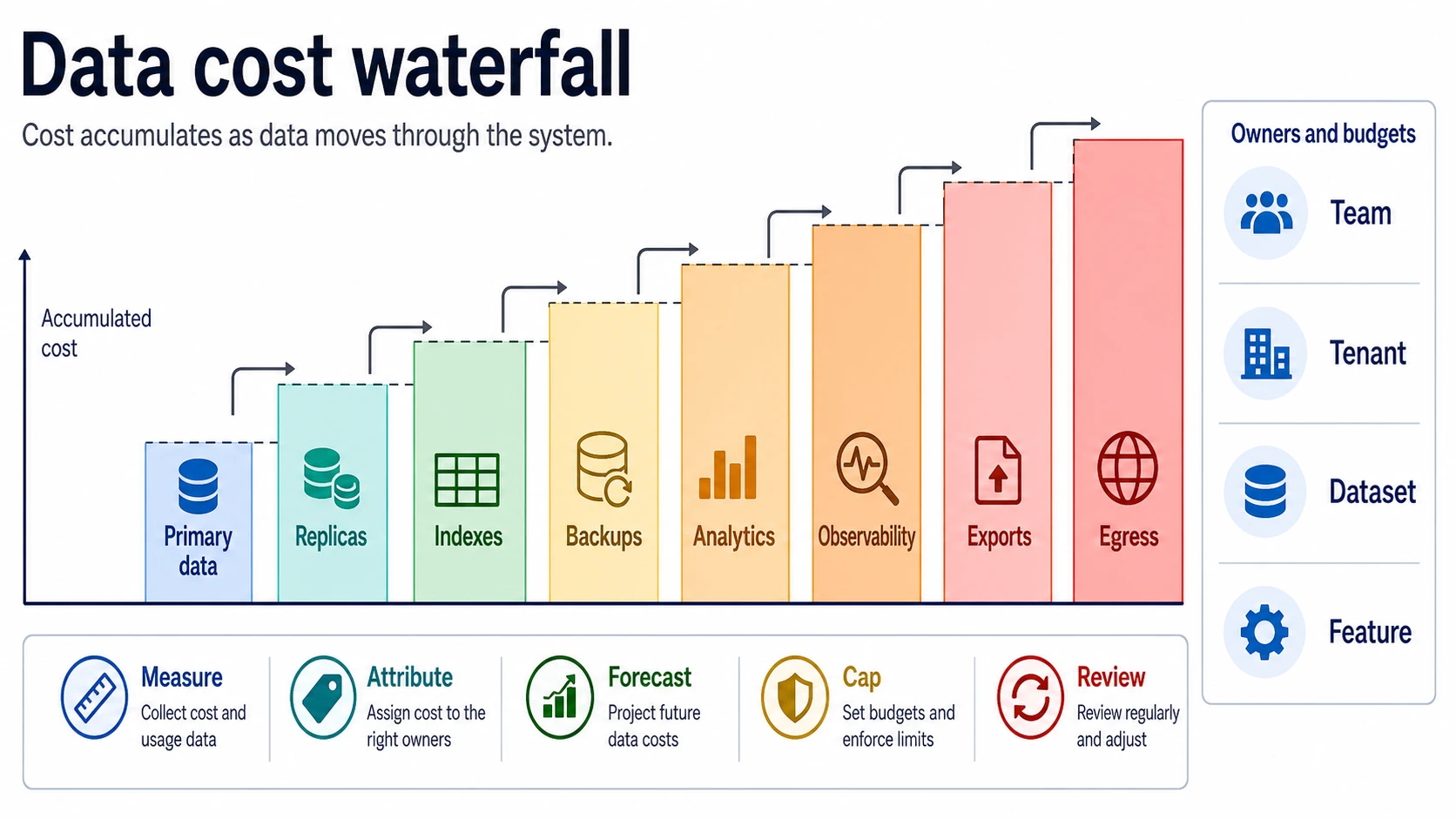
The event now exists in the application database, a descending activity-feed index, a search index, the warehouse, a daily feature table, an observability stream, export files, a masked staging copy, and several backup generations. Hourly dashboards repeatedly scan its warehouse history. None of these choices is absurd. Each solved a real local problem.
Then the monthly data bill jumps. Calling the bill “warehouse spend” or “storage growth” does not explain it. Which copy grew? Which work multiplied? Did a new tenant produce unusual volume, did one dashboard lose partition pruning, did a deployment add a high-cardinality log field, or did an export begin crossing a regional boundary? More important, which response is safe? Pausing a dashboard is different from shortening audit retention; sampling debug logs is different from losing the traces needed during an incident.
FinOps for data systems begins before anyone bargains over a bill. It turns retained bytes, copies, queries, movement, and operational promises into named parts of the architecture. The aim is deliberate spend: enough to keep the system’s product, reliability, recovery, privacy, and support promises, without paying indefinitely for work nobody can justify.
Follow the Work, Not the Invoice
Durable cost reasoning starts with mechanics, not vendor price sheets. A useful first model is:
data cost =
  bytes retained
+ copies maintained
+ work performed over those bytes
+ data moved across boundaries
+ operational promises kept
+ human time required to govern and recover the system
This model is intentionally plain. Vendor prices change; the shape of the work changes more slowly. It gives the DocumentViewed review somewhere to begin.
Bytes retained include primary records, historical versions, change data, logs, metrics, traces, files, indexes, snapshots, backups, archived objects, and tombstones. A cheap byte has a known purpose, tier, owner, deletion rule, and restore expectation. A byte kept because nobody knows whether it is safe to remove carries operational and privacy debt along with storage cost.
Copies maintained include replicas, read models, search indexes, caches, materialized views, feature tables, warehouse tables, development snapshots, partner exports, and model-training datasets. Copies are often worth the money. They reduce latency, isolate workloads, preserve recovery options, or serve a different access pattern. They become waste when their consumers, freshness promise, access policy, rebuild path, and shutdown condition are unknown.
Work performed over bytes includes point reads, range scans, joins, aggregations, compaction, indexing, vector search, backfills, replay, validation, reconciliation, report generation, dashboard refresh, and exploratory analysis. A small table can be expensive if it is scanned continuously. A large dataset can be manageable when partitioning, clustering, materialization, and scheduling align with real queries.
Data moved across boundaries includes cross-region replication, data lake reads, warehouse unloads, partner feeds, SaaS observability export, customer export, support tooling, and movement between accounts, clouds, clusters, or networks. Movement is a design edge. If the architecture diagram shows data crossing an ownership, region, vendor, or trust boundary, the cost model should name the reason and the owner.
Operational promises kept include availability, backup retention, point-in-time recovery, disaster recovery, auditability, legal hold, privacy deletion, observability, support investigation, and incident response. These promises have cost. Pretending they are free causes the team either to underfund them or to discover them as emergency spend.
Human time belongs in the model too. Manual tagging, unowned dashboards, ticket-based access, hand-run backfills, bespoke restore procedures, and spreadsheet allocation reviews consume engineering capacity even when the infrastructure invoice cannot show them.
Tracing the equation through the event path produces a cost waterfall. The primary write creates storage, I/O, an index, backups, and restore scope. Search and analytics add copies and transfer work. The feature table exchanges repeated computation for storage and freshness complexity. Observability adds ingestion, indexing, cardinality, and retention. Exports add object storage and boundary movement. Staging adds another lifecycle to govern.
The useful question is not whether there are too many copies. It is whether every copy has an owner, a reason, a consumer, a retention rule, an access policy, a rebuild or restore path, a forecast, and a shutdown condition. A search index may easily earn its cost by serving support under a clear freshness promise. A forgotten staging snapshot does not earn its cost merely because it is smaller than production.
Attribution Before Optimization
Optimization without attribution often damages the wrong thing. If a warehouse bill rises, a team may shorten retention, pause dashboards, or pressure analysts to run fewer queries. Those actions may miss the actual driver: one tenant with abnormal event volume, one unpartitioned dashboard, one release that doubled log cardinality, one backfill retry loop, or one development environment retaining production-sized snapshots.
Attribution answers the marginal-cost question: which decision, owner, workload, tenant, dataset, feature, environment, or operational promise caused the next unit of spend?
The right granularity depends on the system. A shared transactional database may need cost grouped by service, table family, index, environment, and high-volume tenant. A warehouse may need attribution by dataset, query pattern, dashboard, scheduled job, user group, and compute pool. Observability may need attribution by service, signal type, log level, metric cardinality, trace sampling rule, and retention tier. A data lake may need attribution by bucket, table, partition age, lifecycle tier, scan volume, and consumer.
Tags and labels help only when they match decisions people can change. A cost-center tag may satisfy accounting while teaching engineers nothing. Dataset owner, workload type, retention tier, environment, tenant class, feature, recurring job, and export destination are closer to the controls engineers possess.
Attribution will never be perfect. Shared indexes, cache hit rates, compression, compaction, query planners, and pooled compute make exact allocation hard. Do not wait for perfect precision. A useful model separates steady baseline cost from marginal growth, distinguishes production promises from development convenience, and identifies the few drivers large enough to influence decisions.
There is also a governance benefit. When a central platform hides every cost, teams learn that storage, scans, logs, and copies are free. When product teams receive raw bills without platform guidance, they may optimize unsafely. Good attribution pairs usage with interpretation: why the cost exists, whether it is healthy, and what safe options exist.
Change the Data Path Deliberately
Most data-cost control comes from a small set of design levers. They should be reviewed before launch and revisited when growth changes shape.
Retention. Decide how long raw events, derived facts, logs, exports, backups, and development copies live. Separate hot, warm, cold, archive, deletion, and legal-hold states. Tie each state to access and recovery needs rather than vague age buckets.
Granularity. Decide where the system needs raw events and where aggregates, samples, sketches, summaries, or control totals preserve the required signal. The feature table may need daily engagement counts, not every historical view event.
Layout and scheduling. Align partitioning, clustering, sort order, compaction, and file size with real query shapes. Put recurring work on an explicit cadence. A useful hourly dashboard can become waste when a lost partition predicate makes it rescan the entire event history.
Materialization. Repeated expensive computation may deserve an aggregate table, materialized view, search index, cache, or serving store. This trades storage and freshness complexity for lower repeated compute. The trade is healthy only when the consumer, refresh rule, and rebuild path are explicit.
Isolation. Separate exploratory, batch, support, and production-serving work. Query queues, warehouses, read replicas, compute pools, rate limits, and job schedulers prevent one workload from creating both reliability incidents and cost incidents.
Representation. Data types, serialization, columnar layout, compression, and cardinality affect both storage and scan work. Cost review therefore reaches schema and telemetry fields, not only infrastructure selection.
Copy control. Keep a ledger of derived stores, replicas, exports, indexes, environments, and snapshots. Every copy needs a reason to exist and a way to retire. The ledger is especially important for privacy deletion and incident response because stale copies are not only expensive; they are correctness and trust risks.
Observability discipline. Logs, metrics, and traces are production data. Give them field selection, cardinality review, sampling, retention tiers, ownership, and emergency controls. A debug field becomes an architectural decision when traffic, labels, and retention multiply it.
Environment shape. Development, staging, preview, and analytics sandboxes should not accidentally inherit production scale. Masked subsets, sampled snapshots, synthetic data, shorter retention, sleep policies, and teardown automation often reduce cost without weakening production safety.
None of these levers is universally good. Short retention can destroy evidence. Aggressive sampling can hide rare failures. Materialization can create stale decisions. Compression can increase CPU. Isolation can strand capacity. Each change must preserve the promise that justified the data in the first place.
Retention Begins With the Promise
Retention decisions fail when teams ask only “how long should we keep it?” The stronger question is “what promise does this data support while we keep it?”
Hot data supports live product behavior, urgent operations, and recent support. It needs low-latency access, strong ownership, backup and restore clarity, and tight correctness controls. Warm data supports investigation, replay, recent analytics, customer support, and delayed reconciliation. It can often tolerate slower access or scheduled compute. Cold data supports audit, legal hold, long-term dispute resolution, trend analysis, or rare model retraining. Archive data is retained because the organization has a durable reason, not because the team is afraid to delete it.
Different data classes deserve different treatment. Verbose application logs, security audit events, payment records, customer profile history, consent records, clickstream events, model features, warehouse aggregates, and database backups do not have the same value or risk. Some must be retained. Some must be deleted. Some should be transformed as they age. Some should never leave the source system.
For each class, record why it is kept, who may read it, how it can be restored or queried, and when it must be deleted or held. Those answers distinguish a usable archive from inert accumulation. They also prevent “cheap” long-term storage from becoming broad, forgotten exposure.
Legal hold and privacy deletion are not footnotes. A cost-saving deletion rule that ignores legal hold can destroy required evidence. A long retention rule that ignores privacy can preserve sensitive data after the reason for keeping it expired. The cost model should expose these constraints early because they often determine whether a proposed optimization is safe.
Let Curiosity Become a Workload Explicitly
Query governance has a bad reputation when it becomes a slow approval process for every question. The goal is different: keep exploratory work from silently becoming a production workload.
A one-time analyst query, a support investigation, a scheduled executive dashboard, a customer-facing report, and a fraud decision path deserve different controls. The same SQL text can be harmless once and expensive every hour. The same aggregation can be acceptable in an isolated warehouse and dangerous against the primary database. The same vector search can be an experiment in a notebook and a cost driver when placed on a high-traffic endpoint.
Useful query governance includes:
- timeouts and scan limits for shared systems;
- separate compute pools for production features, scheduled reporting, ad hoc analysis, backfills, and experiments;
- review for new recurring jobs above a defined work threshold;
- dashboard refresh budgets and ownership;
- materialization review for repeated expensive queries;
- partition and clustering checks for large tables;
- safe support-query paths that do not bypass access controls or overload production;
- scheduled windows and rate limits for backfills, replays, and reconciliation jobs.
The only control cannot be “ask permission.” Analysts and engineers need room to inspect, debug, and learn. Give them isolated compute, sampled datasets, query previews, dry runs, and cost estimates where possible. Trigger review when exploratory work becomes recurring, user-facing, high-volume, privacy-sensitive, or capable of harming production. That boundary would have caught the DocumentViewed dashboard when a useful investigation quietly became an hourly full-history scan.
Contain the Spike Without Breaking the System
A cost spike is an incident when it threatens a budget, a customer margin, platform capacity, reliability, auditability, or the ability to keep an operational promise. Treating it as a finance anomaly delays containment. Treating it as a reliability incident without cost context can break the system in the name of savings.
A cost runbook follows the incident movement the operator already knows:
- Detect the changed surface. Was it storage growth, scan volume, compute time, egress, observability ingestion, backup size, request count, or tenant usage?
- Attribute the change. Find the dataset, query, feature, release, tenant, job, environment, export, or retention rule that explains it.
- Contain safely. Pause, cap, reschedule, sample, tier, roll back, or isolate only after checking correctness, security, recovery, and customer commitments.
- Correct the design. Rewrite or materialize the query, restore partition pruning, retire a copy, change retention, add a quota, require attribution, or move the workload behind an isolation boundary.
- Move detection earlier. Put the missing forecast, owner, cap, or review trigger into the platform path that allowed the work.
Containment actions need safety labels. Pausing a noncritical dashboard is not the same as dropping audit logs. Reducing trace sampling during normal operation is not the same as reducing it during an outage. Stopping a runaway backfill is different from stopping ledger writes. A good runbook lists preapproved actions, actions requiring product or compliance approval, and actions that are forbidden without executive risk acceptance.
Return to the event scenario. If the hourly dashboard caused the spike, the team can pause or reduce its refresh rate while preserving the activity feed, security detection, and customer exports. If observability volume tripled during a real outage, indiscriminate sampling may remove the very evidence needed for recovery. The safe action depends on which promise the cost surface supports.
The post-incident question is therefore larger than “who ran the expensive job?” Ask why the system allowed unattributed or unbounded work to become recurring without a forecast, owner, cap, or safe isolation boundary.
Write a Cost Model the Team Can Revisit
Use this artifact in architecture review, platform onboarding, and quarterly operations review. It is not meant to produce fake precision. It is meant to make cost assumptions inspectable while there is still time to change the design.
Begin with the workload unit: cost per tenant, account, feature, dataset, event, query, report, export, or environment. A useful unit connects spend to growth and to a decision. For DocumentViewed, cost per million events may expose ingestion growth, while cost per tenant can reveal a customer whose exports or retention obligations make its marginal shape unusual.
Next, enumerate the surfaces: primary storage, indexes, backups, compute, I/O, requests, egress, observability, licenses, environments, and human operation. Put every replica, cache, export, warehouse table, feature table, snapshot, and nonproduction copy in a copy ledger with an owner and shutdown condition. Make cross-region, cross-account, cross-cloud, partner, vendor, and customer boundaries visible.
Forecast records, bytes, queries, copies, tenants, cardinality, retention, and planned backfills. State uncertainty instead of hiding it behind a precise total. Attach the retention states and query controls, then name the alerts, quotas, thresholds, review triggers, and safe containment actions. Rank optimization work by expected savings, correctness and privacy risk, operational effort, reversibility, and owner.
For a new data path, rough answers reveal missing decisions. For a critical or rapidly growing path, require evidence: usage history, load-test results, query plans, retention inventory, attribution coverage, cost dashboards, or an incident review. Keep the model beside the workload fingerprint and ADR. It is part of the evidence that a design can remain viable as load and promises change.
FinOps Review Drill
Pick one production data path: an event stream, observability pipeline, customer export, search index, warehouse table, feature store, or critical transactional table. Draw its cost waterfall from source truth to every copy, index, backup, derived table, dashboard, export, external tool, and nonproduction environment.
For each step, write five fields: owner, reason, retention rule, attribution tag, and shutdown condition. Then run three tabletop scenarios:
- Observability ingestion triples overnight during a real outage.
- A scheduled warehouse query starts scanning the full event table every hour.
- A cross-region export begins moving far more data than forecast.
For each scenario, separate immediate safe actions from approval-required actions. Identify one design change that would have prevented the spike or made it easier to contain.
If the team cannot name the owner, attribution path, and safe containment action for a cost surface, it does not yet control that surface. The bill is merely where the architecture finally became visible.