Production Data Systems Handbook / Chapter 47
Ethics, User Trust, and Organizational Decision Quality
Evaluate data-system decisions by their effects on users, operators, future maintainers, privacy, recoverability, recourse, and institutional decision quality.
Preparing audio…
Audio edition
Ethics, User Trust, and Organizational Decision Quality
Before Replaying the Queue
For two hours, a reservation service failed to publish expiry reminders. The reservations themselves are correct. The missing rows are known. The notification worker can replay them. Recovery appears to be one command.
It is not.
Some recipients opted out after the original event. Some reservations have expired. Another channel delivered some reminders, so a replay can create duplicates. The message may reveal account activity on a shared device. Support will need to explain why it arrived late. Analytics will count the replay as current engagement unless the events carry a remediation marker.
The queue is technically replayable, but that fact does not answer whether each message should be sent. The decision depends on current consent, the continuing truth of the message, duplicate suppression, user recourse, operational stop conditions, and the authority to accept what remains uncertain.
This is where ethics enters production data work: not as a declaration of values, but as a decision about who may be harmed, who holds authority, what evidence is sufficient, and how a wrong outcome can be repaired.
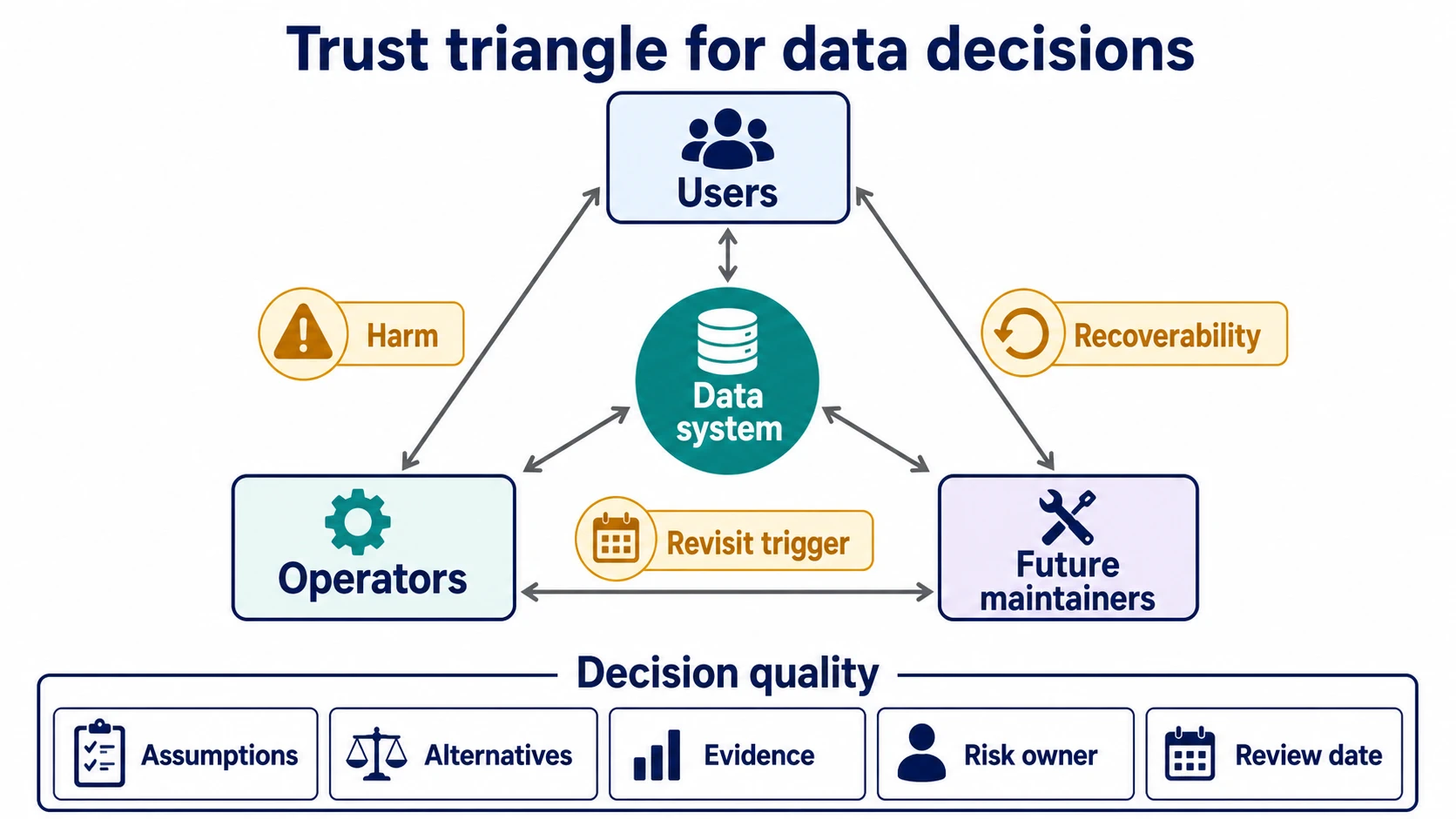
One Decision, Three Trust Surfaces
The user relies on several promises at once. A current preference should outweigh an old event. An expiry reminder should describe a reservation that still exists. A duplicate should not arrive because two delivery paths disagree. If the system gets this wrong, support—not the user—should carry the burden of reconstructing what happened and correcting it.
The operator needs a bounded action. The replay tool should preview the eligible population, scope by event window and tenant, recheck consent and reservation state, deduplicate across channels, record an approval, and stop when rejection or complaint signals cross a threshold. A command that accepts only a topic and an offset transfers the entire policy decision to the person at the keyboard, usually while an incident clock is running.
The future team needs to know why some events were sent and others suppressed. It needs the event schema, consent rule, deduplication key, reason code, approval, observed outcome, and expiry date of the exceptional replay policy. Without that record, a one-time recovery becomes folklore or, worse, a copied runbook step.
These are not three independent audiences. The same evidence serves all of them. A reason code lets support explain the message, lets on-call distinguish remediation traffic from ordinary delivery, and lets a later review measure whether the decision was sound.
Follow the Facts That Can Change the Decision
Begin with the source event, but do not mistake historical truth for present permission. The original record proves that a reservation once approached expiry. It does not prove that the reservation remains active or that the user may still be contacted.
For each candidate reminder, the recovery path should join or query the facts that can veto delivery:
- the reservation still exists and the reminder remains useful;
- the current consent and channel policy permits contact;
- no equivalent notification has succeeded;
- the deduplication key has not already been committed;
- the destination and message template still match the account’s current safety rules;
- the event will be labeled as remediation for support and analytics.
The join may be performed before enqueueing or at send time, depending on the consequences of stale reads. What matters is that the policy is explicit. A bulk selection made at 09:00 may no longer be safe at 09:20 if consent or reservation state can change in between.
The team also needs negative evidence: counts of events excluded because the reservation ended, consent changed, or another channel succeeded. Those exclusions prove that the replay enforced its stated policy. A total such as “12,418 messages sent” proves only that the worker was busy.
Make the Recovery Bounded
Preview is the first control. Before sending, the operator should see candidate, eligible, and excluded counts broken down by exclusion reason. A sample should show the source event, current reservation state, current consent, successful delivery history, intended message, and destination without exposing more sensitive data than the operator needs.
Execution then needs a stable operation identifier and per-message deduplication key. Retries should resume the same operation rather than create a new campaign. Rate limits keep support and delivery systems from being surprised. A canary batch makes the first consequences observable before the full population is contacted.
“Rollback” is often the wrong word for a notification: a message cannot be unsent. The honest control is a stop condition. The team might halt when duplicate detections exceed the expected baseline, rejection rates rise, support complaints show that the copy is misleading, or eligibility queries disagree with the canary results. Irreversible effects demand smaller batches and earlier observation, not optimistic rollback language.
Afterward, reconciliation should account for every candidate event as sent, suppressed with a reason, failed and retryable, or failed permanently. Support should be able to search by operation identifier. Analytics should exclude or separately classify remediation traffic. The exceptional permissions and temporary data should expire when the operation closes.
Decision Quality Under Pressure
Data-system decisions degrade when evidence is weak and identity is strong. Teams choose a database because it worked at a previous employer. They accept eventual consistency without naming the stale behavior. They keep sensitive data because deletion is hard. They buy a platform because a benchmark looks clean. They split a service because ownership is uncomfortable. They reject a migration because the old system is familiar.
Good decision quality does not require perfect certainty. It requires visible uncertainty. In the replay decision, the known facts include the incident window, candidate events, current reservation state, and delivery records. Assumptions may include the reliability of cross-channel deduplication or the usefulness of a message sent late. Disconfirming evidence might be an unexpectedly high suppression rate, consent-query disagreement, duplicate reports, or a support pattern showing that recipients are confused.
Look especially for missing measurements. Did anyone test restore time? Did anyone trace deletion propagation into search, cache, exports, and analytics? Did anyone measure write contention, query shape, queue lag, duplicate delivery, or support workload? Did anyone ask who is paged when a derived system is stale but the source truth is correct? Unknowns are acceptable when they are bounded, owned, and scheduled for review. They become dangerous when hidden inside confident prose or a convenient command.
A strong ADR separates what is known from what is assumed, records rejected alternatives fairly, and identifies evidence that would disprove the choice. A later team should be able to say, “This decision was reasonable under these constraints, and this new evidence tells us the constraints no longer hold.”
Risk Acceptance Is a Design Event
Not every risk should block delivery. Some risk is temporary during migration. Some is a product bet. Some belongs to finance, legal, security, support, or executive leadership rather than to an individual engineer. The failure is not accepting risk; the failure is accepting it vaguely.
“We accept eventual consistency” does not say what may be stale, for whom, for how long, under which user action, with what detection, or with what correction path. A reviewable decision is concrete:
During the catalog migration, search results may lag product updates by up to five minutes. Checkout reads price and inventory from source truth, deleted products emit tombstones to search and cache, support can see the last indexed version, and the migration owner reviews lag daily. If lag exceeds five minutes for more than thirty minutes, the team pauses the backfill and reverts the indexing change.
That statement can be challenged. It names scope, promise, mitigation, owner, and trigger. It also preserves the distinction between a tolerable stale discovery path and an intolerable stale checkout commitment.
Risk authority should match impact. An on-call engineer may choose a documented retry parameter. That does not necessarily authorize contacting thousands of users under an exceptional consent interpretation. Privacy-sensitive retention changes, financial correctness risks, broad customer communication, or irreversible deletion behavior usually require wider review. The ADR should name the decision owner and the forum whose authority covers the consequences; “engineering approved” is not enough.
Write the Trust Review
Use this artifact for data decisions that affect users, privacy, money, access, safety, support, on-call burden, or long-term maintainability.
Start with the promise the data path is meant to keep and the people who rely on it. Name the harm model in observable terms: incorrect, stale, missing, exposed, duplicated, over-retained, unrecoverable, or unexplained behavior. Trace the source truth and copies, including caches, search indexes, warehouses, exports, delivery providers, and support views.
Then record the evidence for the decision and the controls that convert concern into behavior: access limits, reason codes, audit history, dry runs, approvals, idempotency, stop conditions, deletion propagation, reconciliation, and support tooling. State the remaining risk after those controls in operational terms. Name the authority accepting it and the revisit trigger—a date, metric, incident, growth threshold, dependency change, or failed assumption.
Finish with recourse. Explain how a user, support agent, operator, or maintainer can detect a wrong outcome, understand why it occurred, correct what can be corrected, and escalate what cannot.
The review should be short enough to fit inside an ADR and specific enough to survive an incident review. If an item is not applicable, the reviewer should be able to explain why.
For the reservation incident, the completed review might authorize only currently valid, currently consented, not-yet-delivered reminders; require a canary and a support-visible reason code; and stop on duplicate or complaint thresholds. It might explicitly decline to contact users whose reservations have expired. That refusal is part of the engineering decision, not an omission from the recovery plan.
Trust Review Drill
Choose a proposed shortcut: export production data for analysis, skip a restore drill before launch, store user preferences only in a cache, backfill a derived table without idempotency, or retain raw events because a future team may want them.
Write the trust review before arguing for the design. Then test it against three questions:
- Who benefits immediately, and who bears the failure if the shortcut is wrong?
- What would support, on-call, or a future maintainer need to prove what happened?
- What evidence would force the organization to revisit or reverse the decision?
Now change one fact: consent can change during the operation, the data includes financial records, the derived copy is held by a partner, or the action cannot be reversed. Revise the controls and authority instead of merely raising the risk label.
If the review cannot name the affected parties, remaining risk, authority, and recourse, the design is not ready for a high-consequence path. When it can, ethics has become something the system can practice: preserve the right facts, refuse the unsafe action, explain the outcome, repair what went wrong, and leave the next team enough evidence to decide better.