Cybersecurity Engineering Handbook / Chapter 51
Cloud-Native Service Playbook
Ship cloud-native services through account boundaries, workload identity, exposure review, data controls, observability, rollback, incident response, and abuse limits.
Preparing audio…
Audio edition
Cloud-Native Service Playbook
A team is preparing to release a report-export service. An authenticated API accepts a request, a queue wakes a worker, the worker reads customer records, generates a file in object storage, and returns a short-lived download link. The platform supplies a production account, workload identity, private networking, managed storage, a secrets service, centralized logs, and deployment automation. Every component uses an approved service. The design can still expose every customer’s reports.
The worker may have inherited permission to read all storage. The bucket may be private while its signed links live for a week. A public gateway may route an administrative replay endpoint. A retry storm may generate the same costly report hundreds of times. Logs may faithfully record the download link that bypasses authentication.
Cloud guardrails are useful only when the application consumes them with a narrow claim about its own behavior. For this service, the claim is: one tenant may request one authorized report; one bounded worker may produce it from that tenant’s records; one intended recipient may retrieve it briefly; and the team can contain a bad deployment, stolen identity, or abusive request without losing the evidence needed to understand it.
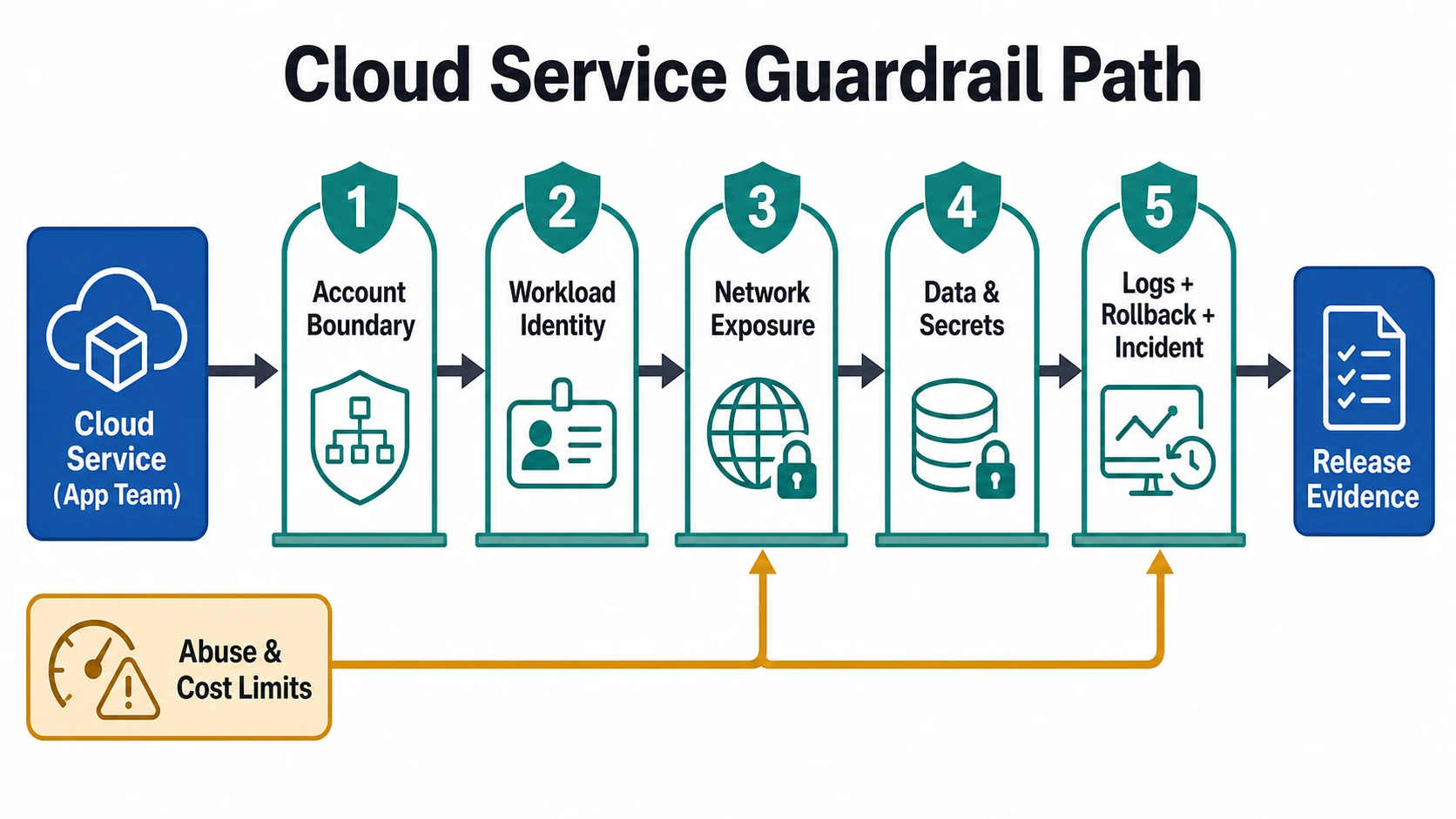
Place the service inside a boundary that can contain it
The report service belongs in an account, project, subscription, or folder whose ownership, environment, policy, logging, billing, and incident path are unambiguous. Production must not be separated from development by a name alone. A useful boundary prevents a development credential, policy change, network route, or experimental job from quietly acquiring production authority.
Before selecting a smaller or shared boundary, ask what must be contained together. The API, queue, worker, report bucket, and operational logs need to cooperate, but they do not all need identical authority. A shared account may be reasonable for low-impact internal workloads when policy and identity still isolate them. An internet-facing multi-tenant export service deserves a boundary that supports distinct production policy, evidence retention, cost attribution, and emergency action.
Record the application owner, landing-zone owner, security contact, incident commander path, and cost owner. Also record dependencies that live outside the boundary: identity provider, source database, encryption keys, build system, observability destination, and customer notification path. Containment will cross those relationships, so the team needs to know who can act before an incident begins.
Give each workload only the authority its step requires
Use managed workload identity instead of distributing static cloud keys. Give the API permission to validate the caller, create a tenant-bound job, and publish to the report queue. Give the worker permission to consume that queue, read the necessary tenant records, write into the report prefix, and use the specific encryption key. The component that issues download links needs that narrow capability; components that merely generate files do not.
Read each policy as an attacker who controls that runtime. Can the API list every object, decrypt another tenant’s reports, publish to arbitrary topics, assume a broader role, mint credentials, alter infrastructure, or delete evidence? Check operations such as read, write, list, delete, decrypt, publish, subscribe, impersonate, and policy change separately. Wildcard resources, copied example policies, broad key access, and cross-boundary trust deserve an explanation tied to actual runtime behavior.
Keep deployment authority out of the running service. The pipeline may create infrastructure and release an artifact; the API and worker should not. Human emergency access should be separately controlled, time-bound, logged, and absent from normal automation. If one shared role is temporarily unavoidable, name the excess permissions, monitor their use, assign the repair, and expire the exception.
Trace exposure all the way to a privileged action
“The bucket is private” and “the service is behind the gateway” do not settle exposure. Trace every route from a caller to an effect: public DNS and edge, gateway route, API handler, queue producer, worker trigger, object link, administrative replay path, health and metrics endpoint, and outbound connection. Include event sources and partner networks; an event-only consumer still accepts input across a trust boundary.
Keep ingress private by default. A public route earns exposure when it has transport protection, authentication where required, object and tenant authorization at the application boundary, request limits, safe errors, useful logging, and an abuse owner. Edge authentication does not replace the report service’s check that the caller may request this report for this tenant. An administrative replay or cancellation operation should use a separate, stronger path rather than a concealed public route.
Public exposure review
For each externally reachable route, capture the public name and path, edge and origin, caller population, authentication method, authorization decision, accepted methods and sizes, rate and concurrency limits, administrative bypasses, sensitive response fields, logs and alerts, and the owner who can remove exposure. Then test the origin directly, alternate hostnames, stale routes, default deployments, storage URLs, redirects, and administrative paths. The review is incomplete if it inventories only the intended front door.
Trace egress with the same care. A compromised worker or parser may use unrestricted outbound access to query instance metadata, internal services, data stores, or an exfiltration destination. Prefer private endpoints and explicit destinations where the service permits them; protect metadata access; and alert on connections that do not belong to report generation. Egress restrictions reduce blast radius but do not excuse unsafe URL fetching or weak authorization.
Follow the report through every copy
The source rows, queue message, working files, finished object, cache, download link, database backup, storage replica, log event, analytics export, and support attachment are parts of one data path. Record the classification, tenant boundary, owner, access rule, encryption control, retention, deletion behavior, backup need, and access evidence for each copy. Encryption is valuable, but it does not repair a role that may decrypt every tenant’s objects or a link bearer that lives too long.
Block public storage by policy, not convention. Scope object names and access by tenant, prevent callers from choosing authoritative storage keys, make download links short-lived and purpose-bound, and ensure deletion covers derived reports and temporary files. Treat snapshots, replicas, exports, and analytics copies according to source sensitivity unless a verified transformation changes it. Cross-account or public sharing needs an explicit owner, purpose, duration, and evidence.
Prefer managed identity for databases and services that support it. When a secret is necessary, keep it in the approved secrets system with an owner, narrow readers, rotation, access logs, and emergency revocation. Do not let credentials or signed download links escape through images, infrastructure outputs, CI logs, command history, crash reports, notebooks, or application telemetry.
Consume the runtime baseline without weakening it
The platform owns the reusable safety rails; the application owns declarations that use them honestly. For a container workload, that means an approved image and provenance path, non-root execution where practical, a minimal filesystem and capabilities, workload-specific identity, resource limits, network policy, runtime logs, and conformance with admission and upgrade policy. Chapter 52 develops the cluster contract; this service review asks whether the report workload complies with it without an unbounded exception.
For a serverless worker, inspect its trigger, identity, package, environment, timeout, concurrency, retry and replay behavior, dead-letter destination, log content, and rollback mechanism. A managed runtime does not supply tenant authorization, safe event semantics, or a cost ceiling. In either model, pin deployable artifacts where incident reconstruction requires an exact version and keep long-lived secrets out of images and environment dumps.
Guardrail exceptions are design changes. An admission bypass, public network rule, expanded role, longer timeout, disabled scan, or unbounded retry needs a named risk, compensating control, owner, approval, and expiry. Release pressure does not make the platform contract optional.
Make a bad release observable and reversible
Useful logs connect the authenticated actor, tenant, workload identity, deployment and artifact version, request and job identifiers, target report, authorization outcome, storage action, administrative action, and bounded error family. They should make it possible to answer who requested a report, which code and identity generated it, where it was written, who retrieved it, and what changed afterward. They must not contain source records, credentials, secret values, or usable download links.
Exercise logs before release. Generate an authorized report, a cross-tenant denial, a replayed job, a failed storage write, a privileged administrative action, and a rate-limit event. Confirm that responders can correlate the path without opening the sensitive report. Verify retention and access at the centralized destination, because local runtime logs may disappear during containment.
Rollback is broader than redeploying yesterday’s image. The team needs bounded ways to stop new report requests, drain or quarantine queued jobs, revoke a runtime identity, expire links, rotate a secret, remove a route, stop a runaway worker, restore a compatible data contract, and return to a known artifact. State or schema changes may make code rollback unsafe, so identify forward repair and feature-disable paths as well.
Containment should preserve enough evidence to distinguish a compromised workload from a bad policy, malicious deployment, exposed route, stolen user session, or abusive but authorized caller. Test the procedure while the service is healthy; emergency permissions and dashboards that have never been exercised are promises, not controls.
Bound retries, abuse, and cost before they reinforce one another
The report service can fail expensively without an intrusion. One request may fan out across partitions, one timeout may trigger duplicate work, or a valid customer may automate the most costly export. Bind the request to an idempotency key and authorized report definition; cap report size, date range, queue depth, attempts, execution time, concurrency, output bytes, and download lifetime. Place limits at the caller, tenant, workload, and account levels so one bypass does not remove every brake.
Budgets and anomaly alerts reveal spend; they rarely stop it quickly enough on their own. Pair them with enforceable quotas, rate and concurrency limits, circuit breakers, bounded retries, and a tested kill switch. Define degradation deliberately: queue a smaller request, require asynchronous approval, reject excess work, or suspend one tenant. Do not let an exhausted dependency cause retries that multiply the original load.
Monitor rejected requests, job amplification, repeated link creation, unusual data volume, concurrency saturation, cross-tenant denials, egress, identity use, and spend together. Name which conditions page a responder, open a ticket, or support trend review. Also define a controlled exception path: a limit with no owner or recovery mechanism eventually becomes either a hidden bypass or a support outage.
Cloud service security profile
Keep one versioned profile with the service rather than reconstructing its security shape from several consoles. It should name:
- the production boundary, application and platform owners, data classification, critical dependencies, cost owner, and incident contact path;
- every runtime, deploy, automation, and break-glass identity; its trust relationships; and the evidence used to review effective permissions;
- public, private, partner, event, administrative, and outbound paths, with a link to the public exposure review;
- stores and derived copies, tenant scoping, encryption and key ownership, retention, deletion, backup, sharing, and access evidence;
- secret sources, readers, rotation owners, revocation procedures, and evidence that secret values stay out of artifacts and telemetry;
- deployable artifact identity, runtime baseline, guardrail exceptions, release and rollback paths, security events, alert destinations, and evidence preservation;
- expensive operations, quotas, retry and concurrency bounds, budgets, abuse signals, tested kill switches, and exception authority.
For the release decision, walk the actual report path against that profile. Request an authorized report and attempt a cross-tenant one. Replay the event. Reach the origin and storage through unintended paths. Compromise each workload identity on paper and inspect its maximum effect. Find every copy of the report and every place a link or secret could be logged. Exercise disablement, identity revocation, link expiry, rollback, evidence preservation, and cost containment. Record the artifacts and observations that support the decision, not a row of unexamined assurances.
The app team does not need to operate the landing zone, identity system, cluster, gateway, secrets service, or logging platform. It does need to show how this service uses each guardrail, where application authorization remains necessary, and which owner can act when the service crosses its boundary. That is the difference between deploying onto a secure platform and shipping a secure cloud service.