Cybersecurity Engineering Handbook / Chapter 36
Secure Production Access and Administration
Control who can access production, for what purpose, for how long, with what monitoring and revocation evidence.
Preparing audio…
Audio edition
Secure Production Access and Administration
At 02:10, invoice corrections begin failing for one customer. The on-call engineer can see the error rate and a redacted trace, but neither reveals whether the worker is holding a stale record or calling the wrong tenant partition. The quickest-looking remedy is also the most dangerous: grant database administration, inspect the rows, and repair them by hand.
The engineer does need production access. That does not imply a standing administrator role. It implies a temporary capability with a named user, a stated purpose, a narrow target, a short lifetime, and an observable end.
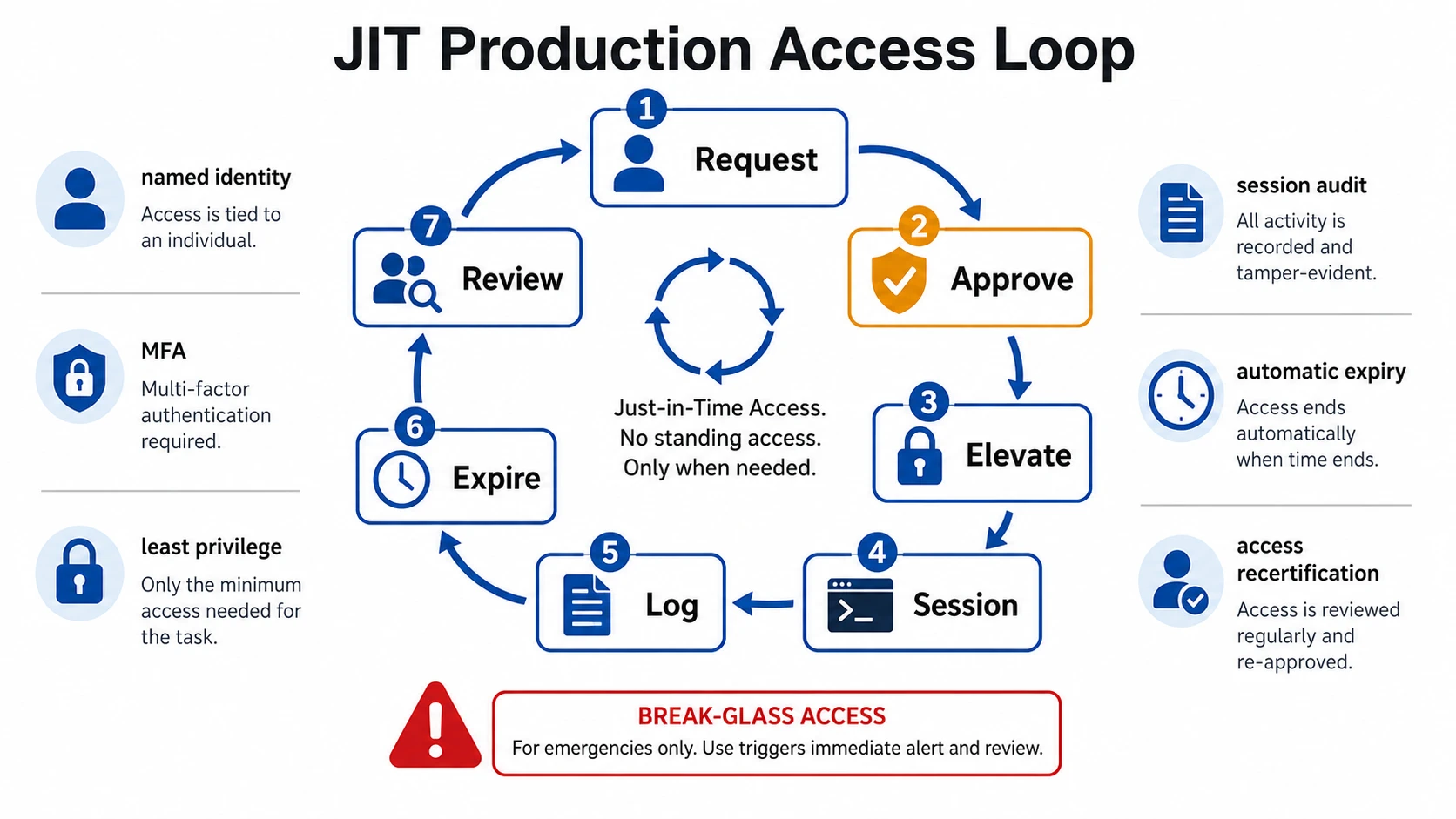
Production access is an exception to the system’s normal isolation. Design it as one loop—request, approve, elevate, work, record, expire, review—rather than as an account that happens to be used carefully.
Grant a capability, not a title
The invoice incident calls for reading a small set of records and correlating them with worker events. It does not call for changing invoices, exporting the customer table, editing access policy, or administering the database. “Read selected invoice state for tenant 482” is a capability. “Database administrator” is an organizational title disguised as authorization.
Least privilege makes a role smaller. Just-enough access makes it fit the task. A read-only role can still expose every tenant when the investigation needs one customer and three invoice identifiers. Prefer an approved diagnostic view, query proxy, or narrowly scoped support operation over a general console. If the initial capability proves insufficient, widen it through another recorded decision; do not grant the largest plausible role in anticipation.
Every action must resolve to an individual identity or a named workload identity. Shared accounts make investigation ambiguous and revocation indiscriminate. Human operators must not borrow automation credentials, and a deployment job must not masquerade as the engineer who triggered it. Automation should receive its own narrow role and short-lived credential, with its changes tied to the job and release record. A person debugging that automation receives a separate temporary diagnostic capability.
The same discipline applies beyond shells. Cloud, Kubernetes, database, CI/CD, identity, secrets, observability, and support consoles are production control planes because they can expose data, alter running behavior, erase evidence, or grant further authority. A polished browser interface does not make an administrative action less privileged.
Make the request carry the decision
The on-call engineer submits an access request that another operator can decide without reconstructing the incident from chat. A useful request records:
- the named requester and the incident, change, or support case;
- the production system, environment, tenant or resource scope, and requested capability;
- the reason ordinary telemetry is insufficient and the actions the engineer expects to take;
- the requested start and automatic expiry time;
- any sensitive data that may be visible and the approved handling path;
- the approver and any conditions, such as a second operator for a destructive action.
Approval need not create delay for every routine task. A policy engine may approve a familiar, low-risk diagnostic request when identity, device, scope, duration, and incident conditions match an established rule. The decision still needs to be explicit and retrievable. Higher-risk capabilities—writing customer state, exporting data, altering identity, disabling logging, or changing production policy—should require an accountable human approver and, where consequence warrants it, dual control.
Elevation should require strong, phishing-resistant authentication where the identity platform supports it, and a managed administrative device when the system’s sensitivity justifies that boundary. Route access through a controlled broker, bastion, query service, or privileged-access system when it can enforce the lease and capture events. Restrict the source network or device as defense in depth, not as a substitute for named identity.
For the invoice incident, the grant lasts thirty minutes and exposes only the diagnostic view. The access record binds the engineer, approved query class, customer scope, incident identifier, approver, and expiry. A broad permanent role would remember almost none of this.
Observe the session without collecting new hazards
An access event should show who entered, under which grant, which target and role they reached, when the session began and ended, and which high-risk actions occurred. Shell commands, database queries, Kubernetes API calls, cloud changes, support views, and privilege changes should be attributable at the control plane that executed them. Preserve the approval reference beside the session identity so an investigator does not have to infer intent later.
Recording everything blindly can create a second security problem. Command arguments, query results, terminal output, and support screens may contain credentials or customer data. Define what the system records, which values it redacts, who can inspect the record, how integrity is protected, and how long it is retained. Log enough to reconstruct consequential action; do not turn session capture into an ungoverned copy of production.
Monitoring should react while the lease is live. Alert on access outside the approved target, attempts to widen privilege, sensitive exports, disabled audit settings, unusual volumes, access from an unexpected device or location, and use after the incident has closed. A recording discovered months later is evidence, but it was not a preventive control when the action mattered.
In this session, the engineer confirms that the worker read the correct tenant but held an obsolete invoice version. No direct database repair is needed. The engineer ends the session, attaches the relevant event references to the incident, and lets the lease expire. The application fix proceeds through the normal release path.
Keep support inside the same boundary
Support access is production access when it reveals customer data, tenant configuration, billing state, audit records, or another user’s view. A support console can be more powerful than a shell because it packages broad data access into convenient search and impersonation actions.
Start with purpose-built diagnostics: expose the minimum fields needed for a support question, redact sensitive values, and bind every view to a customer, case, actor, reason, and data category. Define which roles may see each category, when customer consent is required, how long the grant lasts, and what behavior triggers investigation. Generate this evidence in the support system; a spreadsheet completed afterward cannot establish what the operator actually viewed.
Impersonation deserves its own capability, not a hidden button attached to ordinary support. Show the operator a persistent banner, prevent privileged customer actions unless the case explicitly permits them, and record entry, actions, and exit. For sensitive tenants or regulated data, require an additional approval. When the product or agreement promises customer visibility, expose an appropriate audit event without revealing internal security details.
The support agent in the invoice incident can confirm the affected invoice identifiers through a redacted case view. The engineer’s later diagnostic grant consumes those identifiers but does not inherit the support agent’s broader customer context. Keeping the two purposes separate prevents a support case from becoming an informal passport into production.
Build an emergency path that still ends
Suppose the identity service fails while invoice processing is degrading. Normal elevation cannot issue a lease. Break-glass access exists for this loss of the ordinary control path, or for a delay that would materially worsen safety, security, recovery, or customer impact. It is not an after-hours convenience or compensation for a missing role.
Store the emergency path in a controlled vault and require dual control where practical. Give it enough authority to restore control, not unrestricted power for routine administration. Retrieval should trigger immediate notification and open an incident or emergency-change record. Once ordinary identity is restored, disable or reset the path, rotate any exposed credential, inspect every action, and decide whether the normal access design failed.
Test the path on a schedule. The exercise must prove that authorized responders can find it, authenticate, reach the intended recovery surface, generate the expected alerts and audit events, surrender access, and complete review. An emergency account that exists on paper but has an expired credential or obsolete permission is failed recovery equipment.
A break-glass procedure should fit on the page an operator will actually use. It names the conditions for use, vault and dual-control retrieval steps, permitted recovery scope, notification recipients, logging and monitoring sources, commands or actions that remain prohibited, return-to-normal criteria, credential reset, and post-use reviewer. Keep environment-specific secrets outside the procedure.
Expire the grant, then prove it ended
Automatic expiry is part of authorization, not cleanup. Ending the incident or closing the ticket should also revoke the temporary role, broker session, support grant, and any derived credential. Verify removal at the enforcement point. A workflow status that says “expired” while a cloud session or database credential remains valid is false closure.
Some standing access will remain: service identities, emergency recovery roles, and a small number of operational capabilities whose approval latency is unacceptable. Document why each must stand, restrict where and how it can be used, monitor it more strongly, and revisit the premise. “The team has always had admin” is not a reason.
Periodic review catches drift that event-by-event approval cannot. Review ordinary privileged populations at least quarterly, and set a shorter interval where system criticality or applicable obligations require it. Trigger an out-of-cycle review after departures, reorganizations, incidents, identity migrations, major system changes, and suspicious use.
The reviewer needs the system and role, user or workload, justification, owner, last use, grant source, previous decision, and any exception with its expiry. Then the reviewer decides: retain, narrow, remove, or investigate. Check specifically for orphaned accounts, dormant administrators, inherited group membership, vendor identities, unexpired emergency grants, automation credentials used by people, and support roles that have outgrown the job. A system owner who understands the capability’s consequence should make the decision; an identity administrator can execute it but should not invent the business justification.
For each retained grant, confirm that the identity still exists, the owner still recognizes the subject, the capability still fits current work, recent use matches its purpose, authentication and device conditions remain enforced, and any standing-access exception is current. For each removal, capture the decision, enforcement result, verifier, and time. That is the access review checklist; adding more boxes will not compensate for an owner who cannot judge the role.
Revocation is complete only after removal is verified and exceptions are either closed or assigned an owner and date. Measure the interval from the revocation decision to enforcement. Otherwise an access review can produce a clean worksheet while the dangerous account remains usable.
Write policy around the loop
A production access policy becomes useful when it can answer a real request. For each control plane, record the standard request path, role or capability catalog, approving authority, maximum duration, authentication and device conditions, high-risk actions, prohibited actions, session evidence source, alert conditions, retention, emergency path, review owner, review cadence, and revocation target. Name the exception authority and expiry rule as well.
Use one existing request to test the policy. Could the on-call engineer discover the right capability? Could the approver see the consequence? Did the system enforce the customer scope and expiry? Could a reviewer connect the session to the incident and confirm revocation? If the answers live in chat history or memory, the policy describes intent rather than an operating control.
At 02:40, the invoice engineer no longer has the diagnostic role. The access system can show why it was granted, what it allowed, which records were queried, that no write occurred, and when the capability stopped working. Production administration will never be risk-free. It can, however, be bounded strongly enough that urgency does not erase identity, purpose, evidence, or an end.