Cybersecurity Engineering Handbook / Chapter 35
Evidence, Assurance, and Audit Without Ceremony
Produce security evidence from normal engineering systems so teams can prove controls without building audit-only paperwork.
Preparing audio…
Audio edition
Evidence, Assurance, and Audit Without Ceremony
Three months after the invoice-correction release, a customer asks a simple question: can support staff alter a settled invoice?
The team knows the answer is no. The application rejects the change, the authorization test passes, and the release review approved the repaired path. But knowledge is not yet assurance. To answer responsibly, the team must identify the production control, show that it applied to the version the customer used, and produce a record whose origin and time can be trusted—without handing over source code, customer data, or an internal vulnerability report.
That chain should already exist. If the questionnaire starts a hunt through chat, screenshots, and engineers’ memories, evidence has become a second system built after the real one. Durable assurance comes from the systems that design, build, test, deploy, operate, and respond, provided their records remain tied to the control and survive long enough to be useful.
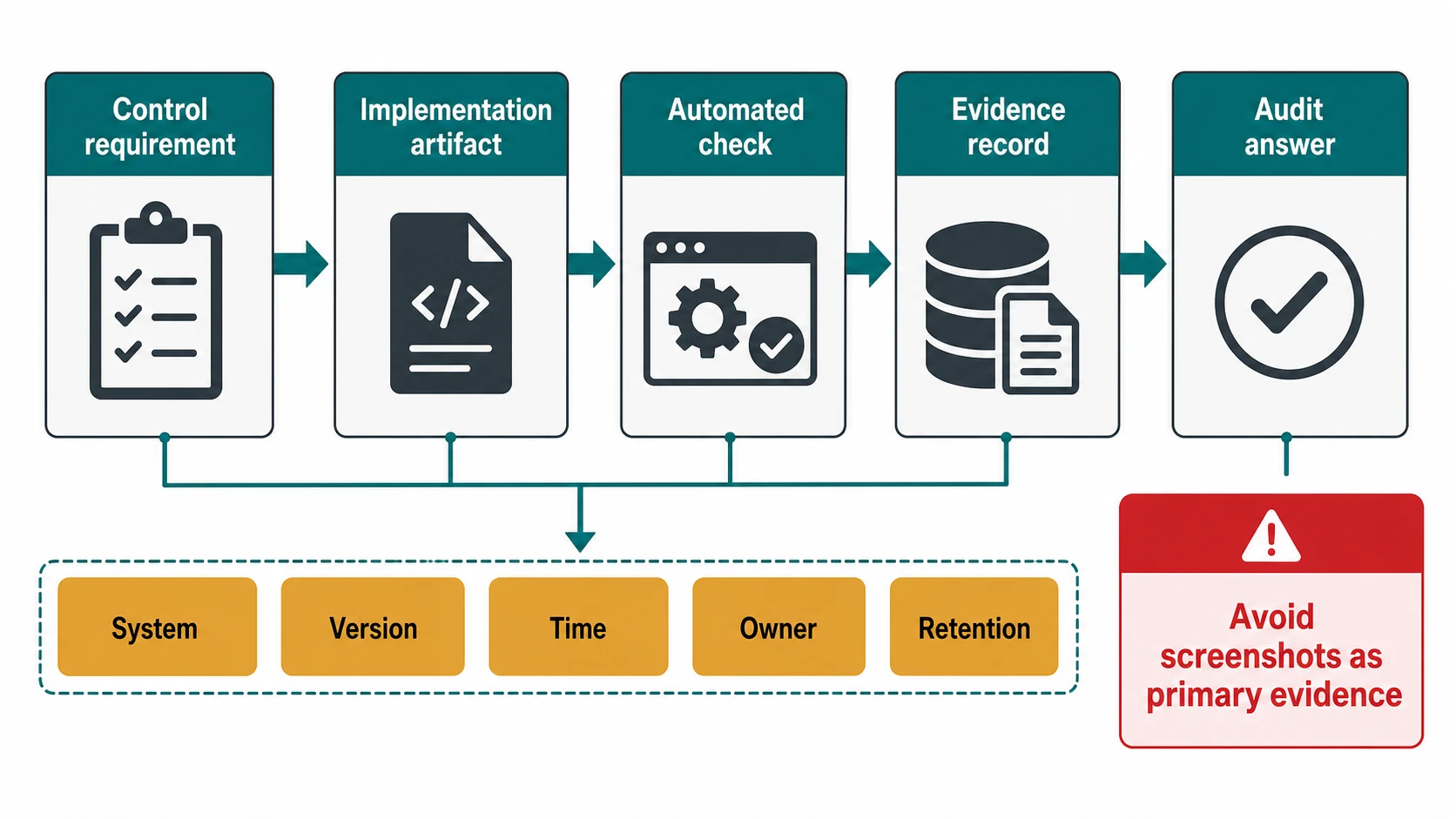
Begin with the claim you need to prove
“We have access controls” is too vague to verify. The useful requirement is narrower: only authorized roles may correct a draft invoice, and no role may correct a settled invoice. It names the protected action, allowed authority, and forbidden state transition. The team can now point to where the rule is enforced and devise a check that would fail if the rule disappeared.
For the released service, the proof chain contains four different things:
- The implementation record identifies the authoritative write boundary and the policy version that enforces the invoice-state rule.
- The check record shows authorized draft correction and denied settled correction through both interactive and bulk paths.
- The release record binds those results to a source commit, immutable image digest, environment, policy bundle, and deployment time.
- The operating record shows that production denial events contain the actor, tenant, invoice identifier, entry point, decision, reason, request identifier, worker job, and deployed version.
No item proves the control alone. Source code reveals intent but not deployment. A test result reveals observed behavior but is useless if it belongs to another build. A deployment log identifies an artifact but says nothing about its security behavior. A production event demonstrates a decision at a moment in time but cannot establish complete coverage. Assurance comes from the links.
The control owner should maintain a compact evidence map with the requirement, implementation point, verification source, production record, frequency or trigger, owner, retention, sensitivity, and exception path. Keep the map short enough to survive routine change. A large spreadsheet that no engineer updates is another audit-only document.
Capture evidence where the work happens
Design work leaves approved architecture diagrams, data-flow diagrams, threat models, decision records, and exceptions. Build work leaves review decisions, dependency manifests, software bills of materials, branch-policy results, and signed or otherwise attributable build metadata. Testing leaves machine-readable results, scanner findings, abuse-case outcomes, and manual reports that name the candidate tested.
Deployment contributes artifact digests, approval records, rollout events, configuration or policy versions, and rollback outcomes. Operation contributes access reviews, vulnerability and drift records, alert queries, restore exercises, and security events. Response contributes incident timelines, containment actions, preserved investigation material, communications, and evidence that the original attack path was closed.
These records need not live in one product. Forcing every artifact into a governance platform can discard the context and integrity properties of its source. Keep a test result in the build system or artifact store, a decision in the review system, and a deployment event in the deployment system when those are their natural homes. Put a stable index above them so a reviewer can retrieve the right version without knowing every tool.
Generation at the source reduces transcription and retrospective storytelling, but automation does not make evidence trustworthy by itself. A green CI result is weak evidence when the job is optional, the branch policy can be bypassed silently, or the result has no commit and artifact identity. An automated export must carry enough context to answer what produced it, under which configuration, for what scope, and whether failures were omitted.
Manual evidence still has a place. A penetration tester’s reasoning, an incident commander’s decision, or a break-glass exercise may not reduce to a machine result. Preserve the author, method, scope, time, system version, observed outcome, and supporting records. A screenshot can illustrate a transient console state when no export or API exists, but it should be a last resort. Capture the URL or resource identity, account or role, timestamp, relevant configuration, and an integrity-protected record around it. A cropped green badge with no provenance proves very little.
Bind the record before it drifts
Every evidence record needs enough identity to survive separation from the event that created it. For the invoice control, the index entry names:
- the control and exact requirement being tested;
- service, environment, tenant scope, and relevant data classification;
- source commit, build or image digest, configuration and policy versions;
- check name, result, timestamp, and producing system;
- accountable team and the person or workload that approved or generated the record;
- sensitivity, access policy, retention period, and refresh trigger;
- exception or limitation, with owner and expiry;
- stable location of the underlying artifact and, when needed, its digest or signature.
Time has two meanings here. The record has a creation time, and the claim has a period for which it remains useful. A restore exercise may remain relevant until the storage design changes or the next scheduled exercise is due. An access review describes a population at a particular cutoff. A release test applies to one candidate, not every later release. Treating old evidence as timeless is as misleading as having no evidence.
Immutability should match consequence. Write-once storage, signed attestations, append-only logs, restricted deletion, object versioning, or an independent digest can make unauthorized alteration detectable or difficult. None is a magic property: a signed false result remains false, and an append-only store cannot repair incomplete collection. Protect the path that generates the record as well as the record itself. Limit writers, log administrative changes, separate ordinary operators from evidence-retention authority where the risk warrants it, and test retrieval.
Design retention from the question backward
The evidence index can follow a simple hierarchy even when the artifacts remain distributed:
invoice-service/
  invoice-state-authorization/
    2026/
      release-2026-04-17/
        index.yaml
        verification/
        release-decision/
        production-samples/
The directory is an index and preservation area, not a license to copy sensitive material indiscriminately. index.yaml can point to an approved threat model, CI result, deployment event, and access-controlled log query. Preserve a local result only when the source system cannot meet the required retention or stable-link guarantee.
Start with the longest legitimate question the evidence may need to answer: a customer review, contractual assurance period, investigation, internal control review, or other applicable obligation. Then compare that period with each source system’s retention. CI logs that disappear after thirty days cannot support a later release claim unless the relevant result and its provenance are exported before expiry. A dashboard is not preserved evidence when its query, data, or schema can change underneath the link.
Longer is not automatically safer. Evidence may expose architecture, user identities, vulnerabilities, tenant information, secrets, or incident details. Retain the minimum material that proves the claim for the required period, restrict it by sensitivity, and delete it when the approved retention expires unless a legitimate hold applies. Test both retrieval and deletion. A retention policy that exists only in prose controls neither.
Ownership must cover more than the control. Name who owns the source integration, index, access policy, retention job, refresh trigger, and exception. If a tool is replaced, the owner must decide which historical records migrate, how integrity is checked, and how old links resolve. Evidence loss during tool migration is a control failure, not clerical inconvenience.
Turn the chain into a customer answer
The customer’s question does not justify exposing the entire chain. An approved response can say:
The service enforces invoice correction at the authoritative write boundary. Authorized roles may correct invoices only while they are in draft state; settled invoices are rejected. The control is verified through automated authorization tests on each release candidate and production security-event checks after deployment. Evidence for the version in scope was reviewed on 17 April 2026. Detailed test and vulnerability records are restricted; a dated assurance summary is available under the applicable agreement.
The dates and service details above belong to the chapter’s continuing example, not to a real provider claim. In practice, the response owner fills the template from the evidence index:
- Question and scope: the customer’s wording, service, environment, feature, data, and period covered;
- Control statement: the precise behavior, including relevant limits and exceptions;
- Implementation and verification: where the control acts and how it is checked;
- Evidence reviewed: dated index entries or sanitized summaries, with approver;
- Disclosure level: material approved for general sharing, NDA access, restricted review, or no external disclosure;
- Validity: response date, refresh trigger, response owner, and next review;
- Qualification: residual risk, excluded scope, or planned remediation that would make an unqualified “yes” misleading.
A standard response library saves work only while it remains connected to current evidence. Store reusable answers with control owners and refresh triggers, not as timeless marketing copy. A release that changes authorization, encryption, retention, subprocessors, incident handling, backup design, or AI data use should invalidate the corresponding answer for review.
Disclosure should reveal the minimum needed to support trust. Many questions can be answered with a scoped control statement and date. Some warrant a sanitized diagram, independent report, or supervised review under a nondisclosure agreement. Detailed vulnerability records, incident artifacts, customer data, credentials, internal attack paths, and unrestricted system diagrams require stricter handling and may be inappropriate to share at all. Record what was disclosed, to whom, by whom, under which agreement, and from which evidence version.
Repair the chain when proof is hard
Suppose the team can find the original invoice authorization test, but its CI link has expired. A screenshot of the old green run appears in a release ticket. The image has no visible commit, the release record names an image digest, and no retained manifest connects the two. The team should not upgrade the screenshot into proof by adding explanatory prose.
The honest answer is that the historical chain is incomplete. The team can verify the control against the current artifact, state the period that new result covers, and record the earlier limitation. It should then change the pipeline: bind results to commit and artifact digests, export the relevant result at release, set retention to the assurance period, and alert before evidence expires. If the missing period carries consequential risk, the control or risk owner decides whether further investigation, customer notification, or an exception is required.
This is why evidence quality belongs in engineering. The strongest audit preparation is not a folder assembled before review. It is a control that states what must remain true, a check that challenges it, a release identity that binds the result, an operating record that reveals continued behavior, and an index that keeps the chain retrievable without making it public.
When the next assurance question arrives, the team should not have to remember the story. It should be able to follow the record.