Cybersecurity Engineering Handbook / Chapter 20
Resilience, Availability, and Recovery Architecture
Make resilience a security requirement with recovery objectives, protected backups, high availability, abuse controls, operational safety, and tested restore evidence.
Preparing audio…
Audio edition
Resilience, Availability, and Recovery Architecture
At 09:12, the payments platform is still answering health checks. Customers, however, cannot complete a refund. A privileged credential has been used to disable a queue consumer and alter recent ledger rows. The first responder can fail traffic to another region, but replication has already carried the bad rows there. The newest backup exists, yet its administration uses the same identity path that is now suspect.
More replicas cannot settle the important questions. How long can refunds be unavailable? Which transactions may be lost? Who may decide that a backup is safe? Can the company restore the refund function without restoring the attacker’s access or serving a plausible but false balance?
Availability is a security property because service is useful only while its state and decisions remain trustworthy. Recovery architecture gives responders a protected route from damaged production to a verified critical function. That route needs explicit time and data-loss objectives, isolated recovery authority, controlled degradation, and rehearsed evidence.
Begin with the function that must survive
The recovery unit is a critical business function, not whichever service owns the incident ticket. A refund depends on customer authentication, authorization, the ledger, payment-provider access, queues, secrets, routing, and a way to tell customers what happened. Restoring the refund API while its ledger is corrupt does not restore refunds. Restoring the database while every signing credential remains suspect does not produce a safe write path.
For each critical function, name its owner, customers, dependencies, authoritative state, and minimum safe mode. Then describe the harms that accumulate while it is absent: financial exposure, safety consequences, contractual or regulatory deadlines, lost evidence, and operational congestion. This gives recovery objectives something firmer than a conventional tier label.
The same function can fail in several ways. A volumetric DDoS consumes the edge; an expensive query or retry storm consumes a shared internal resource. Ransomware and a compromised administrator attack both production and the recovery path. Corruption leaves systems available enough to spread false state. A regional or vendor failure removes a dependency. A bad deployment or configuration change can break every healthy replica at once. Architecture must preserve a different safe option for each failure, rather than treating all unavailability as a need for more capacity.
Put clocks and lost work into the design
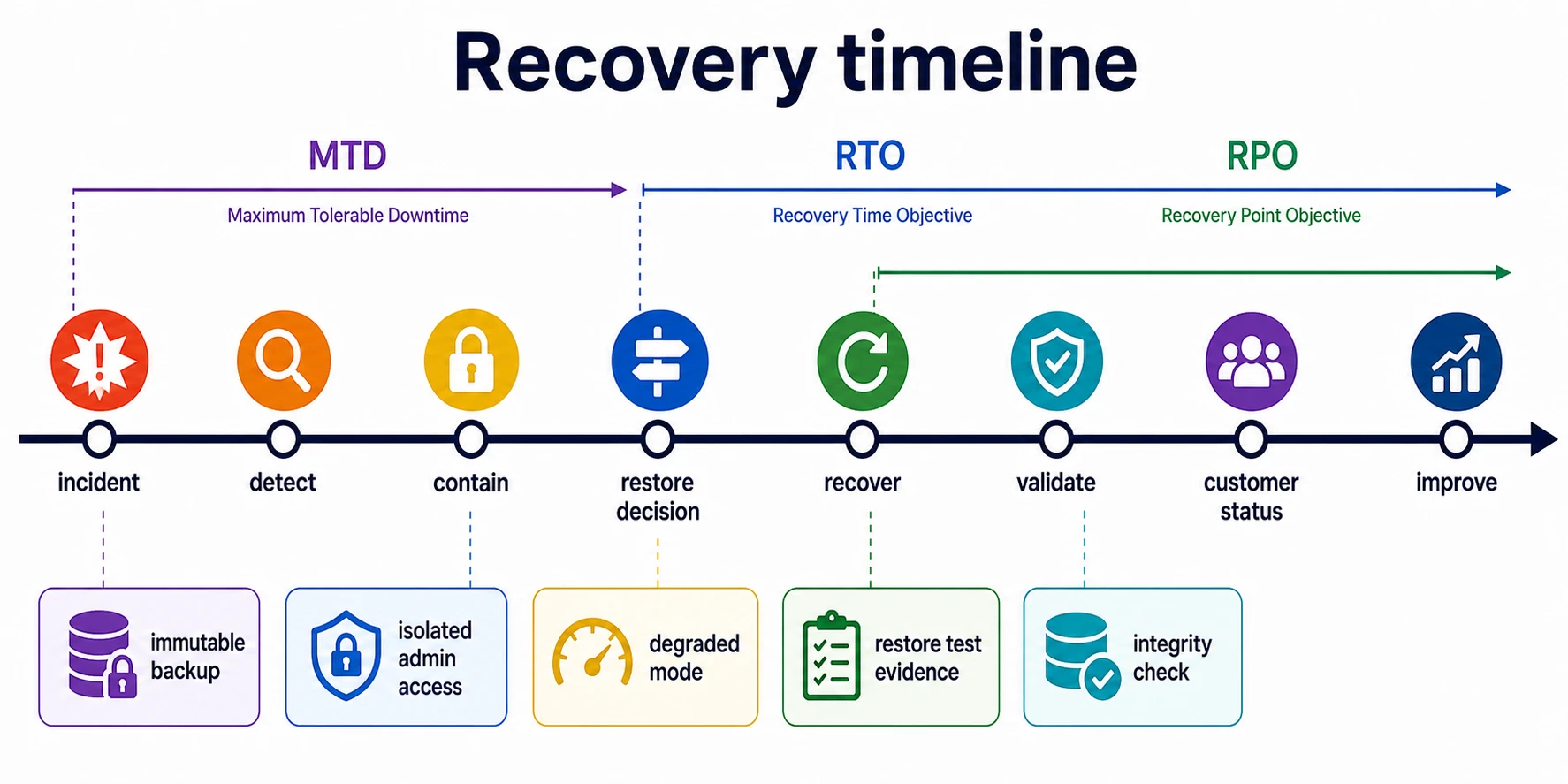
Three objectives bound the recovery. Maximum tolerable downtime (MTD) is the point beyond which the accumulated business harm is unacceptable. The recovery time objective (RTO) is the target for restoring the function. It must sit comfortably inside the MTD because detection, uncertainty, and failed attempts consume time. The recovery point objective (RPO) bounds acceptable lost work. It may be expressed as time, but a transaction boundary is often more honest: “no confirmed payment may disappear” says more than “five minutes.”
At 09:12, the refund function’s clock did not necessarily start with the alert. If corruption began at 08:47, detection has already consumed twenty-five minutes. Its recovery plan must budget time to contain writes, establish clean authority, choose a recovery point, restore, reconcile transactions, validate the function, and communicate. An RTO shorter than that sequence is a promise the architecture cannot keep.
Use a small set of recovery tiers to fund similar obligations consistently, but retain the underlying reasoning. The highest tier normally covers functions such as identity, payments, production control, or safety-critical customer paths. It requires staffed response, protected recovery access, tested failover or restore, and a customer communication path. An important function in the next tier may tolerate a longer restore but still needs objectives, dependency degradation, monitored backlogs, and regular exercises. An internal tool with a workable manual alternative may justify longer downtime. A disposable service may need no data backup if owned source, configuration, dependencies, and credentials can reproduce it.
The durable artifact is a recovery-tier record for each function: owner; MTD, RTO, and RPO with their rationale; minimum safe mode; dependent identity, data, network, and provider paths; backup and regional strategy; exercise cadence; and the approving business owner. A tier name without this record merely hides the decision.
Build a recovery path outside the failure
A backup job is a copying mechanism. A recovery path includes the copy, the authority to use it, the environment that can receive it, and the tests that establish trust. Critical data needs immutable, offline, or logically isolated copies that ordinary production identities cannot alter or delete. Backup administration and encryption-key access should cross a separately protected and monitored path. Otherwise the credential that encrypts production can also erase its supposed escape route.
Scope is wider than database rows. Recovery may require infrastructure definitions, configuration, identity dependencies, key references, object storage, queue state, schema history, software artifacts, and the runbook itself. Set snapshot, log, or journal frequency from the RPO. Define retention from the needed rollback window and the time corruption may remain undetected. Keep an inventory that can answer which critical function and recovery point each copy supports.
For the altered ledger, responders first stop suspect writes and preserve evidence. They determine the last trusted transaction boundary, restore into an isolated environment, and reconcile the restored ledger against independently held payment-provider and event records. They scan restored software and configuration, rotate compromised authority, and prove tenant and balance invariants before routing customer traffic. A checksum can detect changed bytes; it cannot prove that malicious but well-formed transactions are legitimate.
A restore exercise should therefore prove all of the following:
- the chosen copy exists, decrypts, and can be read without production authority;
- infrastructure and application versions can consume its schema and formats;
- identity, network, secrets, DNS, and provider paths can be re-established;
- integrity and business invariants detect corruption rather than merely booting;
- the measured detection, decision, restore, validation, and communication times fit the objective;
- operators retain the logs, approvals, recovery point, exceptions, and test results needed to explain what they trusted.
Exercise with production-like handling rules and sanitized or appropriately protected data. Record the time, recovery point, people and automation used, failed steps, validation results, and follow-up owner. Evidence that a backup job completed is not evidence that the function recovered.
Keep failure from becoming universal
High availability lowers the probability that a component failure interrupts the function. Recovery handles states that redundancy faithfully reproduces. Multiple instances help with a crashed process, but not with a bad image, secret, authorization policy, or configuration delivered to every instance. Multiple zones help only if the data, identity, network, control plane, and operator path do not retain a hidden zonal dependency.
A multi-region strategy must choose its consistency and authority model before the incident. Decide whether a second region is active, warm, cold, or only a recovery destination; how state reaches it; who may redirect traffic; how split brain is prevented; which credentials remain valid; and what happens when the regions cannot communicate. Regularly exercise the routing and data transition. A regional diagram with no failover authority or validation step is geography, not recovery architecture.
The refund platform may preserve customer access while placing new refunds in a bounded queue, or offer read-only status while writes are contained. That is safer than failing open against an untrusted ledger. Each degraded mode needs an entry condition, permitted operations, capacity and duration bound, visible customer behavior, monitoring, and exit test. Cached responses must not reuse stale authorization or cross tenant boundaries. Queued work must remain idempotent and reconcilable when processing resumes.
Spend capacity deliberately under abuse
Availability can also be lost without destroying state. Volumetric DDoS consumes network or edge capacity. Application abuse makes legitimate-looking requests hit expensive searches, authentication work, exports, or third-party calls. One tenant can fill a shared queue; an unhealthy dependency can induce every caller to retry until the healthy components collapse.
Set limits at the boundary that owns the cost: source, account, tenant, token, workload, endpoint, or expensive operation. Quotas bound sustained consumption; rate limits bound arrival; queue partitions protect tenants and priority work; circuit breakers stop calls to a failing dependency; backpressure slows producers; and load shedding preserves a smaller useful service before total collapse. Autoscaling helps only within an explicit cost and dependency bound.
The DDoS and resource-exhaustion playbook begins by identifying the traffic shape, target route, saturated resource, and customer impact. Classify whether the cause is volumetric traffic, abusive application work, a queue flood, or a retry storm; each calls for a different control. Responders can then apply edge filtering, rate or quota changes, queue isolation, a circuit breaker, or a temporary feature disablement while the incident lead coordinates provider, service, and customer-support owners.
Validate both sides of containment: the resource should recover, and legitimate traffic should still receive the promised minimum service. Record emergency rules with an owner and expiry. A silent block left behind after the attack is another availability defect.
Make ordinary change compatible with recovery
Many severe outages begin as authorized changes. Protect branches and review infrastructure, network, identity, and data migrations. Use canaries, staged rollouts, and blast-radius limits so evidence arrives before universal change. A feature flag needs an owner, safe default, expiry, and an independently usable emergency path. High-impact changes warrant separation between the person proposing them and the authority approving or executing them.
Keep deployment, configuration, policy, and administrative events searchable on the incident timeline. A rollback must be rehearsed, but it is not a universal recovery action. Reverting application code cannot undo an incompatible schema change or corrupted ledger rows. In those cases, stop writes, preserve evidence, choose a trusted recovery point, reconcile later legitimate work, and validate the result. Protected telemetry must make that account credible after the production control plane itself has become suspect.
Run the decision before the incident makes it
For the payment incident, the recovery timeline now has an accountable sequence. Responders detect customer failure and ledger anomalies, contain suspect writes and authority, preserve evidence, and declare the minimum safe mode. The recovery owner selects a point using independent transaction evidence. The team rebuilds clean authority and infrastructure, restores into isolation, reconciles state, validates security and business invariants, and only then resumes traffic. Customer updates describe the function and known impact without claiming integrity before it has been established.
Review a critical function by asking:
- What harm defines its MTD, and do the RTO and RPO describe the whole function rather than one service?
- Which failure can cross every replica, zone, region, administrator, backup, or queue boundary in the proposed design?
- Can recovery proceed when production identity, network, software, and state are all suspect?
- What minimum mode remains safe during dependency failure, containment, or resource exhaustion, and how does the system enter and leave it?
- Which backup copy and transaction evidence establish a trusted recovery point, and what proves restored state is legitimate?
- Who may declare, authorize, execute, validate, communicate, and close recovery, including outside normal business hours?
- When did the team last perform the entire sequence, how long did each stage take, and which failed step now has an owner?
Untested backups, recovery authority shared with production, single-region assumptions, shared queues, and improvised degraded modes all fail this review for the same reason: they leave the incident with one path, and the incident already controls it.
Recovery is proved when a team can take a critical function from suspected production through containment and into verified service within its objectives. Redundant components may make that journey less frequent. They do not make it unnecessary.