Cybersecurity Engineering Handbook / Chapter 4
Security Ownership, Governance, and Decision Rights
Define who owns security decisions, who can accept risk, and how gates turn concerns into remediation or explicit exceptions.
Preparing audio…
Audio edition
Security Ownership, Governance, and Decision Rights
Two days before an internal refund console is due to launch, an engineer finds that disabling an operator’s account does not end sessions already in progress. The identity team can add session revocation, but not before launch. The product owner wants to proceed because the console is needed for a support migration. Security describes the takeover path. Operations offers to shorten session lifetime and alert on use by disabled accounts.
Everyone has contributed. Nobody has yet made the decision.
The engineer can explain the defect. Security can judge the control gap. Operations can own detection. The product owner can explain the cost of delay. None of those acts, alone, accepts the consequence of a compromised operator retaining access. Governance begins by giving each decision to someone with the knowledge and authority to make it—and by leaving an inspectable record of what that person decided.
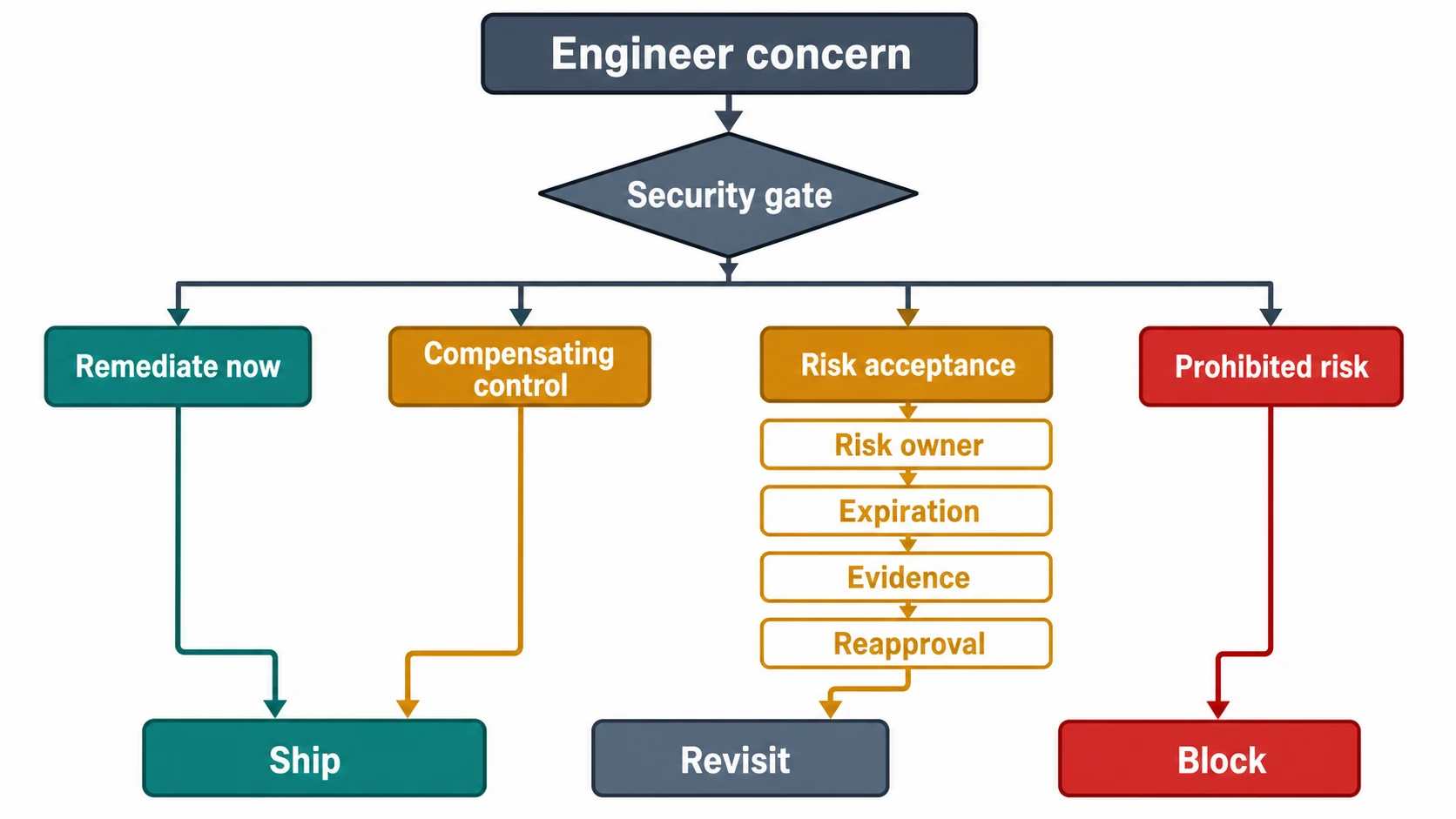
Name authority, not involvement
The governing rule is simple: technical review, remediation, operation, and risk acceptance are different decisions. A meeting invitation does not confer all four rights.
The engineering owner decides how the system will satisfy its requirements and owns the corrective work when it does not. A security reviewer tests the threat assumptions and says whether the proposed design and evidence satisfy the security requirement. The product owner supplies business context and owns product consequences. The operations owner takes responsibility for telemetry, privileged operations, patching, runbooks, and recovery. The data owner decides classification, approved uses, retention, sharing, and deletion. If assumptions fail in production, an incident commander coordinates the response; the role is activated for the incident and should not be confused with permanent system ownership.
The risk acceptor makes a narrower but heavier decision: whether the organization will carry a stated residual consequence for a stated period. The right belongs with someone who controls or is accountable for that consequence. A delivery manager may be able to move a date but unable to accept regulatory exposure. A data owner may approve a new use of a dataset but lack authority to accept a company-wide outage. Authority should rise with blast radius.
Small organizations may put several roles on one person. Keep the roles distinct in the record anyway. “Mara approved” is ambiguous. “Mara, acting as engineering owner, chose the implementation; Dev, acting as risk acceptor for support operations, accepted the remaining exposure until 30 September” can be reviewed and challenged.
Group names are routing information, not accountability. Record a named role holder and an escalation path. If that person leaves, the exception should become unowned and require reassignment, not silently inherit the name of a team.
Keep routine, reversible implementation choices with the engineering team and its code-review process. Escalate architecture choices when they add a trust boundary, public exposure, sensitive data, or a high-impact workflow. Production access belongs to the operations or access owner under the organization’s access policy; privileged, vendor, shared, and emergency access require stronger approval and evidence. A control exception belongs to the designated risk acceptor after technical review. These defaults keep ordinary work moving while moving consequential choices toward the people who can understand and carry their effects.
Follow the refund-console decision
The session-revocation gap is first a technical finding. The security reviewer describes the path precisely: after an operator account is disabled, a stolen session can continue issuing refunds until it expires. The reviewer can reject weak evidence or say that the release requirement remains unmet. That is a review decision, not acceptance of the loss scenario.
The engineering owner then presents real options: delay launch and add revocation; reduce session lifetime and restrict the console to a managed network while revocation is built; or abandon the migration. Operations confirms whether disabled-account use can actually be detected and whether an on-call responder can terminate access. The product owner states what delay would cost. Because refunds create financial and customer consequences, the designated risk acceptor—not the engineer who wants to ship and not the reviewer who found the gap—chooses among the remaining options.
This separation protects disagreement. Security does not need to exaggerate its authority to be heard, and product does not need to pretend a technical requirement has been met. The record can say both: the control is deficient, and an authorized person has accepted a bounded residual risk.
Some decisions should never reach a local accept button. An organization should define prohibited conditions in policy and name the higher escalation path. Typical examples include shared unrestricted administrator credentials, critical actions with audit logging disabled, a known cross-tenant read path, or regulated data sent to an unapproved processor. The exact prohibitions depend on the organization’s obligations and risk strategy. A deadline does not suspend them.
Put gates where choices are still cheap
A gate is a decision point with an owner, entry evidence, and possible outcomes. It is not another meeting by default.
At concept, assign an assurance level and owners before the shape of the system hardens. At design, inspect threat assumptions, trust boundaries, data use, and secure defaults while architecture can still change. During the build, test whether required controls exist and behave as claimed. At release, compare the evidence with the minimum bar and verify that every gap is remediated, covered by a valid exception, or blocks launch.
After release, the operating gate asks whether controls survived reality: access changed, alerts degraded, patches accumulated, dependencies moved, and restore procedures aged. A major change in exposure, data, identity, dependency, or privilege returns the system to the appropriate earlier gate. Governance is a loop because risk conditions do not stay fixed.
Each gate has only four useful outcomes: proceed, proceed with recorded conditions, return for remediation, or escalate/block. “Reviewed” is a description of activity, not an outcome. The refund console cannot pass its release gate on meeting notes; it needs either session revocation evidence or a valid exception supported by the promised restrictions and detection.
Write the exception so it can expire
A useful risk-acceptance record is brief enough to read and specific enough to disprove. It contains:
- the unmet requirement and evidence that exposed the gap;
- the threat event and plausible consequence, including affected systems, data, users, tenants, and operations;
- the considered fixes, with their cost and timing;
- any temporary safeguards and the named failure mode each reduces;
- the residual risk after those safeguards;
- the remediation owner, detection owner, and incident escalation path;
- the risk acceptor’s name, role, decision, and scope of authority;
- an expiration date, earlier revocation triggers, and the evidence required for closure or renewal.
A compensating control is not whatever can be implemented quickly. It must provide comparable protection or demonstrably reduce the named failure mode. For the console, a managed-network restriction reduces where a stolen session can be used; a shorter lifetime reduces the exposure window; detection speeds response. None is equivalent to revocation by itself, so the record must describe the risk that remains.
Use a compact working record:
Exception: REFUND-CONSOLE-007
Requirement: disabled operator sessions terminate within five minutes
Gap and evidence: disabling an account leaves existing sessions valid for eight hours; test linked
Threat and consequence: stolen session retains refund authority after account disablement
Temporary safeguards: 15-minute sessions; managed-network access; disabled-user alert to on-call
Residual risk: attacker on an allowed device or network can act for up to 15 minutes
Remediation: session revocation, owned by Identity Engineering, due 2026-09-15
Decision: accept for the support migration only
Risk acceptor: Director of Support Operations
Expires: 2026-09-30; revoke earlier if alerting fails, scope expands, or exploitation is suspected
Closure evidence: revocation test plus production deployment record
On expiry, the default is not silent renewal. Close the exception with evidence, replace it with a newly reasoned acceptance, or block the affected operation. A recurring exception may reveal a funding or ownership problem; routing it through the same form forever does not govern it.
RACI matrix
Use a RACI matrix only after decision rights are clear. It is useful here because a launch requires simultaneous comparison across roles; it cannot decide whether a particular risk is acceptable.
| Activity | Product | Engineering | Security | Operations | Data owner | Risk acceptor |
|---|---|---|---|---|---|---|
| Set assurance level | C | R | C | C | C | A |
| Maintain system profile | C | R/A | C | C | C | I |
| Threat model | C | R | A | C | C | I |
| Implement controls | I | R/A | C | C | C | I |
| Verify release evidence | I | R | C | A | C | I |
| Approve exception | C | R | C | C | C | A |
| Operate controls | I | C | C | R/A | C | I |
R means responsible, A accountable, C consulted, and I informed. Add the named incident commander and an incident-specific responsibility map when an incident is declared. If two columns appear accountable for one decision, resolve the authority instead of letting the matrix disguise it.
Choose an operating model that shortens the path
Decision rights need a delivery system. Central security reviewers bring scarce expertise to high-impact architecture, cryptography, identity, regulated data, and novel threats. They become a bottleneck when every routine change waits in the same queue. Embedded security champions provide local context and a fast route for ordinary questions, but they need time, training, and escalation support; the title must not make them risk acceptors by accident.
Platform guardrails turn repeated decisions into secure defaults: approved identity patterns, hardened deployment modules, policy checks, and evidence captured by the delivery path. Developer self-service makes the approved path discoverable and gives teams immediate feedback. Neither removes accountability. A guardrail needs an owner and an exception path, and self-service must say when specialist review is required.
A healthy model pushes common, reversible decisions toward the team while pulling novel, high-impact, or irreversible decisions toward appropriate expertise and authority. Measure the time from concern to a clear disposition—not merely the time until a reviewer first responds.
Metrics that change behavior
Security metrics should improve decisions, not reward appearance.
Track a small scorecard that can change a decision. Time to remediate exploitable vulnerabilities should be segmented by exposure and exploitation, not averaged with harmless backlog. The share of critical systems with a recent tested restore reveals recovery readiness; backup-job success does not. Privileged-role reviews should show removals and exceptions, not just completed attestations. Detection coverage should be tied to the top threat scenarios and require an owner and response path. Review lead time should expose where work waits, without rewarding shallow approval. Expired exceptions should trigger escalation, not count as successful renewals.
For each measure, record the owner, source, review cadence, threshold, and action when the threshold is crossed. A scorecard with no decision attached is decoration.
Close the decision
The refund-console record is complete only when it ends in one of four states: session revocation is implemented; temporary safeguards and residual risk are accepted by the right person; the launch is blocked; or the design changes so the original concern no longer applies. The security review supplies judgment and evidence. It does not supply acceptance.
That final separation is the test of the operating model. When someone asks, “Who approved this?”, the answer should identify the decision, the role, the evidence, the scope, and the date it must be revisited—not merely the people who attended the review.