Cybersecurity Engineering Handbook / Chapter 40
Security Monitoring and Alert Operations
Design, own, triage, tune, and retire security alerts through a measurable detection lifecycle.
Preparing audio…
Audio edition
Security Monitoring and Alert Operations
At 02:13, a recovery administrator shortens immutable backup retention. Six minutes later, the same identity begins deleting recovery generations. The rule for each action fires, but the events have been waiting in an ingestion queue for forty-seven minutes. One alert opens a low-priority ticket because retention changes are common during maintenance. The other pages an infrastructure responder with an account identifier, a provider event name, and no link to the affected service. By the time the two alerts meet in the same investigation, the freshest protected copies are gone.
Nothing was wrong with the queries. The monitoring operation failed. It observed two dangerous actions too late, separated evidence that belonged together, assigned urgency without considering consequence, and asked a responder to reconstruct context under pressure.
An alert earns its place when a named threat requires a timely decision and the signal helps a responder make that decision. That obligation extends beyond detection logic. It includes the telemetry path, ownership, routing, runbook, permitted containment, measurement, tuning, and eventual retirement.
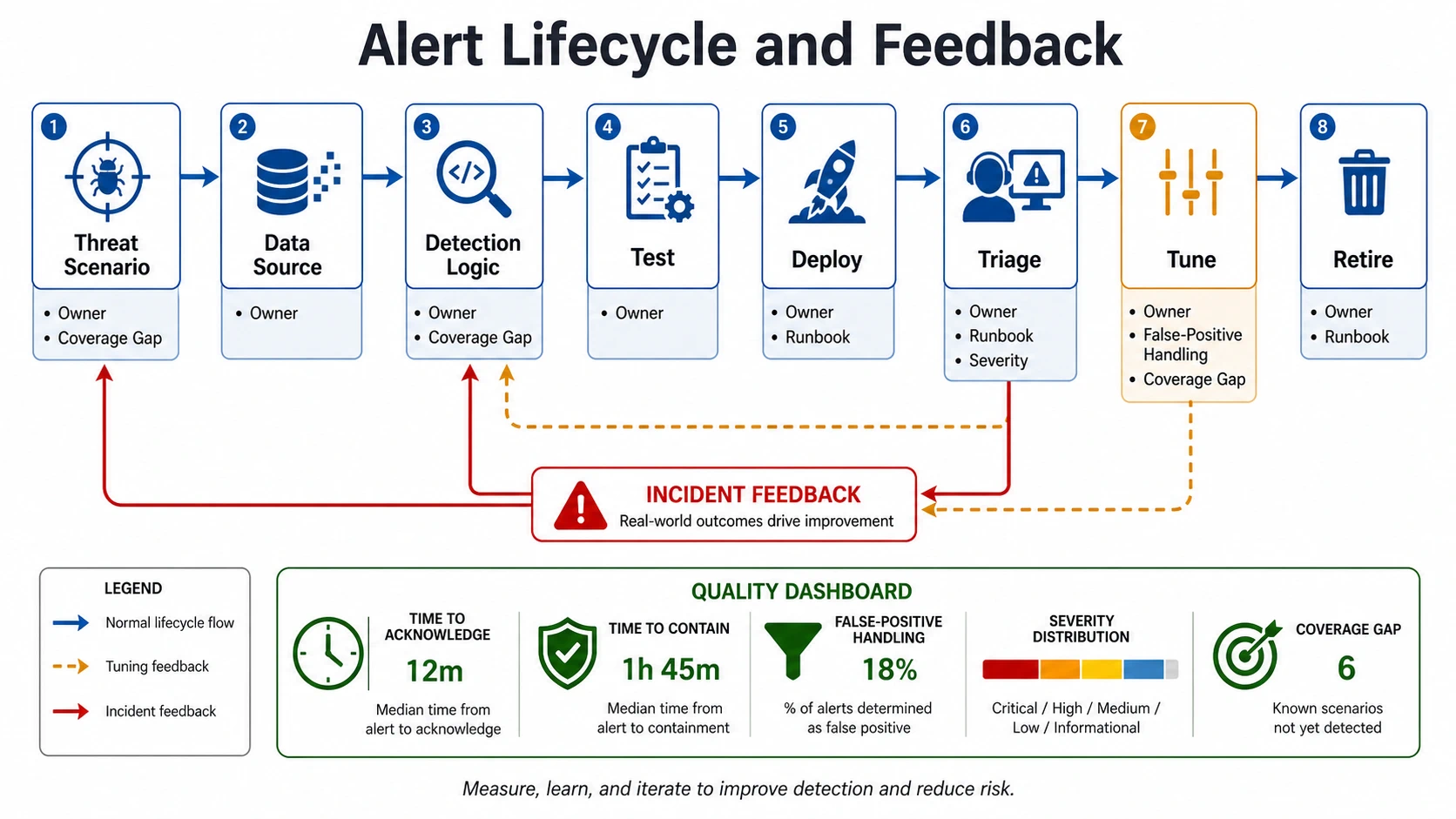
Begin with the decision, not the event
The backup threat is not “a retention setting changed.” An attacker or unsafe administrator may weaken recovery protection and destroy copies before the team can intervene. The decision is whether the activity is authorized and safe—and, if it is not, whether to block further deletion, suspend the identity, preserve remaining generations, and invoke incident command.
That formulation changes the alert. A useful page identifies the service and backup vault, the administrator and authentication method, old and new retention, generations already affected, nearby deletion or policy events, change record if one exists, remaining recovery-point range, and the owners who can contain the action. It also states how quickly the decision is needed. A query result alone transfers the detection engineer’s unfinished work to the responder.
Severity follows urgency and possible harm. A high-confidence event can wait when its consequence is small; an ambiguous control-plane event may deserve an immediate page when delay could erase the only recovery path. Confidence belongs in the evidence. It should not quietly become a substitute for impact.
Keep the detection specification beside the rule or in the same system of record. Before deployment or material change, it should answer:
- Which attacker action or unsafe failure is in scope, and which important variants are deliberately out of scope?
- What decision must a responder make, by what deadline, and what harm grows while the alert waits?
- Which events and fields support the decision? Who owns their schema, parser, freshness, retention, clock quality, and access?
- How does the rule group entities and time windows, enrich context, suppress expected activity, and handle missing fields?
- Who owns detection quality? Where does the alert route at each severity, and who receives an escalation that goes unanswered?
- Which validation, scoping, evidence-preservation, containment, and closure steps belong in the runbook?
- What volume and precision are expected? When will the alert be reviewed, and what evidence would justify tuning or retirement?
The on-call responder is not automatically the detection owner. The responder owns the live disposition while the page is active. The detection owner remains accountable for whether the alert can be understood, acted on, and improved.
Cover threat paths and telemetry health
Monitoring scope starts with systems and threat scenarios, then asks which observations could reveal them. Identity, endpoints, cloud control planes, networks, applications, data stores, CI/CD, secret stores, container platforms, SaaS administration, and backup systems each expose different authority. A system that allows AI tools or agents to call internal services also needs evidence of prompt or instruction sources, retrieved content, model and policy decisions where available, tool arguments, resulting actions, and the human or workload identity under which those actions occurred. Collecting sensitive prompts or model content requires an explicit data-minimization and access decision; “log everything” is not a safe default.
A payment service and a model-serving platform should not inherit identical alert catalogs. For each important threat, record the assets and trust boundary at risk, required observation, available source, expected delay and retention, detection and response owner, current alert or compensating control, and known gap. This is the monitoring coverage record. Review it as a set of attacker paths, not as a count of enabled rules. An uncovered high-consequence path should remain visibly uncovered until the team adds telemetry, changes the architecture, or accepts the residual risk.
Telemetry health belongs in the same coverage model. Track whether sources are arriving, whether volume has changed unexpectedly, whether required fields still parse, whether producer and collector clocks agree, whether sampling or filtering removed security events, and whether end-to-end delay still fits the response deadline. Alert on the health of critical detection paths through an independent route where practical. A rule cannot report the failure of the pipeline that prevents it from running.
The recovery chapter handed this operation several control-plane events: unusual restore attempts, bulk deletion, retention reduction, changes to immutability or keys, disabled replication, and changes to backup administrators. Their usefulness depends on arriving beyond the reach of the authority they describe and before that authority can finish the destructive sequence.
Test the route all the way to action
Detection testing is incomplete when a query returns the expected row. Exercise the entire route: produce a representative event safely, confirm collection and parsing, measure ingestion and evaluation delay, inspect enrichment and entity grouping, verify severity and routing, open the runbook, and observe whether the expected owner can reach a containment decision. Preserve the result with the detection version.
Historical replay can reveal volume and known false positives. Synthetic events can verify parsers and routing. Controlled simulations can test sequences such as retention reduction followed by deletion. Tabletop exercises can expose missing authority or escalation paths without touching production. Each method answers a different question; none alone proves that the operation works during an incident.
For the backup alert, a safe test changes a non-production policy under an approved record, emits representative administrative events, and confirms that the page correlates the actions under one identity and vault. The test should fail if the page arrives after the deletion deadline, routes without a service owner, omits the remaining protected generations, or instructs the responder to disable an account without first preserving evidence and confirming an alternate recovery administrator.
Deployment needs an owner, routing destination, runbook, dashboard or queue view, change record, and a short initial review window. This makes alert deployment an operational change. The next chapter develops the review and validation discipline for changes that alter logging, routing, suppression, or containment authority.
Triage toward a bounded decision
A runbook should be short enough to navigate while the evidence is changing. Put safe queries and exact systems near the step that needs them. Name known blind spots, expected administrative patterns, system owners, and the authority required for disruptive containment. “Investigate suspicious activity” is not a step.
For the backup sequence, the responder moves through six questions:
- Can the signal be trusted enough to proceed? Check source freshness, end-to-end delay, parser status, timestamp and clock quality, entity resolution, duplicates, and the raw event. Do not mistake a malformed alert for proof that the underlying action did not happen.
- Was the action expected? Locate the change record, verify its scope and window through a channel independent of the acting identity, and compare the observed values with the approved change. A ticket identifier supplied by the event is a lead, not authorization.
- What is affected now? Identify the administrator’s active sessions and credentials, vaults and services within reach, retention already changed, generations deleted, replication or keys altered, and customers or recovery objectives exposed. Search for related identity, control-plane, endpoint, and network activity.
- What evidence indicates control or intent? Establish authentication method, device, source, recent privilege changes, policy edits, failed attempts, lateral movement, persistence, and nearby destructive actions. Preserve raw events, configuration state, and candidate recovery generations before an irreversible response when delay permits.
- Which containment is justified? Options may include blocking deletion, freezing policy changes, revoking sessions, disabling a credential, isolating an endpoint, or moving remaining copies behind independent authority. Choose the narrowest action that interrupts harm within the decision window. Do not wait for complete attribution when evidence is perishable and containment is reversible.
- Who must take command? Define thresholds for paging security, the service and recovery owners, SRE, and incident command. Add privacy, legal, communications, or leadership according to verified data and customer consequences, not as an automatic distribution list. If the primary owner does not acknowledge, the page must have a timed secondary route.
Close with a disposition that another reader can understand: confirmed incident, authorized activity, benign but unexpected behavior, detection defect, telemetry defect, or unresolved escalation. Record the evidence, actions, affected scope, remaining uncertainty, and follow-up owner. “False positive” is too coarse when the rule correctly observed an unsafe but authorized change or when broken enrichment made a real event look harmless.
Measure the operation, not responder endurance
Alert volume and backlog reveal load, but they do not reveal protection. Read them beside distributions of time to acknowledge and time to a containment decision, separated by threat and urgency. An average can hide pages that routinely miss their decision deadline. Measure end-to-end telemetry delay separately so a fast responder does not make a slow detection path appear healthy.
Precision is the share of fired alerts judged relevant to the threat and decision. A false-positive rate must name its denominator; teams often use that phrase for the inverse of precision, while statisticians use it for false alarms among benign cases. Define the local metric so its movement cannot be misunderstood. Also track duplicate pages, repeated manual enrichment, untriaged age, escalation failures, and dispositions that remain unknown.
Coverage is measured against prioritized threat scenarios, not product integrations or rule count. A single reliable control-plane detection may cover several actions; twenty variations on commodity scanning may leave privileged recovery operations dark. Report explicit gaps and compensating controls alongside covered scenarios.
Time to contain requires equal care. Revoking one session is not containment if the actor retains another credential or destructive workload. Declare the containment state for the scenario, then measure when evidence supports that state. Metrics should expose system defects and decision delays, not reward premature closure or blame responders for poor telemetry.
Tune without hiding the threat
The backup alert produces twelve pages during scheduled retention maintenance. Suppressing every event inside a maintenance window would lower volume, but it would also grant anyone who can schedule or imitate maintenance a quiet path to destruction. A safer change enriches the alert with approved scope, groups related actions by identity and vault, lowers urgency only while observed values remain within that scope, and still pages on bulk deletion, unexpected identities, missing approval, or policy changes that reduce the protected recovery window below its requirement.
Keep the reason and evidence for each threshold, filter, grouping rule, or suppression. Replay known incidents and representative benign activity after the change. Then exercise routing again. Tuning is successful when it removes work that does not help the decision while preserving the threat variants the alert promises to cover.
Review a sample of closed alerts on a defined cadence and after significant incidents or system changes. The quality review asks whether the alert fired for the promised reason, arrived within its deadline, contained the context used in triage, reached the right owner, opened a usable runbook, supported safe containment, and ended with a clear disposition. Repeated responder searches should become enrichment. Repeated judgment calls should become better decision guidance, not an ever-longer list of steps.
An alert may be correct yet unaffordable at its current volume. The choices are to improve its precision, automate safe enrichment or disposition, change the underlying control, narrow the promised threat coverage honestly, or accept the operating cost. Quietly routing it to a queue no one reviews is not tuning.
Retire with the coverage visible
Retire a detection when its threat no longer exists, its data source is irreparably unreliable, architecture has removed the attacker path, or another tested detection covers the decision more effectively. Historical success is not a reason to preserve a rule after the system around it has changed.
Retirement is also a security-sensitive change. Record the reason, affected threat scenarios, replacement or compensating control, evidence that the replacement works, removal date, owner, and residual gap. Disable obsolete routing and dashboards with the rule so responders do not mistake dead machinery for coverage. If the threat remains and no replacement is ready, the coverage record must show the gap rather than converting retirement into disappearance.
The backup sequence becomes a useful alert only after the operation changes around it. Critical administrative events travel through a path whose latency is measured. Retention reduction and deletion correlate into one decision. The page names the service, remaining recovery window, expected change, and containment authority. Its test proves that a responder receives it before protected copies can be exhausted.
The query still matters. It is simply no longer asked to carry the whole control. Security monitoring works when observation, context, ownership, and authority meet in time to change what happens next.