Cybersecurity Engineering Handbook / Chapter 28
Dependency and Software Supply-Chain Security
Choose, pin, verify, monitor, and remediate dependencies with controls that survive package compromise, vulnerable components, and emergency response.
Preparing audio…
Audio edition
Dependency and Software Supply-Chain Security
The invoice-export release from Chapter 27 includes a new document renderer. The pull request adds one direct package, but the lockfile admits forty-three transitive packages. One downloads a native binary during installation. Another is maintained by a single account. The renderer handles customer-controlled text inside a privileged build job and, once deployed, inside an internet-facing service.
“Use a popular library” does not decide whether this dependency is safe enough. The decision has at least three timescales: what authority the component receives today, who may change its bytes in a later build, and how quickly the service can escape if trust in it collapses. Dependency security joins those questions into one lifecycle: admit deliberately, resolve deterministically, observe actual exposure, and keep a credible way out.
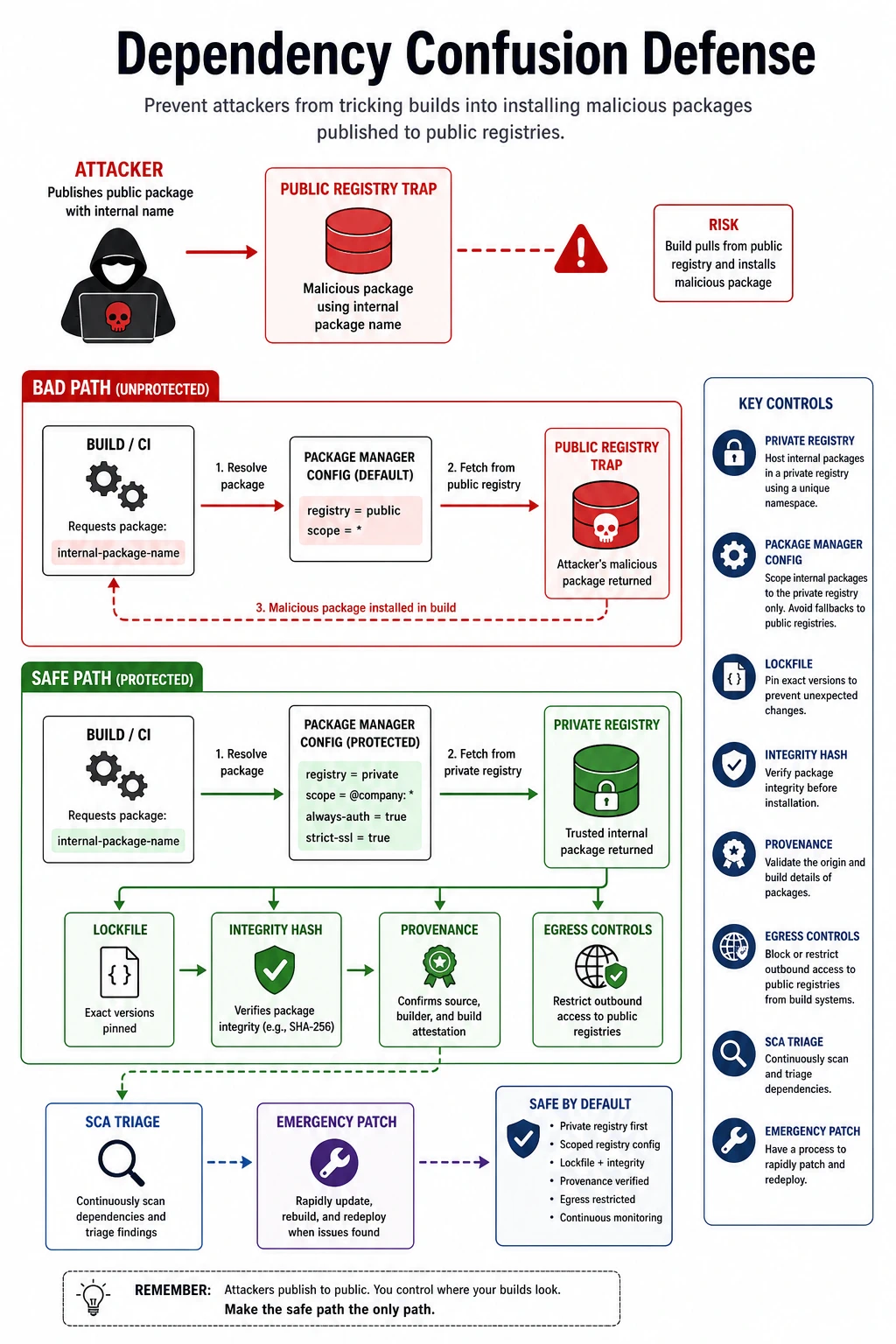
Begin with authority, not package type
An inventory that says “library,” “image,” or “SaaS” is useful for locating a dependency. It says too little about the harm that dependency can cause. Review the authority it receives instead: when it runs, which data it reads, where it can connect, what credentials or files it can reach, and whether its output becomes trusted code or configuration.
Application libraries execute with the service’s runtime privileges. Browser packages share an origin with sensitive UI and may reach dangerous DOM sinks. Infrastructure modules can create public networks or broad cloud roles. Container bases and operating-system packages establish much of the executable environment beneath the application. AI models and data sets can change behavior without resembling source-code changes. A SaaS API may hold customer data, sit on a critical availability path, or become difficult to leave even though none of its code enters the artifact.
Build dependencies deserve particular suspicion. Compiler plugins, generators, package lifecycle hooks, CI actions, and tools that fetch native binaries run before the artifact is signed. They often have source, network, credential, and filesystem access at once. A runtime package may be constrained by a container and network policy; a malicious installer can act while those controls are still being assembled.
For the renderer, the native downloader changes the review. The team is not accepting only a parsing API. It is accepting an installation program, a binary host, that host’s release process, and the build job’s ability to reach it. If that authority is unnecessary, disable the script or select a package that does not require it. If it is necessary, constrain the installation stage, allow only expected destinations, and verify the downloaded object before it can influence the build.
Make acceptance an engineering decision
A new critical dependency needs a short written case. Start with purpose: what capability it supplies and why existing code or a platform service is insufficient. Then examine the source and release posture—maintainers, ownership changes, release history, issue response, vulnerability handling, license, signed or otherwise verifiable releases, and any unexplained gap between source and distributed bytes.
Inspect what the change actually brings with it. Read the lockfile diff, package metadata, lifecycle hooks, native extensions, binary downloads, telemetry, and the highest-authority transitive dependencies. Check how the ecosystem chooses a registry and version. Popularity may increase scrutiny, but it is neither integrity evidence nor a promise that maintainership will remain healthy.
The acceptance record should answer six questions:
- What capability are we buying, and who owns its use?
- What runtime, build, network, filesystem, data, credential, or deployment authority does it receive?
- Which maintainers, registries, signing identities, mirrors, and download hosts can change the resolved bytes?
- Which direct and transitive components, scripts, binaries, models, data sets, or external services enter the trust decision?
- What tests and review evidence show that the component behaves acceptably in this system?
- How would we pin, patch, isolate, replace, fork, or remove it under time pressure?
An unanswered exit question is a present risk, not merely a future inconvenience. Reject or isolate a dependency when its privileges have no clear reason, its distributed binary cannot be connected to reviewed source, it hides generation or installation behavior, it requires unrelated runtime network access, or the service could not be secured while waiting for its owner to respond.
Control what a name resolves to
Acceptance covers particular bytes under particular assumptions. The build must not silently turn that decision into “whatever this name means today.” Pin direct versions, commit application lockfiles, and verify integrity metadata where the ecosystem supports it. Pin container bases, infrastructure modules, toolchains, and third-party CI actions with immutable identifiers appropriate to their registries. An update then becomes a reviewed change instead of an ambient event.
Lockfiles alone do not decide which registry is authoritative. Configure internal namespaces explicitly, separate private and public scopes, and prevent fallback that lets a public package with an internal name win resolution. Restrict build egress to approved registries and download hosts. A private proxy or mirror can improve availability and create an enforcement point, but only if upstream admission, cache mutation, retention, and administrator access are controlled.
Dependency confusion exploits the difference between the source a developer intended and the source the resolver selected. Typosquatting exploits the difference between the name a reviewer intended and the name they typed. An allow-list and review of new package names reduce both risks. Integrity hashes detect unexpected bytes after resolution; provenance can add evidence about where an object came from and how it was built. Neither repairs an unsafe rule that selected the wrong source in the first place.
Review dependency updates as code changes. A one-line manifest edit may add hundreds of files, a lifecycle hook, a new license, or a maintainer-controlled binary. The reviewer needs the direct and transitive diff, the reason for the update, changes in authority, test results, and any new resolution source. Chapter 27 binds the approved dependency set to the released artifact; this chapter decides whether that set deserved admission.
Assume a trusted source can become hostile
Names and hashes address only part of the supply-chain threat. A legitimate maintainer account can be compromised. A project can transfer ownership. A build tool can emit malicious output while its source repository looks unchanged. A model or data set can be replaced or poisoned. Pinning limits unreviewed movement, but it also preserves a known-vulnerable version until an explicit update occurs.
Use overlapping controls because these attacks break different assumptions. Constrain install scripts and build networks so package execution has less room to act. Verify release provenance and expected publisher identities where useful evidence exists. Compare generated or binary artifacts with their declared sources when the risk warrants it. Run behavioral and evaluation regressions for models and data sets, because a checksum can prove that bytes are unchanged without proving that their behavior is acceptable. Monitor ownership, publisher, registry, signature, download-host, and dependency-graph changes as events worth review.
A practical supply-chain threat review asks:
- Could a near-identical or public name enter through typosquatting or dependency confusion?
- Could a maintainer, publisher account, registry administrator, mirror, download host, or build tool replace accepted bytes?
- Does installation execute code or fetch another object, and what can that step reach?
- Can a transitive update, floating reference, mutable tag, or unpinned CI action change a rebuild without review?
- Would provenance, integrity verification, constrained execution, or an independent behavioral test reveal the change before release?
- If prevention fails, which artifact, deployment, and owner records make containment possible?
The objective is not to predict every compromise. It is to reduce how many identities can change production silently and to make the remaining changes observable.
Triage the deployed fact, not the scanner label
Two weeks after release, suppose an advisory reports remote code execution in the renderer’s parser. Software-composition analysis establishes a lead: an affected version appears in a component graph. It does not yet establish exposure. Responders must determine whether the vulnerable function is present in the final artifact, reachable from customer-controlled input, enabled in this configuration, and running with useful privilege.
Record the triage as a compact chain of evidence:
- the advisory or compromise report, affected component and versions, exploit preconditions, public exploit or known exploitation information, and confidence in each claim;
- the artifact digest and SBOM match, deployed services and environments, reachable call path, input exposure, data sensitivity, and execution privilege;
- existing isolation, validation, feature controls, network restrictions, monitoring, and the residual path around them;
- candidate fixed version or replacement, compatibility and regression results, mitigation limits, decision owner, deadline, and verification after deployment.
Severity influences urgency; it does not substitute for this reasoning. An internet-reachable parser processing hostile documents can outrank a nominally higher-severity flaw in a development-only tool used on synthetic data. Conversely, “not reachable” must name the call path or configuration that makes the claim true and remain valid as the service changes.
The team also needs an emergency path that has been exercised before an advisory arrives. Identify affected artifacts, disable the exposed feature or isolate the workload when that safely buys time, patch or remove the component, rebuild through the protected pipeline, run focused security and compatibility tests, redeploy the new digest, and watch both exploit signals and service behavior. Preserve the original artifact, SBOM, logs, triage decision, exceptions, and deployment record. If the fix breaks compatibility, a named owner must be able to choose among isolation, a temporary fork, feature disablement, compensating control, or time-bounded risk acceptance.
Ticket volume is not vulnerability management. A finding becomes managed when evidence connects it to deployed exposure, a decision, an owner, and a verified end state.
Make the SBOM answer incident questions
The SBOM for the invoice-export artifact should be generated from the final composition and bound to the same digest as its provenance and release record. Retain it for at least as long as the artifact may remain deployed or supported. Index it by component identity and version, artifact digest, service, environment, deployment time, and owner.
During the renderer incident, responders should be able to move in both directions: from the advisory to every affected artifact and deployment, and from a production digest back to its components and dependency evidence. The SBOM supplies the composition index. Deployment inventory establishes what is live. Reachability analysis and runtime evidence establish whether the vulnerable path can execute. No one of these artifacts can answer the incident alone.
An SBOM response guide should therefore be executable:
- Normalize the reported component identity, aliases, ecosystem, and affected version range.
- Query retained SBOMs and confirm matches against immutable artifact digests rather than service names or mutable tags.
- Join those artifacts to current and recent deployments, environments, owners, customer exposure, and support obligations.
- Test reachability and exploit preconditions; record the evidence and uncertainty.
- Open remediation and communication decisions with named owners and deadlines.
- After redeployment, verify that the fixed digest is live and that the affected component no longer appears where removal was intended.
Generating an SBOM without retaining, indexing, and rehearsing its use creates assurance paperwork, not response capability. Sharing one with a customer or regulator also needs a policy for sensitive component metadata, supported formats, correction, and the limits of what the document proves.
Keep the exit real
Return to the document renderer. It is acceptable only if its capability justifies its authority, its complete resolution path is controlled, its transitive and installation behavior are reviewable, and focused tests exercise the risky parser. The released digest must have a queryable record of the exact component version. The service owner must know how to disable document rendering, deploy a compatible fix, or replace the renderer without first negotiating ownership during an incident.
Floating versions, ignored transitives, unreviewed build tools, mutable base images, and CI actions pinned only by friendly tags all break this chain at different points. Their common failure is quieter than an ordinary code change: production behavior can move while the team still believes the old decision is in force.
A dependency remains trusted only while evidence continues to support the acceptance decision. Control the bytes, watch the authority around them, and practice the route out before trust fails.