Cybersecurity Engineering Handbook / Chapter 41
Secure Change Management and Operational Safety
Classify operational changes by security risk, require the right review path, and verify safety after execution.
Preparing audio…
Audio edition
Secure Change Management and Operational Safety
At 02:13, the support team cannot unlock customer accounts. An identity-service failure has taken the normal recovery path with it. The proposed fix is short: enable a feature flag that lets the support role write account state directly for thirty minutes.
The flag looks reversible. Its effects are not. It changes who may act, bypasses an authorization path, alters the events the monitoring system expects, and may leave writes that survive after the flag is disabled. The team needs to restore service quickly, but speed does not relieve it of deciding what authority it is creating.
Operational changes are security decisions when they alter privilege, exposure, enforcement, evidence, data handling, or recovery. A safe change process preserves that decision under pressure, limits what can happen during execution, and proves what state remains afterward.
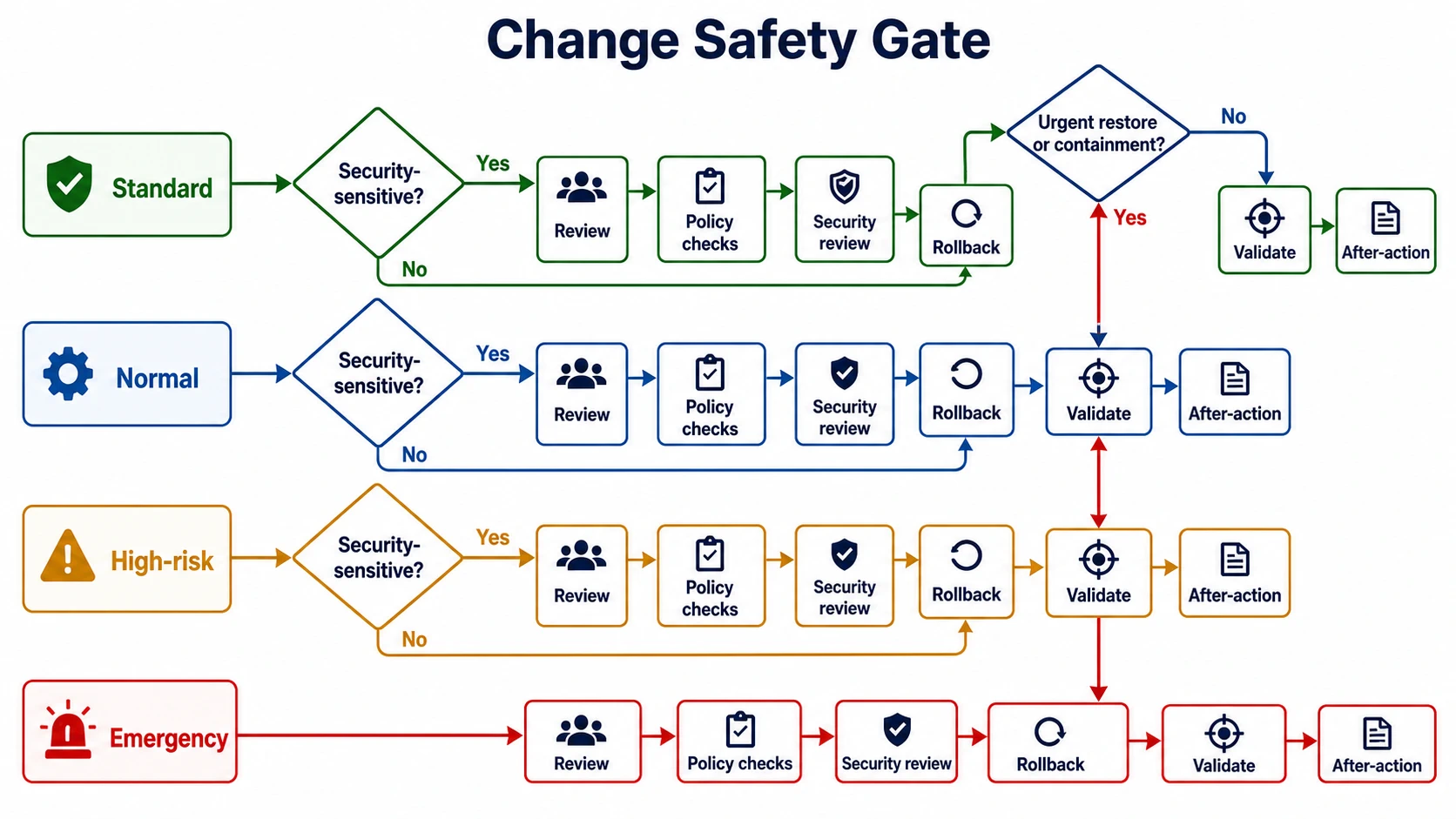
Classify the effect, not the size
Change classes exist to route work, not to describe how many lines changed.
A standard change is repeatable, preapproved, low-risk, and performed through a tested runbook. Rotating a stateless worker through a known deployment path may qualify. The execution record and post-change checks show that this instance stayed within the preapproved envelope. Once an operator must improvise, the change has left that envelope.
A normal change is planned but not preapproved. It receives peer review, applicable automated checks, owner approval, a rollback plan, blast-radius controls, and validation. Most routine configuration and deployment work belongs here.
A high-risk security-sensitive change may alter privilege, exposure, enforcement, evidence, secrets, protected data, deployment authority, or recovery. It requires security review before execution because an implementation that works as requested may still make an attacker path easier or a responder’s job impossible.
An emergency change is a timing condition, not a risk reduction. Delay must create material harm: continuing exploitation, failed containment, unsafe production state, significant customer impact, or lost recovery time. The team may compress or defer normal review, but it compensates with narrow scope, named command, live communication, durable logging, immediate validation, and a mandatory after-action decision.
The support flag is both emergency and security-sensitive. Calling it emergency explains why waiting is dangerous; it does not erase the need to understand the new authority. Classification belongs at the beginning, while the team can still change the implementation.
Find the security decision inside the change
A change needs security review before execution when it can grant access, create a public route, weaken a control, remove evidence, expose or retain data differently, alter recovery, or introduce a bypass. The review boundary includes identity and authorization policy, network exposure, logging, encryption, secret handling, data retention, CI/CD and deployment authority, administrative tools, and the permissions or retrieval sources available to AI systems and agents.
The useful question is not “does this component belong to security?” It is “which security claim could stop being true?” A shorter token lifetime may break an integration and provoke a dangerous workaround. A logging cost change may remove the field that binds an action to an identity. A new tool available to an AI agent may carry the caller beyond the authorization boundary even when the tool itself is sound.
For the support workaround, the team writes the intended claim precisely: a named incident role may unlock accounts for affected tenants during a thirty-minute window; it may not change contact details, credentials, or tenant ownership; every attempt and result must reach the independent audit stream. That claim gives the peer reviewer, security reviewer, executor, and validator the same object to inspect.
Design the execution before approving it
Review should make the proposed path safer, not decorate it with signatures. The peer checks whether the implementation matches the claim. The service owner checks operational consequence. The security reviewer asks which attacker path becomes easier, which detection weakens, whether the actor can change the evidence about its own actions, and whether the proposed restored state is actually recoverable. Automated policy checks should catch known violations such as wildcard IAM actions, open ingress, public storage, disabled audit streams, unencrypted stores, unpinned deployment inputs, or newly privileged CI/CD workflows.
Blast radius is a design variable. Instead of widening the standing support role, the incident team can issue a short-lived role to two named responders, restrict it to the affected account state and tenant set, require a ticket identifier, rate-limit its use, and place automatic expiry outside the executor’s control. A canary operation against one known account tests the path before expansion. These measures do not prove the change safe, but they reduce what one mistake or stolen session can do.
Rollback needs equal precision. “Turn the flag off” withdraws the new path; it does not undo account writes, revoke sessions already issued, restore missing audit events, or stop a delayed reconciler from turning the path on again. A usable rollback plan names the trigger, the person authorized to call it, the steps that stop further action, the state that must be reconciled, and the observations that prove restoration. Some effects cannot be reversed. Key disclosure, data deletion, shortened backup retention, and public data exposure require containment and recovery plans, not the word rollback.
Approval follows this design. A change that cannot name its intended secure state, affected authority, blast radius, rollback or containment path, and validation evidence is not ready for execution.
Keep an emergency observable
At 02:19, waiting for the normal identity path would prolong customer lockout, so the incident commander authorizes the bounded role. One operator executes; another watches the audit stream and service health. Both work in the incident channel against the same change record. The record names the clock deadline and the independent owner who can revoke the role if the executor loses access or judgment.
An emergency record should be brief enough to complete while the incident is moving. Capture:
- the event creating urgency and the material risk of delay;
- the exact action, affected systems, intended security state, and maximum scope;
- the commander or approver, executor, observer, communication channel, and time window;
- evidence to preserve, checks to run during execution, stop conditions, and rollback or containment authority;
- expected customer, data, detection, and recovery effects; and
- the immediate validation owner and the person responsible for after-action review.
If a normal review or automated gate is skipped, record which one, why delay is unsafe, and when the deferred decision will be completed. Emergency authority is not a reusable approval for later work.
Containment itself may destroy evidence or enlarge an outage. Before disabling identities, deleting resources, rotating keys, blocking traffic, or restoring a backup, preserve logs, snapshots, access records, and relevant configuration when the brief delay does not materially increase harm. Chapter 40’s monitoring operation depends on security-sensitive changes remaining visible; suppressing an alert or changing its route during the incident belongs in this same record.
At 02:27, the account-unlock canary succeeds and its audit event arrives. The team expands only to the named tenant set. When an attempt tries to change a recovery email, the authorization boundary denies it and the audit stream records the denial. That observation is more valuable than confidence in the flag’s name or the size of its diff.
Prove the state that remains
Functional success answers whether customers can proceed. Security validation answers what else became possible. Run both during the change, at completion, and again after any reconciler, cache, deployment controller, or token lifetime could alter the result.
For the support change, validation confirms that only named responders assumed the role; only affected tenants and account-unlock fields were writable; disallowed writes failed; accepted and denied attempts reached the audit stream with actor, tenant, target, and incident context; alert routing still worked; the role expired; active sessions were revoked; and the feature flag remained off after configuration reconciliation. The team also compares resulting account state with the incident record. Disabling the mechanism without inspecting its durable effects would leave the change half-finished.
The same method transfers to other control surfaces. After a network change, compare observed routes and exposure with inventory. After an IAM change, test allowed and denied actions and inspect effective policy rather than only the source diff. After logging or detection work, produce a representative event and follow it through routing. After encryption, secret, retention, backup, or CI/CD changes, verify the deployed control and its failure path. An approved infrastructure plan is evidence of intent, not evidence of runtime state.
Attach durable proof to the change record: effective-policy output, control and denial tests, configuration diff, log sample, alert result, scanner finding, deployment identity, or a link to immutable evidence. A screenshot can help a reader locate a state, but machine-readable output is usually stronger for later comparison.
Use this post-change validation checklist as a sequence:
- Match intent to runtime. Compare the approved secure-state claim with effective configuration and observed behavior.
- Exercise the boundary. Test a permitted action and the most consequential denied action; inspect tenant, role, data, network, and dependency scope.
- Follow the evidence. Confirm that logs, metrics, traces, alerts, and audit records arrive with the fields and delay required for response.
- Test restoration. Execute rollback when safe to do so, or verify the containment and recovery path for irreversible effects. Include caches, sessions, controllers, and delayed jobs.
- Account for residue. Reconcile data mutations, temporary identities, feature flags, exceptions, secrets, and manual console state.
- Close or escalate. Record the evidence and final state. Failed or uncertain checks keep the change open and receive an owner, deadline, and explicit risk decision.
Keep the decision usable
Before a security-sensitive change begins, its record should let an executor answer a compact set of questions:
- What class is this change, and which effect makes it security-sensitive?
- What secure-state claim should remain true, and which attacker or failure path could violate it?
- Which systems, tenants, identities, data, routes, evidence, and recovery paths are within reach?
- Who owns execution, peer review, service approval, security review, and rollback or containment?
- Which automated checks ran, and which gate was deliberately deferred under emergency authority?
- What is the stop condition, restored state, and proof that restoration worked?
- Which allowed and denied behaviors, telemetry paths, and durable effects will be checked afterward?
These questions form the security-sensitive change checklist. They are useful because they follow one decision from intent to observed state; copying them into a ticket without answering them changes nothing.
At 03:05, the normal identity path has recovered. The temporary role has expired, its sessions are gone, the flag remains off after reconciliation, and every exceptional write matches the incident record. The after-action review still finds work: the emergency path did not initially emit a denial reason, so the detection specification and test fixture need an update. That work receives an owner and date.
Without that final review, emergency mechanisms become quiet architecture. Feature flags keep authorization bypasses, temporary roles become standing privilege, and alert exceptions outlive the event that justified them. A change is complete only when the team can explain what authority existed, what it changed, what remains, and which evidence supports that account.