Cybersecurity Engineering Handbook / Chapter 39
Secure Backup, Restore, and Disaster Recovery Operations
Make recovery from cyber incidents and operational failures measurable through protected backups, clean-room restore, and tested disaster recovery.
Preparing audio…
Audio edition
Secure Backup, Restore, and Disaster Recovery Operations
At the start of a recovery drill, the invoice platform looks prepared. Database snapshots are current. Object replication is healthy. Infrastructure definitions and deployment artifacts are retained. The dashboard is green.
Then the recovery team opens a clean account and tries to rebuild the service. The application database restores, but the identity tenant cannot: no one exported its policy and group configuration. The runbook links to a secrets service that exists only in the unavailable production account. The restored application starts, sends email to real customers, and cannot decrypt documents written after the last key backup. A successful collection of backup jobs has produced an unrecoverable service.
The measure of a backup is the service that can be reconstructed from it. Recovery becomes a control only when a team can move protected state into an isolated environment, establish that the state and environment are trustworthy, restore useful service within an agreed time, and preserve evidence of what happened.
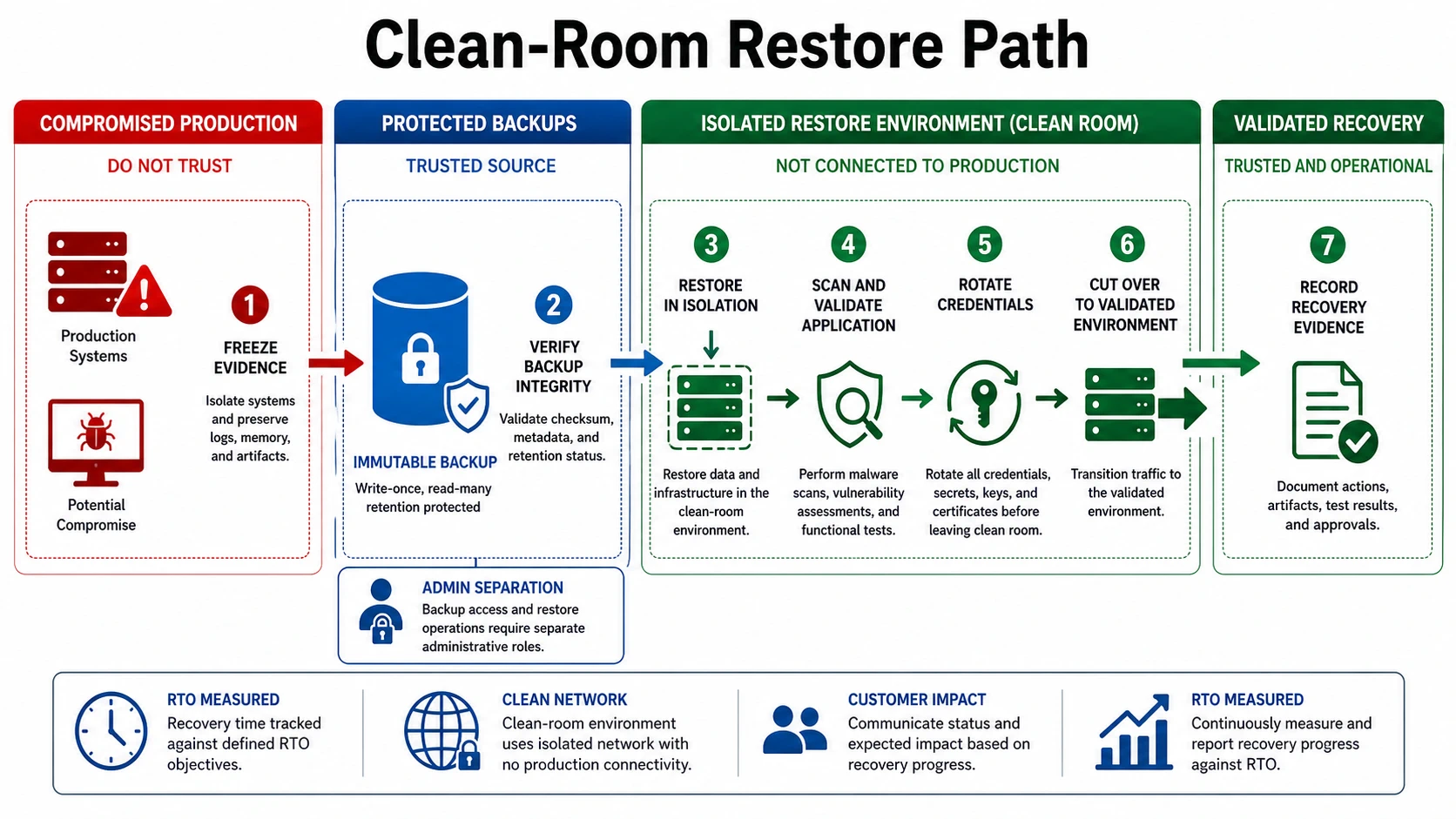
Define the service that must come back
Begin with a customer capability, not a storage product. For the invoice platform, minimal recovery might mean that customers can sign in, view invoices, and download existing documents. Creating invoices, sending email, changing payment details, and running analytics can wait. That choice determines which state and dependencies belong on the shortest recovery path.
The database and object store hold business records and rendered documents, but they are only part of that path. Recovery also needs the application version that understands the data; infrastructure and deployment definitions; network and DNS configuration; identity policies and federation settings; secrets metadata and a way to recover encryption keys; queues and feature-flag state; critical SaaS exports; and logs needed to establish the incident boundary. Source and build artifacts may be required when the normal build service is unavailable or no longer trusted.
Configuration from the previous chapter joins this inventory as recoverable state. A repository records intended configuration, while provider exports and protected audit records can reveal what production actually contained before failure. During a cyber incident, that difference may identify both a safe restore point and the change that caused the damage.
Record exclusions with the same care. A cache can be omitted if the service can repopulate it safely and the refill time fits the recovery objective. A search index can be rebuilt if its source remains authoritative and the rebuild will not overwhelm the restored database. Derived analytics may wait if customer transactions do not depend on them. “Rebuildable” is a claim about a tested procedure, elapsed time, and source of truth—not a property of a component name.
For each critical service, keep a small backup inventory that answers:
- What customer capability is being recovered, at both minimal and full service?
- Which data, configuration, identity state, keys, artifacts, logs, and third-party settings are required?
- Which backup or export creates each copy, at what cadence, with what retention, and under whose ownership?
- Which identities can read, restore, alter retention, or delete it, and where are those actions recorded?
- Which recovery point and recovery time objectives govern the service, and what result did the latest test actually achieve?
- Which dependencies must be restored first, which have a manual fallback, and which can remain absent?
- What is deliberately excluded, how is it rebuilt, and what time and customer cost does that add?
This inventory should be reviewable beside the architecture and service catalogue. If a new identity provider, key hierarchy, region, data store, or SaaS dependency changes the recovery path, the inventory and the next restore test must change with it.
Keep the copy outside the failure
A backup that shares production’s authority shares its blast radius. If one production administrator can encrypt the database, disable logging, reduce retention, and delete every recovery copy, the system has redundant storage but no administrative separation.
Critical copies need an independently controlled boundary. Depending on the threat and platform, that may be a separately administered account, a write-once or immutable retention mechanism, a logically isolated vault, an offline copy, or a combination. Ordinary production identities should not be able to shorten retention or delete protected generations. Restore, deletion, retention change, and cross-boundary replication should require narrowly scoped roles, stronger approval, and monitored break-glass access. Recovery access must still be usable when federation, normal administrator workstations, or the primary collaboration service is unavailable.
Protect confidentiality without making decryption depend on the failed environment. Encrypt copies in transit and at rest, and design a separately recoverable route to the required keys. A key available to every production workload offers weak separation; a key whose only recovery instructions live inside production is unusable. Test the key route as part of restore, including quorum, escrow, hardware, or offline steps where those exist.
Protection also includes time. A ransomware operator may corrupt data quietly and wait for clean generations to expire. Retain enough independently protected history to reach behind the plausible detection delay, while respecting approved deletion requirements. Backup retention does not cancel privacy or records policy: regulated or contractually deleted data should age out through designed, auditable behavior. Legal holds and exceptional retention need explicit authority and scope, not a permanent excuse to keep every generation.
Watch the control plane as closely as the jobs. Alert on failed or late backups, missing populations, unusual restore attempts, bulk deletion, retention reductions, immutability changes, key-policy changes, disabled replication, and changes to backup administrators. Preserve those events beyond the reach of the roles they describe. A green snapshot count cannot reveal that an attacker quietly changed what gets copied.
Replication and failover solve a different problem. They can reduce interruption after a regional or infrastructure failure, but they may faithfully replicate deletion, corruption, or attacker changes. A replica that can become primary is useful availability capacity; it is not a substitute for versioned, protected recovery points.
Make the restore earn its evidence
The invoice drill begins again, this time from a declared assumption: production administration may be hostile. The incident commander chooses a backup from before the suspected compromise, records why that point is plausible, and authorizes a clean recovery boundary. Operators use known-clean devices and recovery identities that do not depend on production federation.
The restore test then follows an order that can be repeated under pressure:
- Name the failure or attacker condition, the affected service tier, the target recovery point, the recovery time objective (RTO), and the recovery point objective (RPO). Start the recovery clock at the event defined by the plan.
- Confirm the recovery team’s authority and a communication channel that survives loss of ordinary systems. Freeze destructive changes to candidate backups and preserve relevant logs.
- Create or verify an isolated recovery environment with no implicit trust in production. Disable outbound side effects such as customer email, payments, webhooks, scheduled jobs, and third-party writes.
- Select the backup by timestamp, generation, provenance, and incident boundary. Verify its integrity and the availability of keys before changing the only usable copy.
- Restore dependencies in their tested order: foundational identity and keys, network and name resolution, data services, application artifacts and configuration, then supporting queues, observability, and external integrations.
- Inspect the recovered environment for indicators of compromise, unauthorized identities, persistence, malicious artifacts, unexpected configuration, and data corruption. Rotate exposed credentials and review keys rather than importing production authority unchanged.
- Start minimal service with side effects still contained. Run storage checks, schema and referential checks, authorization denials, representative customer reads, document decryption, reconciliation totals, and other business invariants that can expose a logically broken restore.
- Measure elapsed time and the age of the restored state. Record manual work, failed steps, missing dependencies, and decisions made under exception. Compare the observed result with the RTO and RPO instead of rounding it into success.
- Decide whether the environment is fit for cutover. Reconnect external effects deliberately, monitor them, communicate verified customer impact, and retain a route back if validation fails.
- Preserve the restore record and assign defects. A missed objective creates engineering or risk work with an owner and due date; it does not become a more flattering objective after the drill.
Checksums and storage-engine consistency are necessary, but they prove only that bytes and structures survived. Application validation asks whether the recovered version can read those bytes. Business validation asks whether invoice totals reconcile, tenant boundaries still hold, documents decrypt, and customers see the right state. Security validation asks whether the intrusion path, stolen authority, or persistence survived the trip. A useful restore test reaches all four layers.
Test cadence follows consequence and change. A critical, frequently changing service needs more frequent and varied restores than a stable internal archive. Trigger an additional test after a storage migration, identity redesign, key change, regional move, major retention change, or recovery-path incident. Rotate scenarios: accidental deletion, lost region, unavailable identity provider, corrupted generation, compromised administrator, and loss of the normal deployment system exercise different weaknesses.
Operate disaster recovery as a decision sequence
A disaster recovery plan coordinates more than restoration. It decides which service to recover first, whether to fail over or rebuild, what reduced service is acceptable, who can authorize customer-impacting actions, and how to work when usual people or tools are absent.
Keep the runbook short enough to navigate during an outage. Its first page should name the incident authority, service tiers, invocation criteria, primary and alternate communication channels, current RTO and RPO, and the location of protected credentials and detailed service procedures. The operating sequence should then be explicit:
- Establish command, record the decision time, declare the failure assumption, and protect evidence.
- Assess which regions, identities, data stores, control planes, staff, suppliers, and communication systems are trustworthy and available.
- Choose failover, point-in-time restore, clean rebuild, or reduced manual service according to the cause. Do not fail over active compromise merely because capacity exists.
- Recover foundational dependencies before dependent applications. Publish a dependency order for minimal service and another for full service.
- Validate data integrity, security boundaries, application behavior, and capacity before directing customer traffic.
- Cut over through controlled DNS, routing, or service-discovery changes; watch error, authorization, reconciliation, and security signals; retain rollback criteria.
- Communicate what customers can observe, available workarounds, known data implications, and the next update time. Promise only what the latest evidence supports.
- Stabilize full service, reconcile writes made during degraded operation, preserve the recovery record, and turn every workaround or missed objective into owned work.
Recover when production cannot be trusted
Ransomware uses the same recovery sequence with a stricter trust assumption. Confirm that backup administrators and recovery devices are independent of compromised production; recovery instructions and contacts are available offline or through an alternate channel; protected generations extend behind the likely intrusion; identity sessions, credentials, keys, and federation trust are reviewed or rotated; restored systems are checked for persistence and unauthorized configuration; and the initial access path is closed, contained, or explicitly monitored before cutover.
This is the ransomware recovery checklist, but it cannot identify one universally safe restore point. Incident evidence must bound when destructive access, persistence, or quiet corruption may have begun. A newer generation reduces lost work but may retain attacker changes; an older generation may be cleaner but deepen customer data loss. Preserve candidate generations while investigators and service owners make that decision. When systems must return in stages, the incident authority—not the loudest service owner—sets priority from safety, customer harm, legal obligations, and dependency order.
Let the measured failure change the system
The invoice platform eventually restores without sending email or accepting writes. Its documents decrypt, tenant-isolation tests deny cross-customer reads, and invoice totals reconcile. Minimal service returns in three hours and forty minutes against a two-hour RTO. The chosen generation leaves a measured twenty-two-minute data-loss window against a fifteen-minute RPO. Those are not failed paperwork fields. They describe customer consequences.
The restore record binds the result to a system, incident or drill assumption, backup identifier and timestamp, recovery environment, operators and approvals, test start and cutover times, measured data-loss window, validation output, exceptions, defects, and final decision. Keep failed commands and manual workarounds where they help reproduce the path. Backup-job logs remain supporting evidence; the application and business checks are what show that service returned.
The team now has choices. It can shorten snapshot intervals, reduce the amount of state on the minimal path, automate identity export, make the secrets service independently recoverable, prebuild the clean environment, or negotiate different objectives with the accountable business owner. It may accept the gap for a bounded period with compensating measures. It may not cite the untested two-hour estimate at the next review.
The next drill starts from the defects found in this one. That is how recovery improves: each protected copy is forced through the path it is supposed to support, and each measured shortfall changes the architecture, automation, runbook, or risk decision. A dashboard can say that backups exist. Only a restore can say what the team is able to recover.