Cybersecurity Engineering Handbook / Chapter 47
Recovery, Eradication, and Lessons Learned
Close incidents with validated recovery, removed attack paths, and engineering improvements that prevent recurrence.
Preparing audio…
Audio edition
Recovery, Eradication, and Lessons Learned
The unapproved release from the previous chapters is contained. New traffic cannot reach its pod, the deployment identity has been disabled, and the evidence owner has preserved the state needed for investigation. The customer-facing service is degraded, but stable. It is tempting to delete the pod, rotate the obvious credential, deploy the last known release, and declare recovery.
That sequence would restore service without answering the harder question: what would make the restored service trustworthy? The credential may have minted sessions that remain valid. The same release path may exist in another environment. The last known release may depend on a build system the intruder could alter. Containment has bought the team time; it has not made these uncertainties disappear.
Recovery is a decision supported by evidence. The team must remove the path that enabled the incident, restore from sources it has reason to trust, test the conditions that matter, and name any risk it cannot eliminate. The incident closes only when those findings also become owned changes to the engineering system.
Three states, with imperfect boundaries
Containment limits continuing harm: isolate the pod, block the route, freeze deployments, narrow permissions, or disable the identity. It is allowed to be blunt and temporary. Its question is, “What must stop now?”
Eradication removes the attack path and any persistence it created. Its question is, “What could let the actor retain or regain control?” Patching the first observed flaw is only one part of the answer.
Recovery restores trusted operation. Its question is, “What evidence justifies exposing this system to customers and normal change again?” The pre-incident state is not automatically the target; it may be the vulnerable state.
These states overlap. The team may restore a read-only path before every credential has been rotated, or keep an isolation rule while a clean environment is built. A sequencing decision should name the customer or operational need, the uncertainty being accepted, the compensating control, the owner, and the time at which the decision will be revisited. Labels are less important than preventing a temporary containment measure from silently becoming the permanent basis for trust.
Turn observations into an eradication boundary
The evidence from the unapproved release gives the team a starting path: an identity issued a credential, the credential invoked a deployment, the resulting workload obtained authority, and that authority reached a tenant object. Eradication follows every link. For each one, ask where else the same condition exists and what the actor could have created before containment.
Disabling the deployment identity is insufficient if its issued sessions remain valid. Rotation scope therefore follows exposure, not organizational convenience: sessions, refresh tokens, service credentials, deployment secrets, integration keys, signing material, and cached credentials all need a recorded disposition. Sequence rotations so that a surviving credential cannot mint replacements, and verify rejection of the old material rather than trusting the rotation command’s success message.
The team then inspects adjacent deployment paths, recent privilege changes, unauthorized automation, scheduled work, new accounts and keys, modified policies, and matching vulnerable configurations in other environments. It searches for the weakness class, not merely the observed instance. If the release bypassed an approval check, every route capable of producing or promoting an artifact belongs inside the boundary.
When the integrity of a host, image, registry, build agent, pipeline, model artifact, or deployment account is uncertain, repairing it in place preserves that uncertainty. Rebuild from reviewed source and dependencies through a controlled pipeline, using fresh credentials and an independently verified expected artifact digest where the system supports it. A provenance record is useful only if the signer and the process that produced it remain trustworthy.
The eradication record can be short, but it must be inspectable. It names:
- the observed attack path and the evidence that supports it;
- every credential, session, persistence mechanism, asset, and adjacent path considered in scope;
- the action taken for each item and the evidence that the action worked;
- the searches performed for recurrence elsewhere, including their limits;
- any unresolved path, its owner, and the control that contains it.
This is not proof that no attacker remains. It is the team’s bounded argument for why the known path and plausible continuations no longer provide control.
Make the release decision from claims
Before restoring traffic, write the claims that would have to be true. For the affected service, they might be: the deployed artifact came from reviewed source; only the approved pipeline can promote it; the abused credential and its descendants are rejected; tenant authorization denies the captured exploit; affected records are intact or reconciled; security logs and alerts observe another attempt; and support knows which customers may have been affected.
Attach evidence to each claim. A successful health check establishes availability, not trust. Trust may require an artifact digest and build record, a negative authorization test, a safe replay of the exploit, an attempted use of revoked credentials, policy inspection, an alert test, an audit-log sample, and integrity or reconciliation results for affected data. A restored database also needs evidence that the chosen restore point precedes harmful changes without discarding legitimate later work.
Customer impact is part of recovery validation, not a communications afterthought. Reconcile the evidence preserved in Chapter 46 against application and data records. State which tenants, objects, actions, and time ranges were checked; what the sources cannot reveal; and who decides whether notification, remediation, or further investigation is required. Security engineers provide facts and technical uncertainty. The appropriate legal, privacy, product, and incident authorities make decisions in their domains.
For a high-risk incident, recovery proceeds through a named observation period. Assign an owner, the signals to watch, thresholds that trigger renewed containment, customer-support triggers, and an exit time. Include positive telemetry-health checks: quiet logs mean little if collection stopped during the rebuild. At the exit review, the recovery authority either accepts the evidence, extends the watch, narrows service again, or records residual risk through the organization’s normal exception process.
A useful recovery release record fits on one page. It identifies the recovery authority and time; the restored versions and trust sources; functional, security, data-integrity, logging, detection, backup, and customer-impact claims; evidence links and test results; the monitoring owner and exit criteria; open risks; and the decision to restore, restrict, or defer. “Service is up” is never its acceptance criterion.
Review the system that permitted the path
Once immediate recovery no longer consumes the team, reconstruct how the path became possible. The technical defect matters, but “a credential was exposed” or “an approval check was missing” stops one question too early. Why could that credential promote a release? Why did the path lack an independent policy check? Why did the resulting tenant read produce an investigation before it produced a useful alert?
Look for conditions in design, implementation, review, detection, ownership, training, documentation, dependency management, and platform defaults. A good review distinguishes observations from hypotheses and conclusions. It also records what limited the damage: perhaps tenant-scoped database credentials prevented broader access, or immutable audit logs survived the compromised identity. Preserving successful controls prevents the organization from rewriting the incident as total failure.
The review is not a ceremony transcript and not a search for a single culpable person. It is a decision record answering: what happened and with what impact; what made the path possible; what detected or constrained it; what slowed containment, investigation, and recovery; which assumptions failed; what remains uncertain; and which engineering changes follow. Builders, operators, responders, detection owners, and customer-facing teams each hold different pieces of that account.
Make each lesson change a system
“Improve deployment security” cannot be reviewed or closed. “Require a policy decision from a separately administered control before production promotion, and add a test proving the deployment identity cannot bypass it” can. The action names a changed condition and the evidence that will demonstrate it.
Track immediate corrective work separately from changes that prevent the weakness class, improve detection, repair a runbook, preserve better evidence, or change training and product behavior. The categories expose gaps; they should not manufacture one action in every lane. Training is justified when a judgment or skill gap contributed. It is not a substitute for changing an unsafe default.
For each action, record the incident finding it addresses, the system and owner, the exact change, priority or due date, acceptance evidence, dependencies, residual risk, and closure reviewer. Keep the work in the engineering system where its owner plans other changes, while retaining a link from the incident record. Closure means the reviewer has inspected the evidence, not that someone moved a ticket to Done.
Some findings deserve broader treatment than a local fix. The unapproved release should produce a regression test for the captured path, but also a review of every promotion route and identity with equivalent authority. Its evidence gap may lead to a retention check across production accounts. These preventive actions need explicit scope; “all services” without an inventory and owner is only a larger unowned theme.
Close exceptions and preserve uncertainty
Containment often leaves behind emergency firewall rules, disabled features, widened responder access, frozen automation, paused detections, or changed retention. Before closure, remove each exception or give it an owner, an expiration, and a safe removal test. Otherwise the incident trades one invisible risk for another.
The same honesty applies to incomplete knowledge. The team may never establish whether a credential was stolen or accidentally used, or whether an unlogged read occurred. State the uncertainty, the evidence gap, and the decision it affects. Do not turn absence of evidence into a clean bill of health.
The final incident review should leave four connected artifacts: an eradication record showing what was removed and how that was verified; a recovery release record showing why normal operation was allowed; a lessons-learned decision record that preserves facts, uncertainty, contributing conditions, and successful controls; and an action tracker whose items close only on acceptance evidence.
The close-the-loop figure is therefore literal. A finding becomes a requirement, code or configuration change, regression test, detection, runbook or training change where warranted, and durable evidence. If the link breaks at “lesson identified,” the organization has documented the incident without learning from it.
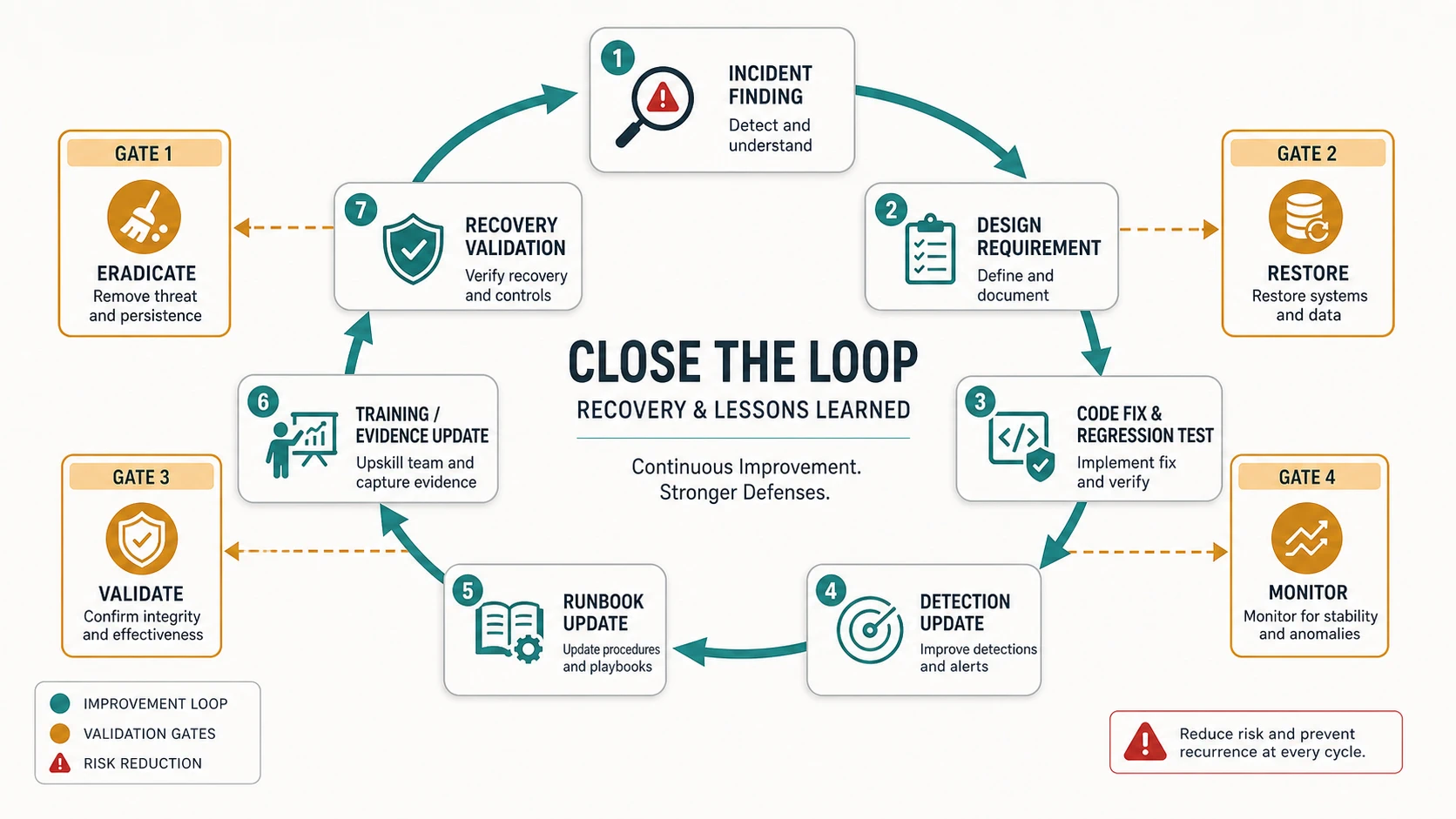
The incident can close when containment is no longer the principal control, the known attack path and plausible persistence have been removed or explicitly accepted as residual risk, recovered service has passed its trust claims, temporary exceptions have owners or are gone, and consequential findings have entered engineering work with owners and acceptance evidence. Recovery is complete at that decision point. Improvement continues after it.