The Rust Engineering Handbook / Chapter 32
Allocation Strategies, Arenas, Pools, and Allocation-Free Paths
Choose allocation architecture from lifetime, identity, capacity, reset, latency, and failure requirements—and verify the result instead of relying on folklore.
Start with the workload contract, not the allocator
Four services report “allocation overhead.” They do not have the same problem:
| Workload | Evidence | Architectural pressure |
|---|---|---|
| parser builds 80,000 short-lived nodes, then discards the whole tree | allocation/deallocation dominates a measured batch phase | common lifetime and bulk reset may matter |
| connection service creates a few buffers but retains rare 16 MiB spikes | resident memory grows after traffic bursts | retention and size-class policy matter more than call count |
| scheduler needs stable task identity across slot reuse | stale work occasionally targets a new task | generations and explicit identity matter |
| control loop has a fixed memory budget and deadline | any unbounded work violates the system contract | capacity and exhaustion must be explicit before execution |
“Use an arena” is not an answer to all four. Allocation strategy becomes architectural when it changes at least one of these contracts:
- lifetime: values are destroyed individually, by phase, or with an owner;
- identity: callers retain references, indices, handles, or keys;
- capacity: growth is elastic, bounded, reserved, or forbidden;
- reset: destructors run individually, resources are cleared for reuse, or storage is reclaimed in bulk;
- failure: exhaustion returns an error, sheds work, blocks, panics, aborts, or violates a deadline;
- evidence: the chosen design improves a measured distribution on supported targets.
The ordinary global allocator is often the right baseline. Box, Vec, String, and standard collections provide clear ownership, mature implementations, and useful capacity controls. Replace that baseline only after the workload contract exposes a real mismatch.
The allocator call is only one term in the cost model
Allocation can involve size-class selection, synchronization, metadata access, page acquisition, zeroing or initialization, cache and translation effects, and eventual reclamation. Yet a profile that attributes time to allocation does not prove allocator substitution is the best repair. The surrounding design may allocate too often, retain too much, copy unnecessarily, or destroy a large graph on a latency-sensitive thread.
Measure at least the relevant subset of:
- allocation and deallocation counts by request path and size class;
- bytes requested, live, retained as spare capacity, and resident;
- peak memory and high-water behavior after a burst;
- p50, p95, p99, and maximum request or phase latency;
- destructor/reset time and which thread pays it;
- cache misses, page faults, and allocator contention;
- failure behavior at the configured memory limit;
- throughput and compile/binary cost if abstractions add generics or dependencies.
Benchmarking only construction time can reward a design that postpones all destruction into an operationally worse spike. Measuring a microbenchmark with warm pages can conceal first-use page faults. Counting allocations without sizes can make one enormous retained buffer look cheaper than several small, promptly freed values.
Rust’s standard library uses one global allocator for facilities such as Box and Vec. A program can select a global allocator with #[global_allocator] and implement the unsafe GlobalAlloc contract. That is a process-wide boundary with deep correctness and observability consequences. The per-container Allocator API remains unstable in the Rust 1.97 snapshot; do not present Vec<T, A> customization as a stable application default.
Capacity planning is the first allocation strategy
Before introducing a new storage abstraction, remove accidental growth. Vec::with_capacity, String::with_capacity, HashMap::with_capacity, reserve, and try_reserve express expected demand and separate capacity failure from later mutation. Reuse a collection with clear when retaining its capacity is beneficial and bounded.
Capacity planning needs a distribution, not a guessed maximum. A protocol batch that is usually 20 items and occasionally 200,000 should not preallocate the peak for every request. Options include:
- reserve a measured common percentile, then allow bounded growth;
- reject or stream oversized inputs;
- use a small inline path plus an explicit spill path;
- share a budget across concurrent requests;
- trim or discard exceptional buffers instead of returning them to a pool.
reserve may panic on capacity overflow or allocation failure according to the API’s behavior; try_reserve returns an error for callers that can recover or shed load. Neither removes the need to cap adversarial lengths before multiplication and allocation. Input-provided counts must be validated against semantic limits and checked arithmetic.
Spare capacity is not initialized data. Unsafe code using set_len or raw spare storage must prove every exposed element is initialized and handle panic during partial construction. Prefer safe collection APIs unless profiling shows the initialization path itself is material and a narrow unsafe abstraction has a complete safety case.
Arenas turn many lifetimes into one owner lifetime
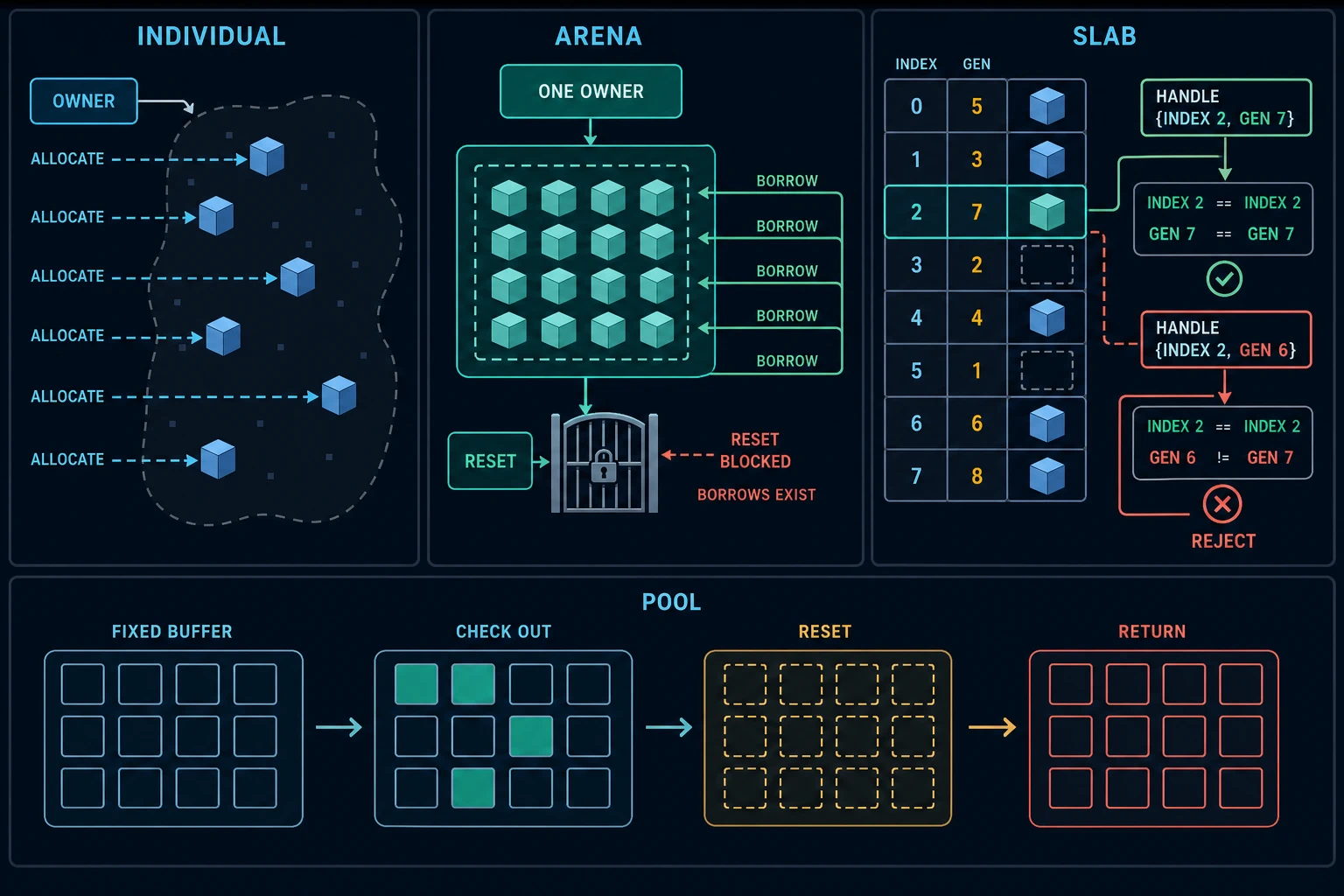
An arena owns a group of values and lends references tied to the arena. This is useful when values share a phase: parse one request, build an intermediate graph, compute a result, then discard the whole graph. Bulk reclamation can reduce per-node deallocation work and make locality more predictable.
The essential contract is not “fast allocation.” It is:
Values allocated in the arena cannot outlive the arena, and reset or destruction cannot occur while safe borrows into that storage remain usable.
Rust’s borrowing rules can encode this relation. A simple arena backed by Vec<T> can insert during one mutable construction phase and lend references during a later immutable phase. Because a returned reference borrows the arena, safe code cannot call a mutating reset through the same owner until the borrow ends.
let mut arena = StringArena::with_capacity(2);
let root = arena.insert("root");
let leaf = arena.insert("leaf");

assert_eq!(arena.get(root), Some("root"));
assert_eq!(arena.get(leaf), Some("leaf"));

arena.reset();
assert_eq!(arena.get(root), None);
This fixture returns epoch-tagged IDs during mutation and borrows later, avoiding references that would be invalidated by vector reallocation and rejecting an ID after reset. A production arena may instead keep IDs strictly phase-local or use chunked backing storage to preserve address stability while allocating. The public contract must say whether addresses are stable, whether destructors run, whether values may contain external resources, whether identifiers survive reset, and whether reset retains memory.
An arena is a poor fit when objects need independent destruction, unpredictable retention, cross-phase ownership, or prompt release of scarce resources. Putting file descriptors, locks, or large buffers into a phase arena can delay cleanup until the largest owner dies. If one long-lived object keeps the arena alive, all otherwise-dead peers remain retained.
Bump allocation is a narrower arena policy
A bump allocator advances a cursor through one or more chunks. Individual deallocation does not recover space; reset or arena destruction reclaims a region. Allocation can be a small alignment-and-bounds calculation, but construction, drop, and growth policy still matter.
For plain scratch data with one lifetime, bump allocation can be excellent. For values with destructors, a bump arena must either track and run drops, restrict admitted types, or document that resources are not reclaimed individually. “Freeing the bytes” and “running semantic destruction” are different operations.
Reset should be an explicit phase boundary. On reset, decide whether chunks are retained, zeroed, decommitted, or returned. Retention improves subsequent throughput but raises steady-state memory after spikes. Zeroing can protect against data remanence but adds latency; sensitive buffers may require deliberate clearing even when safe Rust already prevents accidental typed access.
Slabs provide slots; generations provide time-aware identity
A slab stores values in numbered slots, often with a free list. It can reduce per-value allocation and provide compact lookup. A bare index is not durable identity: remove slot 12, reuse it for a different task, and an old queued message for index 12 can silently target the new task.
A generational handle pairs the index with a generation counter. Lookup succeeds only when both match the occupied slot. Removal increments the generation before reuse:
let mut slab = GenerationalSlab::default();
let old = slab.insert("old task");
assert_eq!(slab.remove(old), Some("old task"));

let current = slab.insert("new task");
assert_eq!(slab.get(old), None);
assert_eq!(slab.get(current), Some(&"new task"));
This prevents a common stale-handle logic error, not every identity failure. Review:
- generation width and wraparound policy;
- whether handles can cross process restarts or persistence boundaries;
- tenant or shard identity when indices are meaningful only locally;
- synchronization if removal and lookup occur concurrently;
- authorization: a valid handle is not automatically permission;
- observability without exposing predictable handles as secrets.
The fixture uses a wrapping u64 generation and is intended for in-process demonstration. A production design must show that wraparound is unreachable within the threat and uptime model, retire exhausted slots, or use a wider/randomized identity scheme. Serialize a domain identifier with an explicit version; do not persist raw arena addresses.
Slabs do not guarantee stable references if their internal storage can reallocate. Opaque handles let the implementation move values and resolve them at access time. If an FFI operation or intrusive structure needs stable addresses, use storage whose pointees remain stable and make that additional contract explicit. Chapter 31’s pinning proof is not automatically supplied by a numeric slot.
Pools trade allocation calls for reset and retention policy
An object pool checks out a reusable object, then requires it to be returned in a clean state. That can help when construction is expensive, object sizes are reasonably uniform, demand is bounded, and reuse is frequent. It can hurt when pooled objects retain exceptional capacity, require complex sanitization, or turn a local owner into shared contended infrastructure.
The lab’s buffer pool makes reset visible:
let mut pool = BufferPool::new(4096);
let mut buffer = pool.checkout();
buffer.extend_from_slice(b"request bytes");
pool.return_buffer(buffer); // clears length before reuse
It also rejects buffers whose capacity grew above twice the configured baseline. That is one policy, not a universal threshold. Without a cap, one malicious or rare oversized request can leave large buffers resident indefinitely. Without clearing, the next borrower observes stale logical data. Clearing a Vec<u8> resets length but does not necessarily overwrite capacity bytes; security requirements may demand zeroization through a carefully reviewed mechanism.
RAII guard designs can return objects automatically, but panic and leak behavior still need analysis. A guard dropped during unwind can run reset logic at an awkward time. A forgotten guard permanently reduces pool capacity. A global mutex-protected pool may add contention worse than the allocation it replaces. Per-thread pools reduce contention but can multiply retained memory and complicate load balancing.
Pools also obscure ownership in profiles. Instrument checkout misses, wait time, in-use count, retained bytes, rejected oversized returns, reset duration, and leak detection. Bound the pool and define what happens at exhaustion: allocate outside the pool, wait with cancellation, reject work, or shed an older item.
Fixed and small-object paths make exhaustion part of the API
A stack-backed or inline buffer stores up to a known capacity without heap allocation. This is useful for protocol headers, formatted identifiers, bounded command paths, embedded systems, and common-case small data. The trade-off is that capacity becomes part of every value’s size or type, and overflow needs an explicit result.
let mut output = FixedBuffer::<8>::default();
output.extend_from_slice(b"ready")?;
assert_eq!(output.as_slice(), b"ready");
Credible overflow policies include returning CapacityError, truncating only when the format explicitly permits it, spilling to heap storage, splitting output into chunks, or rejecting the request. Silent truncation is usually a data-integrity or security defect. A heap spill preserves generality but means the path is not allocation-free in the worst case; name it a small-object optimization instead.
Inline-capacity containers increase object size even when empty. Large arrays passed by value can increase copying or stack pressure, though the compiler may optimize particular moves. Recursion, task stack limits, interrupt stacks, and many concurrent instances can turn “no heap” into a worse memory bound. Measure complete resident and stack usage on the deployment target.
An allocation-free steady-state path requires more than an inline vector. Logging, error formatting, metrics labels, callbacks, hidden conversions, TLS initialization, or lazy singleton setup may allocate. Warm-up tests can miss first-use allocation; fault-path tests often reveal it. If the contract is strict, instrument the allocator in a controlled test, run representative success and failure paths, and define whether startup allocation is allowed.
The strategies can now be compared by the contracts they preserve: owner lifetime, temporal identity, reset policy, and bounded capacity.
Fragmentation has several meanings
External fragmentation leaves free regions that cannot satisfy a large request despite sufficient total free bytes. Internal fragmentation rounds requests up within size classes or reserves capacity beyond live data. Application retention keeps reachable but unnecessary capacity. Virtual memory and resident memory can diverge when pages are reserved, committed, decommitted, or cached by the allocator.
Do not diagnose all of these from RSS alone. Pair allocator statistics, process mappings, heap profiles, live-object accounting, and traffic phase data. An arena can reduce external fragmentation within a phase but retain entire chunks because one object survives. A pool can cap allocation churn while increasing internal fragmentation. A slab with uniform slots is predictable for one type but wastes space for widely varying payloads.
Memory release to the OS is an implementation and platform concern, not the same event as dropping a Rust value. A global allocator may cache freed memory. Containers may retain capacity after clear. If operational policy depends on returning pages, measure the selected allocator and target under representative loads and document the supported configuration.
Real-time and constrained systems require a closed resource model
General-purpose allocation APIs do not by themselves provide hard real-time guarantees. A hard deadline needs upper bounds for allocation, initialization, page faults, locks, destructor work, interrupt interaction, and every transitive dependency. “No allocations in the loop” is useful only inside that wider proof.
A constrained design commonly separates phases:
- During initialization, allocate fixed pools, touch pages if the platform contract requires it, create queues, and validate configuration bounds.
- Before entering the critical phase, freeze capacities and expose only bounded operations.
- During execution, return explicit exhaustion results and apply a documented shedding or safe-state policy.
- Outside the deadline, reclaim or replenish resources and report high-water metrics.
Embedded and no_std environments may have no global allocator at all. Fixed arrays, const-generic buffers, static pools, and caller-supplied storage make ownership and capacity explicit. They also demand careful synchronization and initialization discipline for global storage. Avoid static mut; use safe concurrency primitives appropriate to the target or a small audited unsafe abstraction.
For soft real-time services, a bounded allocator or pool can reduce tails without proving a hard bound. State the classification honestly. Evidence from one Linux host cannot establish an interrupt or embedded deadline on another target.
Custom allocators widen the unsafe and operational boundary
Implementing GlobalAlloc requires correct handling of Layout, alignment, allocation failure, deallocation pairing, reallocation, concurrency, and optimizer caveats described by the standard library. Allocation counting inside the allocator must avoid recursion. Panicking from allocator methods is not a general recovery strategy. Foreign libraries may use different allocators, so memory must be freed by the same boundary that allocated it unless an ABI explicitly says otherwise.
Choose a process-wide allocator only with evidence that the workload benefits and operational tooling supports it. Record:
- allocator and crate version, features, and license;
- Rust version, target, libc/OS, and linkage mode;
- profiling and heap-inspection support;
- behavior under memory pressure and allocation failure;
- fork, FFI, dynamic-library, sanitizer, and shutdown interactions;
- rollback criteria and canary metrics.
Most libraries should not dictate the application’s global allocator. They should control allocation frequency through API design, accept caller-owned buffers where useful, offer capacity hints, and document hot-path behavior. A library that globally selects allocation policy creates an integration conflict with every executable that has different needs.
Benchmark the ownership design, not a caricature
The fixture compares Vec<Box<u64>> with one capacity-planned Vec<u64> in release mode. That demonstrates a reproducible measurement harness and a likely locality/allocation contrast; it is not a complete arena benchmark. A serious experiment should compare designs that provide equivalent semantics:
- Define the node shape, edge representation, destruction needs, and lookup operations.
- Generate representative batch sizes and lifetime distributions.
- Compare individually owned nodes, a phase arena, and any handle-based packed design.
- Include construction, traversal, mutation, and teardown/reset.
- Record allocation count/bytes, peak live and resident memory, throughput, tail latency, and reset time.
- Run multiple samples in release mode on named hardware, target, Rust version, allocator, and load conditions.
- Prevent dead-code elimination and validate equal results.
- Test oversized and failure paths, not only the median batch.
Use criterion-style statistical tooling or an equivalent maintained harness where project policy permits dependencies. For the dependency-free book fixture, Instant observations are printed without timing assertions because shared CI and desktop scheduling make such assertions flaky.
The result may show that packed ownership wins because it also changes indirection and layout. Say so. Do not attribute the full difference to allocator call overhead. If the arena retains memory or omits individual destruction, include those semantic differences in the decision.
Failure modes that survive a fast benchmark
- Arena references escape their owner through unsafe lifetime extension.
- An arena resets while foreign code still retains a pointer.
- A bare slab index reaches a new occupant after reuse.
- A generation wraps or loses shard/process identity.
- A pool returns dirty state or sensitive bytes to another tenant.
- Exceptional buffers permanently inflate pool or collection capacity.
- Reset or mass destruction creates a tail-latency spike on the request thread.
- A stack-backed “optimization” overflows task stacks or silently truncates.
- An allocation-free claim omits error formatting, logging, callbacks, or warm-up.
- A custom allocator mismatches allocation/deallocation across FFI or dynamic libraries.
- Global pooling adds lock contention and correlated failure.
- The benchmark compares different semantics or ignores memory peak and teardown.
Each failure comes from a missing ownership, identity, capacity, reset, or evidence clause. Naming the storage mechanism is not enough.
Worked decision: the parser needs two ownership phases
Consider the parser from the exercise before choosing an implementation. Most results die at the request boundary, but a small fraction enter a cross-request cache. That one exception prevents a single arena lifetime from describing every value honestly.
The baseline uses Box<Node> plus vectors of child owners. It has the clearest independent destruction and promotion story: move the chosen root into the cache. Its costs are one allocation for many nodes, pointer-heavy traversal, and recursive or distributed teardown. The first experiment should flatten children into capacity-planned vectors or indices without changing the ownership boundary; this separates layout improvement from allocator substitution.
A per-request arena makes the dominant phase explicit. Nodes refer to one another by arena-local IDs or safe borrows after construction. At request completion, reset reclaims the batch. But a cached node cannot simply retain an arena borrow. Three promotion policies are credible:
- Deep-copy the selected subgraph into independent ownership. This makes cost proportional to promoted data and keeps ordinary requests cheap.
- Freeze an arena chunk behind a shared owner and retain it. This avoids copying but may retain unrelated nodes and sensitive data.
- Parse cache-eligible records directly into independent storage once eligibility is known. This complicates the construction path but avoids later copy and bulk retention.
The correct policy depends on promotion frequency and subgraph size. If promotion is 0.01 percent and nodes are small, copying is likely simpler. If promotion is 20 percent and graphs are large, a two-tier builder or packed immutable owner deserves measurement. The percentage is workload evidence, not an arena property.
A generational slab provides another axis. It allows the active request to mutate or remove nodes by handle and rejects late work after reuse. Selected nodes still need a transfer rule: clone/move their payload into the cache, retain a whole slab owner, or keep a cache-owned slab whose lifecycle differs from request storage. Generations solve temporal identity; they do not solve ownership transfer.
Now include failure behavior. Suppose a request declares 500,000 nodes. The parser should validate a configured limit before reservation, use checked size calculations, and return a domain resource-limit error. If the arena grows by chunks, the limit applies to total bytes or nodes, not merely one chunk. If promotion copying exceeds the cache budget, admission rejects or evicts according to policy rather than borrowing from request storage past its lifetime.
Teardown deserves its own trace. Dropping thousands of individually boxed nodes may recursively walk and free them; an arena reset may run many destructors or retain chunks; a packed vector drops contiguous values then frees one buffer. Move expensive cleanup off the latency-sensitive response path only if the handoff is bounded and shutdown drains it deliberately. Otherwise an asynchronous “cleanup optimization” becomes an unbounded memory queue.
Security changes reset policy. A logical clear makes old elements inaccessible through safe collection APIs but may leave bytes in retained capacity. If parsed secrets share an arena with ordinary data, either avoid retention for those chunks, explicitly zero sensitive storage with an implementation resistant to unwanted optimization, or keep sensitive values in a separately governed owner. Whole-process memory disclosure defenses cannot rest on an ordinary Vec::clear call.
Finally define observability before rollout: nodes and bytes per request, arena chunks, promotion bytes, stale-handle rejects, reset/destructor duration, cache retention attributed to source request, allocation failures, and post-spike resident memory. A canary should compare the complete latency and memory distributions against the baseline. The rollback trigger might be a 10 percent p99 regression or a 15 percent worker-memory increase, but those numbers belong to the product’s capacity plan, not this handbook.
This case produces a hybrid architecture, not one winning allocator: bounded request-phase packed storage, generational IDs for queued work, and explicit copy or move into cache ownership. The design follows lifetimes first and lets measurements choose the storage implementation.
Exercise: produce an allocation decision record
Take a parser that builds 50–500,000 nodes per request and currently uses one Box<Node> per node. The p99 latency objective is 40 ms, memory per worker is capped at 512 MiB, one percent of requests contain sensitive fields, and parsed results are normally discarded together but may occasionally be retained in a cache.
Build and measure three equivalent variants:
- individually owned nodes with deliberate capacity planning for edge collections;
- a per-request arena with handles or safe borrows;
- a packed slab with generational handles that can move selected results into independent cache ownership.
Your decision record must include:
- lifetime and owner diagram, including the exceptional cached path;
- stable-reference or handle rules and stale-identity behavior;
- reset, destructor, sensitive-data clearing, and panic behavior;
- ordinary and maximum capacity plus exhaustion policy;
- allocation count/bytes, peak memory, construction/traversal/reset timings, and p95/p99 across representative batches;
- fragmentation and post-spike retention observations;
- supported Rust/MSRV/target/allocator matrix;
- the rejected alternatives and the evidence threshold that would reverse the decision.
Do not approve the arena merely because its construction median is lower. If cached objects force whole arenas to survive, a hybrid ownership transfer may be the decisive design.
Allocation strategy review card
- Is the measured problem call overhead, copying, layout, contention, fragmentation, retention, or destruction?
- What are the lifetime, identity, capacity, reset, and exhaustion contracts?
- Would reserve/reuse/streaming fix the issue before a new abstraction?
- Can an arena borrow escape, or can reset happen while it exists?
- Does a slab validate both index and generation, including wrap and restart policy?
- Does a pool clear logical state, cap retained capacity, and define checkout exhaustion?
- Is “allocation-free” true on success, first use, error, logging, and callback paths?
- Are destructor and reset costs included in tail measurements?
- Are sensitive bytes and cross-tenant reuse addressed?
- Is a custom allocator stable, necessary, observable, and paired correctly across FFI?
Storage policy is a system contract
Ordinary owned allocation is the reference design, not an embarrassment. Capacity planning, reuse, and streaming often solve the measured problem while preserving simple ownership. Arenas are strongest when many values share a lifetime and reset boundary. Slabs offer compact storage, while generational handles protect identity across reuse. Pools move cost into reset, retention, contention, and exhaustion policy. Fixed buffers exchange elastic growth for explicit capacity.
Every alternative changes more than speed. It changes when destructors run, which references remain valid, how stale work is rejected, where memory peaks, and what the system does under pressure. Benchmark equivalent semantics through teardown, record distributions and memory, and qualify all target/toolchain claims.
Zero-copy parsing puts these choices under pressure. Borrowing fields from an input can remove copies, but it couples output lifetime to storage and can recreate self-referential traps if the owner and views are packaged carelessly.
Sources and version notes
- Standard library: allocation APIs and the global allocator
- Standard library:
GlobalAllocandLayout - Standard library:
Veccapacity guarantees - Standard library:
TryReserveError - Rust Reference: destructors
- In Rust 1.97.0, the standard library’s per-container
Allocatortrait remains unstable; the stable core discussion therefore uses ordinary collections and the process-wideGlobalAllocboundary only where relevant. - The dependency-free
pinning-allocation-labuses Rust 2024, pinned Rust 1.97.0, and MSRV 1.85. Its timings are local observations. It verifies ownership/reset and stale-generation behavior without claiming allocator portability or real-time bounds.