The Rust Engineering Handbook / Chapter 3
Toolchains, Editions, Channels, and Stability
Build a deliberate policy for compiler releases, Rust 2024, release channels, components, MSRV, and CI.
The release is green; the supported build is broken
A parsing library declares edition = "2024" and rust-version = "1.85". Its release job passes on Rust 1.97.0. The published patch then fails for a downstream user on 1.85 because a maintainer called Vec::pop_if, a standard-library API stabilized in 1.86.
Nothing about Edition 2024 caused the failure. The current compiler accepted the code correctly. Stable Rust behaved as promised. The defect was in the library’s evidence: it advertised an oldest supported compiler without testing that compiler against the changed source.
Ask this project for its Rust version and you may still receive 2024, 1.97.0, stable, 1.85, or “nightly for Miri.” Every answer can be true, and none can replace the others. They name an edition, compiler release, channel, minimum supported Rust version (MSRV), and tool role.
One contributor may use Rust 1.97.0, a downstream distribution may build with 1.85, and a nightly-only tool may require its own snapshot. Without separate policy for each dimension, all three participants can believe they are following the same promise while testing different claims.
A complete project policy declares the edition used to interpret each crate, the oldest compiler it promises to support, the toolchain used to reproduce development and release evidence, and the channels, targets, components, and features its CI verifies. The recall rule is short: edition is not compiler version, compiler version is not MSRV, and a channel is not a support promise.
Five version dimensions, five different decisions
| Dimension | Where it appears | Engineering question |
|---|---|---|
| Edition | edition = "2024" per package |
Which edition-specific language rules and migration lints apply to this crate? |
| Compiler release | rustc 1.97.0 |
Which stable language and standard-library capabilities are available in this build? |
| Channel | stable, beta, nightly |
Which point in the release train is being tested? |
| MSRV | rust-version = "1.85" plus policy |
What is the oldest compiler downstream users may rely on? |
| Component/tool | rustfmt, Clippy, rust-docs, rust-src |
Which tool is installed and under what compatibility expectations? |
Rust 2024 is an edition, not a compiler branch. A sufficiently new compiler can compile crates from different editions in the same dependency graph, and each crate chooses its edition independently. Editions provide opt-in boundaries for changes that would otherwise be source incompatible. They do not split the ecosystem into incompatible package universes.
The compiler release determines which stable features and standard-library APIs exist. An API can be stable in compiler 1.97 while unavailable at an MSRV of 1.85. Selecting edition 2024 does not make every later standard-library API available, and selecting a recent compiler does not silently migrate a crate to a later edition.
MSRV is a compatibility promise. Cargo’s rust-version field communicates it to tools and helps produce a direct diagnostic on an older compiler. The field alone is not evidence: dependencies, build scripts, examples, tests, and feature combinations must also remain compatible under the claimed policy. In the opening failure, a real 1.85 lane would have rejected Vec::pop_if before publication.
rustup selects toolchains; Cargo builds packages
rustup manages Rust toolchains and components. Cargo manages Rust packages, dependencies, targets, and builds. Keeping their jobs separate makes diagnostics clearer.
Useful inspection commands include:
rustup show active-toolchain
rustup toolchain list
rustup component list --installed
rustc -Vv
cargo -Vv
The -Vv output records commit, host target, release, and backend details useful in a validation record. A bare rustc --version is often enough for local support, but it is thin evidence for a version-sensitive claim.
A project can pin a development snapshot with rust-toolchain.toml:
[toolchain]
channel = "1.97.0"
profile = "minimal"
components = ["clippy", "rustfmt", "rust-docs"]
Pinning improves reproduction and prevents a new stable release from changing diagnostics or lint behavior halfway through a release candidate. It also creates maintenance work: someone must update the pin, inspect release notes, run the matrix, and record exceptions. A rolling channel = "stable" offers faster uptake but less temporal reproducibility. Applications often prefer an exact release for production evidence; some libraries prefer rolling stable locally while testing an explicit MSRV in CI.
Do not list components merely because a template did. rustfmt supports formatting policy, Clippy supports lint policy, and rust-docs supports offline official documentation. rust-src is useful for source inspection and some tools, but it is not required for ordinary builds. Each component adds installation and update surface.
Stable, beta, and nightly are a release train
Rust development uses three channels. Nightly reflects ongoing development and exposes unstable features behind feature gates. Beta stages the next stable release for compatibility testing. Stable is the supported release channel for normal production use.
The official project documents a six-week release train: a beta is prepared from nightly development, then becomes stable after its beta period while the next beta begins. On 2026-07-09, Rust 1.97.0 was released as stable. That date and release are a snapshot, not a timeless statement; future editions of this chapter must update both the prose and verification record.
Channel choice is not feature maturity by itself. A feature may exist on nightly behind a gate, change, or be removed before stabilization. Once stabilized, it rides the train into a stable release. A project using nightly for Miri or another named analysis tool is not necessarily shipping nightly-compiled production code; toolchain roles should be recorded separately.
A conservative policy is:
- stable is the default for core code and release artifacts;
- beta runs compatibility checks so regressions can be found before the next stable release;
- nightly runs only named jobs that require it, with blocking status stated explicitly;
- unstable production use requires an owner, tracking reference, last verification date, stable alternative, and removal or reevaluation trigger.
“We need nightly” is incomplete. Name the feature, why stable alternatives fail, the affected targets, and what happens when the implementation changes.
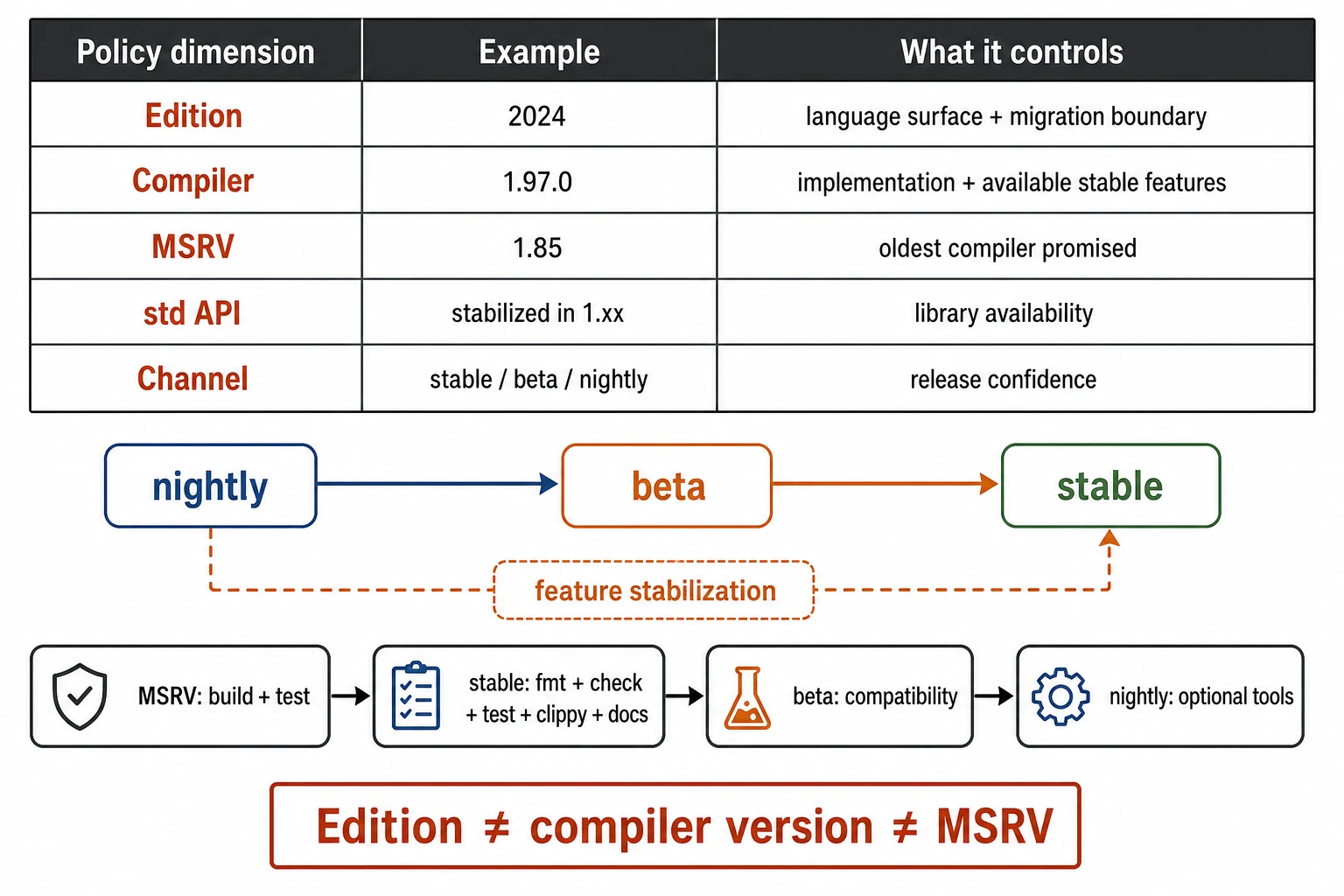
The policy map is more useful here than at the chapter threshold, after each axis has acquired a job. Read it from promises to evidence: edition governs source interpretation, compiler and library stabilization govern availability, MSRV governs downstream support, channels govern the release train, and CI tests the combinations the project actually claims.
Edition migration is a reviewed change
An edition migration is designed to be largely mechanical, but it still changes the interpretation of source and can expose behavior that needs judgment. The official migration sequence centers on updating dependencies, running cargo fix --edition, changing the manifest edition, building and testing, then formatting.
A production migration should add safeguards:
- Establish a clean baseline on the current edition.
- Read the Edition Guide for changes relevant to the codebase.
- Run compatibility lints and
cargo fix --editionon a reviewable branch. - Inspect every semantic or unsafe-sensitive edit rather than accepting the diff as proof.
- Change
editionpackage by package when workspace risk favors smaller steps. - Run tests, doctests, examples, Clippy, documentation, feature configurations, and supported targets.
- Re-run behavior-sensitive checks involving drop order, macro matching, unsafe operations, environment mutation, and FFI.
Rust 2024, for example, changes some temporary scope behavior and marks some historically safe functions unsafe in that edition. The migration tool can insert syntax that compiles, but it cannot establish an unsafe precondition. Compiler-assisted migration is evidence generation, not an automatic safety review.
MSRV is a product promise
For a public library, raising MSRV can force downstream toolchain upgrades even when the library’s API is otherwise compatible. The Cargo documentation treats changing rust-version as a compatibility consideration and recommends an explicit support policy.
An MSRV policy should answer:
- Is the promise “the package loads,” “all public functionality works,” or “the tested feature matrix passes”?
- Which targets and features are covered?
- Do examples, build scripts, procedural macros, and dev dependencies participate?
- How often may MSRV rise, and in which package release category?
- Are security fixes backported to a branch that retains the older MSRV?
- How does dependency resolution avoid selecting transitive versions that require newer Rust?
The Part I fixture declares rust-version = "1.85" and pins 1.97.0 for publication verification. The batch ran cargo check --all-targets and cargo test with Rust 1.85.0, then regenerated the full formatting, check, test, doctest, Clippy, example, and release-build evidence with 1.97.0. That proves the fixture’s current supported configuration on the MSRV; a production repository should preserve the same check as CI rather than rely on a one-time release record.
Applications often make a different trade-off. If a service controls its build environment and deploys one artifact, tracking current stable may reduce maintenance and unlock compiler improvements. The service should still pin release inputs and make toolchain upgrades deliberate, because rollback and incident reproduction depend on them.
CI begins with the promise most likely to drift
For the parsing library, the first lane should run the supported targets and feature sets on Rust 1.85. That is the lane the opening release omitted. It does not prove behavior on newer compilers; it proves that the oldest advertised compiler can still build and test the supported package surface.
Current stable carries the broader development gate: formatting, checks, tests, doctests, Clippy, and documentation. Beta provides early evidence about the likely next stable release. A nightly lane belongs only when a named tool such as Miri supplies evidence unavailable on stable, and its blocking policy should reflect that tool’s instability. Cross-target jobs compile, link, or execute the subset needed to support each platform claim.
Running every combination is often too expensive. Select feature powersets and targets from risk, then document exclusions. Conversely, --all-features alone can be wrong when features represent incompatible backends or targets. A green matrix proves only the configurations it actually ran. In particular, current stable cannot stand in for MSRV merely because both are stable releases.
The application matrix can be narrower on MSRV and broader on deployment fidelity: exact stable toolchain, locked dependencies, release profile, production target, container or system image, smoke tests, and upgrade/rollback evidence.
Failure modes that policy prevents
- Edition equals version: a maintainer assumes
edition = "2024"means any Rust 2024-era compiler works, ignoring the actual stabilization and MSRV requirements. - MSRV by accident: a dependency update or standard-library call raises the required compiler without an intentional release decision.
- Rolling release evidence: a build is reproduced later with a different stable compiler and diagnostic or optimization observations are compared as though inputs were identical.
- Nightly leakage: a tool-only nightly setting becomes the default release compiler.
- Component assumption: CI invokes Clippy or rustfmt without provisioning a known component.
- Matrix theater: stable default features pass while no-default, optional features, examples, docs, or production target fail.
- Migration by diff acceptance: automated edition edits compile but unsafe or drop-order consequences are not reviewed.
Senior review checklist
- Does every package declare an edition and, where promised,
rust-version? - Is the publication or release compiler recorded with
rustc -Vv? - Does
rust-toolchain.tomlpin deliberate components rather than ambient state? - Are stable, beta, and nightly jobs assigned distinct purposes and blocking policies?
- Is every unstable feature named with a tracking and removal plan?
- Does CI actually run the claimed MSRV and supported feature/target matrix?
- Are standard-library stabilization versions compatible with the MSRV?
- Is edition migration reviewed for semantics, unsafe preconditions, macros, and drop behavior?
- Can a release be rebuilt after the next stable compiler ships?
- Does the MSRV update policy reflect downstream cost?
Design exercise: two products, two policies
Write separate version policies for a public parsing library and an internally deployed ingestion service. For each, specify edition, MSRV, pinned release compiler, stable/beta/nightly roles, components, targets, feature combinations, upgrade cadence, and rollback evidence. Include one dependency that requires a newer compiler than the library’s MSRV and decide whether to pin, replace, gate, or raise the MSRV.
Evaluate the policy by asking what a downstream user may rely on and what the team can reproduce during an incident. A strong answer need not minimize versions; it makes the support cost and user cost explicit.
Durable takeaways
- Edition, compiler release, channel, standard-library stabilization, and MSRV are separate policy dimensions.
rustupselects toolchains and components; Cargo builds package targets and enforces manifest policy.- Stable is the production center of gravity, beta is early compatibility evidence, and nightly needs a named purpose.
rust-versioncommunicates an MSRV, while CI and dependency policy prove it.- Edition migration is tool-assisted but still requires semantic and operational review.
Once those inputs are fixed, a subtler reproducibility question remains: given the same source and toolchain, what runs first, what denotes storage, where can control return early, and when do temporary values disappear?
Sources and version notes
- Publication snapshot: Rust 1.97.0, released 2026-07-09;
rustc 1.97.0 (2d8144b78 2026-07-07), Cargo 1.97.0; verified 2026-07-11 onx86_64-unknown-linux-gnu. The declared MSRV was separately checked and tested with Rust 1.85.0. - Rust Blog: Announcing Rust 1.97.0
- Rust Blog: Announcing Rust 1.86.0
- The Rust Programming Language: release channels
- Rust Edition Guide: what editions are
- Rust Edition Guide: migrating an existing project
- Cargo Book: the
rust-versionfield - rustup Book: overrides