Performance Engineering and System Design Handbook / Chapter 65
Ownership, Culture, and the Performance Program
Build an operating model that centralizes standards, tools, and scarce expertise while service teams retain performance accountability.
Preparing audio…
Audio edition
Ownership, Culture, and the Performance Program
Northstar has twenty service teams, four shared-platform groups, and recurring performance failures that cross their boundaries. Its proposed cure is a three-person central performance team. The proposal gives that team approval authority over benchmarks, capacity plans, SLOs, launch reviews, and incidents.
The arithmetic makes the flaw visible. Three specialists cannot own twenty workloads, attend every design decision, maintain every test, and operate every service. If they try, review latency grows and local teams wait for permission. If the central group merely publishes advice, every team invents a different workload model, harness, and exception process. One model concentrates accountability where control does not exist; the other distributes work without distributing capability.
The operating decision is not “centralized or decentralized?” It is which responsibilities gain leverage when shared, and which must stay with the team that can change the workload, design, and operation? A durable program centralizes standards, paved roads, evidence infrastructure, portfolio visibility, and scarce methods expertise. Service teams still own objectives, architectural choices, production behavior, regression response, capacity, and accepted risk.
Use this chapter when performance work depends on a few heroic specialists, when every team measures differently, or when a central review has become a queue. By the end, you should be able to assign service, platform, enablement, and portfolio decision rights; establish a six-month program for roughly twenty teams; govern regressions and exceptions; and choose health indicators that reward valuable outcomes instead of local metric wins.
Ownership follows control
Performance has several owners because no single layer controls the result. That is not the same as shared accountability, where everyone can plausibly claim that someone else owned the miss.
The service team controls endpoint semantics, dependency depth, concurrency, cache identity, degradations, and most code-path choices. It owns the user-centered service-level objective (SLO), workload model, on-call response, local capacity boundary, and remediation plan.
The platform group controls the runtime, service mesh, deployment system, data platform, observability substrate, and shared resource pools. It owns documented platform limits, isolation, default telemetry, upgrade behavior, and the performance contract its consumers can test. A service team cannot repair a global connection-tracking limit hidden in the platform; a platform group cannot decide which customer response may omit recommendations.
The performance enablement group owns reusable methods: workload and evidence templates, reference harnesses, profiler access, benchmark review, difficult investigations, training, and facilitation of high-consequence reviews. It can challenge an unsupported design. It does not inherit the service’s pager or silently accept its residual risk.
The portfolio authority—usually engineering leadership paired with product, reliability, security, and finance owners—sets investment boundaries. It decides which journeys require objectives, how exceptions escalate, when repeated misses displace feature work, and which cross-team redesigns receive funding. Its job is to resolve competing outcomes, not tune thread pools.
| Decision or artifact | Service team | Platform group | Enablement group | Portfolio authority |
|---|---|---|---|---|
| User journey, SLO, and correctness population | accountable and operating owner | consulted on measurable platform boundary | reviews method | accepts business trade-off |
| Endpoint workload and dependency budget | owns and updates | supplies shared dependency limits | supplies template and challenge | sees material exposure |
| Runtime and telemetry defaults | adopts or records exception | accountable and operating owner | validates diagnostic usefulness | funds cross-cutting work |
| Benchmark and load-test method | owns claim and workload | maintains representative environment | owns reference method and review | receives consequential evidence |
| Regression response | diagnoses and acts | acts for platform-caused regression | facilitates difficult cases | resolves policy exception |
| Capacity forecast | forecasts service demand | forecasts shared pools | checks model and uncertainty | approves commitment portfolio |
| Incident corrective action | owns local actions | owns platform actions | tracks recurring mechanism class | funds redesign and arbitrates priority |
“Consulted” must not become veto by invitation. Every decision has one accountable owner, a named evidence provider, and an escalation path. Chapter 64’s design record remains the right artifact for a consequential architecture choice; this matrix states who keeps that record alive after the meeting.
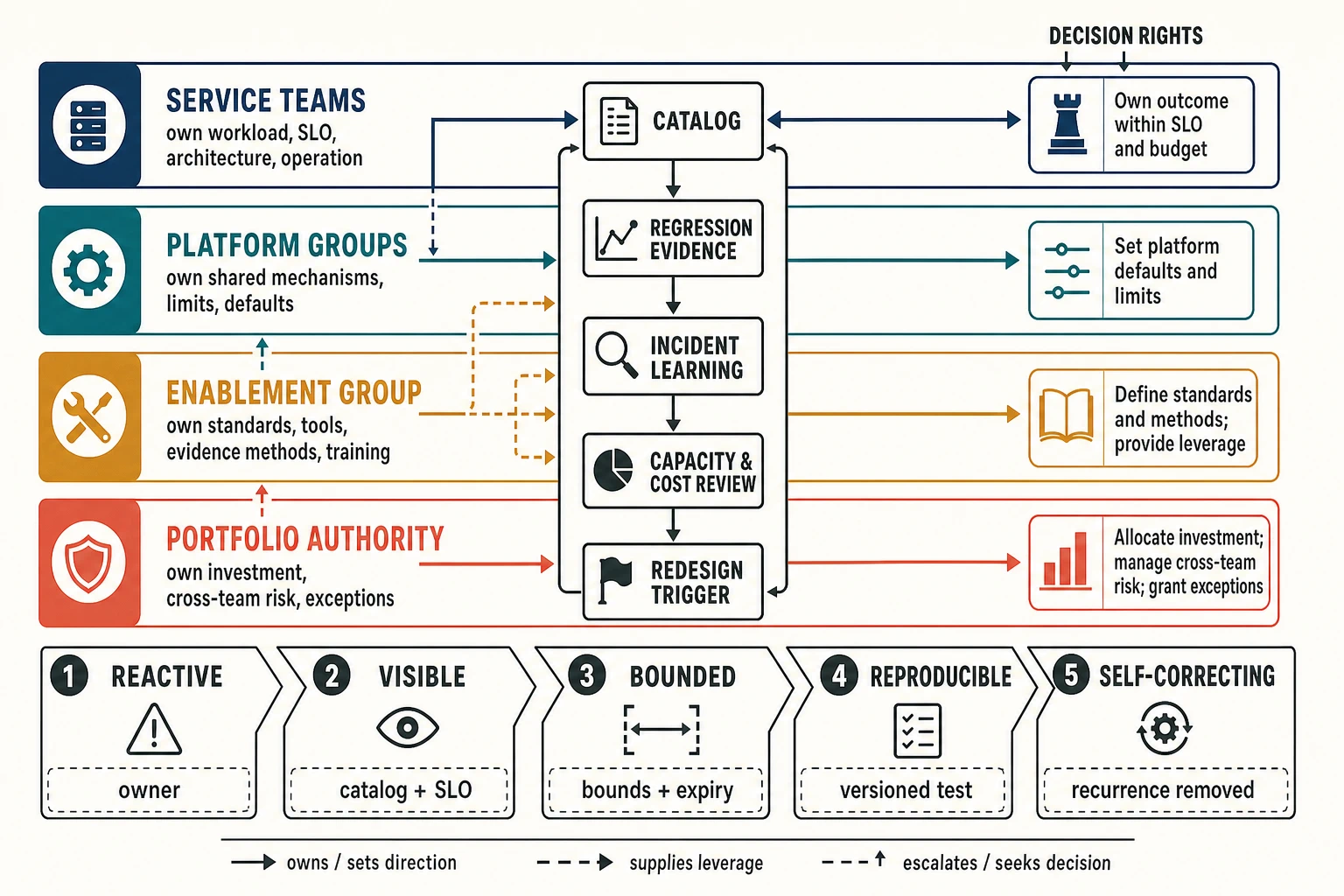
The service catalog is a performance control plane
A service catalog becomes useful when it answers an operational question, not when it proves that a service exists. Northstar’s minimum performance record has nine fields:
service and owning team
valuable user journey and unit of work
SLO population, statistic, window, exclusions, and correctness rule
current workload envelope, mix, skew, and growth owner
first known capacity boundary in normal and failed states
critical synchronous dependencies and their budgets
dashboard, trace entry point, load profile, and runbook
next capacity forecast date and decision
open performance exception with owner, expiry, and containment
The catalog links to authoritative artifacts instead of copying them. Its freshness can be tested: owner exists, SLO has been evaluated recently, forecast has a due date, and exceptions have not expired. A completeness percentage alone is easy to game; a team can fill every field with stale or unactionable text. Sample records against incidents and design reviews. If on-call cannot find the current dependency budget during an event, catalog coverage did not create operational coverage.
SLOs and budgets coordinate decisions only when a written policy assigns action. The Google SRE Workbook’s SLO guidance describes documenting the SLO, its rationale, review date, and the actions and owners tied to budget exhaustion. Its example error-budget policy is explicitly local policy, not a universal threshold. A performance program should adopt the same pattern: define which objective breach changes work, who may waive the response, and when the policy is revisited.
Northstar uses three separate budgets:
- The service’s error or latency budget controls user-outcome response.
- A regression budget limits how much a change may worsen a named distribution, resource demand, or capacity margin.
- A capacity risk budget records uncertainty and reserve for failure and recovery.
They cannot be exchanged casually. A team cannot justify a 30% memory-demand increase merely because latency improved by 2 ms, nor spend correctness failures to preserve a latency percentile. Each budget has its own population, unit, owner, and escalation.
Central enablement should feel like leverage
The enablement group’s product is a shorter path from question to defensible evidence. Its paved road should include:
- a versioned workload manifest with arrival process, mix, object sizes, skew, retries, and correctness checks;
- a load generator with generator-saturation and clock-error checks;
- common latency histograms, queue-age and active-work measures, trace context, and resource-demand panels;
- an isolated reference environment plus an approved production-experiment path;
- analyzers that preserve raw results, versions, uncertainty, and transfer limits;
- regression gates that distinguish blocking evidence from advisory signals; and
- a short engagement path for profiling, experiment design, tail analysis, and capacity modeling.
Adoption is evidence of usefulness only if teams can run the road without the central group operating it for them. Track time from a regression alert to a reproducible local result, percentage of critical paths with queue and deadline telemetry, harness version lag, and the fraction of review claims linked to reproducible evidence. “Number of dashboards” and “benchmarks executed” reward output regardless of whether it changes a decision.
OpenTelemetry’s current signals documentation separates traces, metrics, logs, and other signals, while its metrics data model defines exemplars that can associate a metric event with trace context. A shared observability road can therefore standardize correlation without demanding one backend. The durable program requirement is semantic: a team must be able to move from a bad latency bucket to representative request paths and from those paths to constrained queues or resource work.
Shared infrastructure also creates shared failure modes. The enablement group must publish its own capacity, availability, retention, privacy, and access boundaries. A central test cluster that queues every team’s release test is another approval bottleneck. A profiler requiring unrestricted production access is not a paved road. Prefer self-service isolation, least-privilege capture, explicit data classes, quotas, and a documented degraded path.
Regression policy needs an exception path
A regression gate without an exception path invites people to weaken the test. An exception path without expiry converts every temporary waiver into architecture.
Northstar classifies evidence into three gates:
| Gate | Example | Default action | Exception authority |
|---|---|---|---|
| invariant | correctness result changes, cancellation leaves unsafe effects, isolation fails | block exposure | cannot be waived by performance program |
| operating boundary | p99 exceeds objective, queue bound fails, failure reserve is consumed | stop or restrict rollout | service and portfolio risk owner |
| efficiency budget | CPU demand rises 6% against a 3% budget while user latency improves | compare full outcome and opportunity cost | service owner within allocation; portfolio owner beyond it |
An exception record names the claim, affected population, measured delta, user and operational consequence, containment, owner, approval authority, expiry, exit evidence, and redesign trigger. Expiry opens a decision; it does not automatically break production. The service either removes the exception, narrows exposure, funds remediation, accepts renewed risk with authority, or supersedes the objective.
The wrong leading indicator is “percentage of tests passing.” Teams can delete hard cases or widen thresholds. Better indicators are the percentage of consequential changes evaluated against a versioned workload, the percentage of exceeded budgets that produced the policy action, median exception age, expired exceptions, and time to close evidence gaps. The lagging outcomes remain user SLO attainment, severity-weighted regression escapes, repeated incident classes, recovery time, capacity surprises, and cost per correct SLO-compliant outcome.
Never use these program measures as individual rankings. If compensation rewards the lowest service CPU, teams will move work to databases, clients, or other cost centers. If leaders rank teams by p99, teams will narrow the measured population. Measure at the boundary of the valuable outcome, preserve exclusions visibly, pair quality with cost and correctness, and use metrics to choose system work—not to create a leaderboard.
Cadence makes the program real
Performance work loses to urgent feature work when it has no decision cadence. Northstar uses four linked clocks.
Per change: service teams run relevant regression checks and act on budget violations. High-consequence changes use Chapter 64’s focused review. The central group participates only when evidence risk or mechanism novelty warrants scarce expertise.
Monthly: service and platform owners reconcile SLO consumption, top regressions, open exceptions, workload shifts, and shared-platform version changes. They select at most a few corrective actions with named capacity. This is not a dashboard tour.
Quarterly: portfolio owners reconcile demand forecasts, failure reserve, cost per outcome, repeated incident classes, redesign triggers, and platform investment. The result is an allocation decision, an accepted risk, or a bounded evidence task.
After incidents and game days: owners update models, limits, tests, runbooks, and paved-road defaults. The Google SRE postmortem guidance emphasizes learning and systemic change rather than blame. A program operationalizes that principle by tracking mechanism classes across services. Five incidents caused by unbounded recovery replay are one organizational defect with five manifestations.
Quarterly performance review agenda
| Time | Decision job | Required evidence | Output |
|---|---|---|---|
| 10 min | confirm workload and objective shifts | catalog deltas and forecast error | changed decision boundaries |
| 15 min | examine user and economic outcomes | SLO, goodput, cost/outcome, major exclusions | outcome risks and owners |
| 15 min | examine operating envelope | capacity reserve, failure/recovery tests, queue and retry evidence | capacity commitments or tests |
| 10 min | eliminate recurrence | incident-class register and action effectiveness | redesign or shared default change |
| 10 min | govern exceptions and debt | age, containment, expiry, projected exposure | close, renew, restrict, or fund |
| 10 min | check capability and paved roads | adoption friction, evidence lead time, lab/game-day results | enablement backlog |
| 5 min | record decisions | owners, dates, trigger, authority | portfolio decision record |
The agenda begins with changed assumptions because an unchanged dashboard can conceal an obsolete boundary. It ends with decisions, not observations.
Champions distribute skill, not unpaid ownership
Each Northstar service group nominates a rotating performance champion for one quarter. The champion helps maintain the workload record, facilitates a design drill, and connects the team with the enablement group. The service manager still allocates remediation time; the on-call owner still responds; the architect still owns design consequences. Calling someone a champion without time or authority is workload transfer disguised as culture.
Training must use the team’s systems and artifacts:
- A design drill allocates a real endpoint budget and challenges it under one dependency slowdown.
- A profiling lab starts with an unknown bottleneck and requires participants to distinguish CPU work, queue wait, lock contention, allocation, storage, and network delay.
- A game day exercises an overload or recovery boundary and verifies controls, observability, and authority.
- A review rotation pairs a domain owner with a methods reviewer, then records which evidence changed the decision.
Completion counts are leading indicators, not competence proof. Better transfer evidence is whether a team later constructs the right workload, selects a discriminating measurement, contains a failure, or rejects an invalid benchmark without central rescue.
Debt needs exposure and a trigger
A performance-debt register is not a backlog of slow code. It records a known boundary that the current design cannot safely cross:
mechanism and affected journey
current evidence and uncertainty
workload, failure, or cost boundary
temporary containment and its operating cost
owner and dependency owners
redesign trigger and decision date
candidate options and reversal constraints
Useful triggers are observable: a pool remains above 80% occupancy for three peak windows; recovery consumes more than half the failure reserve; forecast error exceeds 20% twice; one incident class repeats; an exception reaches 90 days; cost per compliant outcome rises 15%; or a dependency adds another synchronous hop. “When we have time” is not a trigger.
Debt can be rational. Rewriting a stable service to remove a limit that demand will not reach is waste. The register preserves the reason for waiting and the evidence that ends the wait. Portfolio leadership funds redesign when exposure, not embarrassment, crosses the agreed boundary.
Maturity is an evidence vector
Maturity ladders become dangerous when a single score substitutes for outcomes. Northstar uses five descriptive states, evaluated separately for objectives, workload evidence, validation, operating controls, and learning:
| State | Behavior | Required evidence before claiming it |
|---|---|---|
| reactive | performance work begins after user harm | named incident owner and preserved evidence |
| visible | teams can name the journey, workload, objective, and owner | current catalog, user-centered SLO, workload owner |
| bounded | designs declare queues, budgets, capacity, exceptions, and failure reserve | enforced regression budget, capacity boundary, owned expiring exceptions |
| reproducible | consequential claims can be regenerated under relevant states | versioned harness, adverse-state test, forecast reconciliation |
| self-correcting | production evidence changes defaults and eliminates recurring mechanisms | verified recurrence removal, portfolio trigger, redesign outcome |
A service can be reproducible in benchmarking and reactive in recovery. Report the vector. Advancement requires inspectable evidence, while regression is expected when workload, team, or architecture changes. The ladder guides the next investment; it is not a badge.
Worked program: Northstar’s six-month pilot
Northstar starts with eight of twenty teams holding complete catalog records, seven with actionable SLOs, and four using the shared harness. Seven of twelve open exceptions are expired. Only one of nine known repeated incident classes has been eliminated. Eight sampled capacity forecasts have a mean absolute error of 36.5%.
The three-person enablement group does not review everything. It chooses three leverage points:
- make the nine-field service record and regression manifest self-service;
- pair four platform engineers with service champions to add queue, deadline, and dependency-budget telemetry to shared libraries; and
- run monthly exception and recurring-failure clinics, escalating only cross-team investment decisions.
The portfolio group funds two shared corrections: bounded recovery replay in the event platform and standardized cancellation propagation in the RPC library. Service teams integrate and test those defaults against their own correctness boundaries.
After six modeled months, eighteen teams have complete records, sixteen have actionable SLOs, fifteen use the harness, and seventeen have completed a hands-on lab. Forty-three of forty-six regression-budget evaluations resulted in the declared policy action. One of eight open exceptions is expired. Seven of eleven identified repeated incident classes have verified elimination. Mean forecast absolute error across the sampled teams falls to 16.75%.
Those numbers do not prove a causal program effect. Teams were not randomized; workload and staffing changed; catalog quality could vary; and only sampled forecasts are represented. They are signals to inspect. The strongest evidence is linked: a repeated recovery mechanism disappeared after a shared default changed, adverse-state tests reproduce the boundary, incidents no longer show the signature, and service owners can operate the control without central intervention.
Reproduce the teaching portfolio:
cd examples/performance-engineering-system-design-handbook/part-07/performance-program
node analyze.mjs
node verify.mjs
The analyzer intentionally emits a portfolio rather than one score. It verifies 90% catalog coverage, 80% actionable-SLO coverage, 75% harness adoption, 93.48% regression-policy follow-through, 87.5% exception hygiene, 63.64% repeated-failure elimination, 85% lab coverage, and 16.75% mean forecast absolute error. These thresholds and data are modeled Northstar policy, not external benchmarks or employee measures.
Applied design drill
You inherit an organization with twenty teams, one performance specialist, six services with user-centered SLOs, three shared platforms, eleven expired performance exceptions, and a quarterly release peak. Teams distrust central review because it takes two weeks.
Design the first two quarters of the program. Produce:
- a decision-rights matrix for service, platform, enablement, and portfolio owners;
- the minimum catalog record and freshness rule;
- one paved-road investment;
- a regression policy with an exception path;
- three leading and three lagging indicators; and
- a quarterly agenda that ends with allocation decisions.
Answer guide
A defensible answer keeps SLOs, workload models, local remediation, and operational ownership with service teams. It assigns shared mechanism limits and defaults to platform groups. The specialist should build leverage—perhaps a versioned workload manifest plus queue/deadline telemetry—rather than approve every release. Portfolio authority should own exceptions crossing a declared exposure or funding boundary.
Leading indicators could include current catalog coverage, consequential changes linked to reproducible evidence, exception age, or time to reproduce a regression. Lagging indicators could include SLO-compliant goodput, repeat incident classes, forecast surprises, or cost per correct compliant outcome. “Benchmark count” is weak unless connected to decisions. A valid alternative may start with a single critical journey rather than all services, provided its selection rule, expansion trigger, and excluded risk are explicit.
Decision rules and field questions
Centralize a responsibility when shared implementation creates leverage, consistency, or scarce-method access and when the central owner can actually control its failure. Keep it embedded when the decision depends on local workload, correctness, architecture, or operation. Escalate only when exposure, cross-team coupling, or investment authority crosses a declared boundary.
Before adopting a program, ask:
- Can every objective and workload name an operating owner?
- Does each shared platform publish testable limits and degraded behavior?
- Can teams reproduce consequential evidence without a central operator?
- Does every regression budget define population, unit, action, and authority?
- Do exceptions include containment, expiry, exit evidence, and redesign trigger?
- Does the capacity cadence model failure and recovery as well as peaks?
- Are repeated incident mechanisms tracked across service boundaries?
- Do champions receive time, authority, and a finite rotation?
- Can incentives be satisfied only by improving the valuable end-to-end outcome?
- Does the maturity claim point to inspectable evidence rather than a score?
The program is working when it makes local ownership stronger and specialist intervention rarer, while cross-system evidence and investment decisions improve. It is failing when the central team becomes an approval queue, teams optimize scorecards instead of outcomes, or exceptions become permanent design.
Continuous validation, incident response, disciplined optimization, safe migration, overload recovery, economics, security, and review become durable only when their evidence and decisions have operating owners. The next test is whether that integrated method survives an ambiguous production case. Chapter 66 begins with a latency SLO miss that looks like a capacity problem and turns out to be a topology, queue, and deadline problem.